Wolfson Centre for Prevention of Stroke and Dementia University of Oxford United Kingdom.
J Am Heart Assoc. 2020 Sep;9(17):e017804. doi: 10.1161/JAHA.120.017804. Epub 2020 Aug 28.
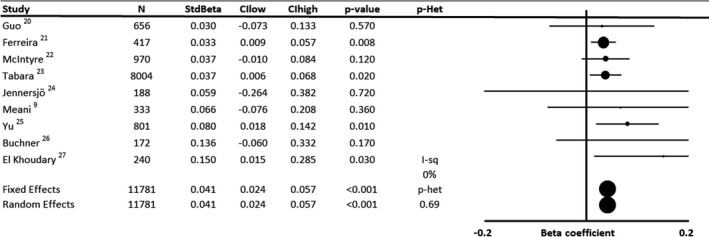
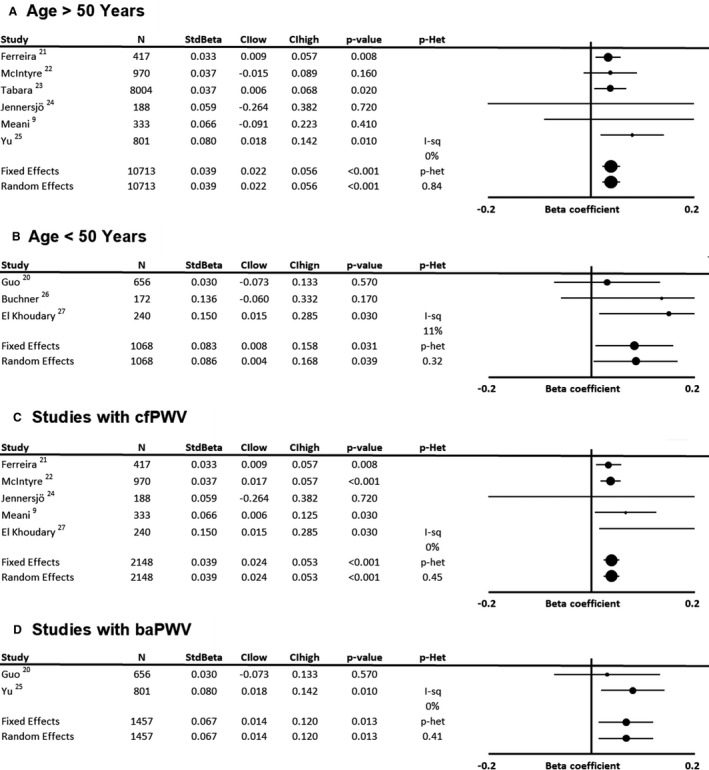
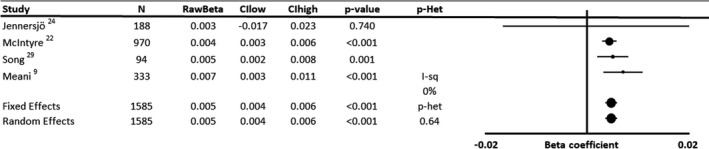
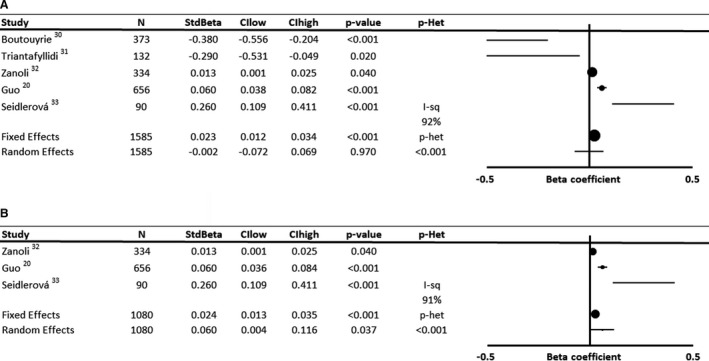
Background Arterial stiffness predicts the risk of cardiovascular events and all-cause mortality and is associated with age and hypertension. However, the magnitude of the relationship between blood pressure (BP) and progression of arterial stiffness is unclear, limiting our understanding of how arterial stiffness mediates clinical effects of hypertension and planning of clinical trials. Methods and Results Medline and EMBASE were searched for prospective studies reporting linear models between baseline BP and progression of arterial stiffness, with and without adjustment for demographic characteristics and baseline stiffness. Standardized and unstandardized β coefficients for pulse wave velocity were combined by fixed and random effects meta-analysis, weighted by the inverse variance. Of 566 fully reviewed articles from 30, 524 titles, 22 populations from 21 reports were included. In 9 cohorts, there were consistent, adjusted associations between baseline systolic BP and progression of arterial stiffness (11 781 patients; standardized β=0.041; 95% CI, 0.026-0.055; <0.001; value for heterogeneity=0.70), equivalent to a 1.14-m/s increase in standard carotid-femoral pulse wave velocity per decade per 20-mm Hg systolic BP, independent of age. Unstandardized, adjusted associations were similar (1762 patients; β=0.0047; 95% CI, 0.004-0.006; <0.001; value for heterogeneity=0.64), equivalent to a 0.94-m/s increase per decade per 20-mm Hg systolic BP. In limited studies, standardized associations between mean BP and arterial stiffness progression were not significant and heterogeneous (913 patients; β=0.039; 95% CI, -0.008 to 0.086; =0.11; value for heterogeneity=0.03). Conclusions Baseline systolic BP was associated with a clinically important progression of arterial stiffness, independent of age, providing a reference for the potential effect of arterial stiffness in mediating changes in clinical outcomes associated with hypertension and providing a reference value to aid clinical trial design.
动脉僵硬度可预测心血管事件和全因死亡率的风险,且与年龄和高血压相关。然而,血压(BP)与动脉僵硬度进展之间的关系程度尚不清楚,这限制了我们对动脉僵硬度如何介导高血压的临床影响以及规划临床试验的理解。
在 Medline 和 EMBASE 中搜索了前瞻性研究,这些研究报告了基线 BP 与动脉僵硬度进展之间的线性模型,这些模型既包括也不包括人口统计学特征和基线僵硬度的调整。采用固定和随机效应荟萃分析对脉搏波速度的标准化和未标准化β系数进行了合并,权重为逆方差。在从 30524 个标题中进行了 566 篇全面综述的文章中,有 21 份报告中的 22 个人群被纳入。在 9 个队列中,基线收缩压与动脉僵硬度进展之间存在一致的、调整后的关联(11781 例患者;标准化β=0.041;95%CI,0.026-0.055;<0.001;异质性值=0.70),相当于每 20mmHg 收缩压每十年增加 1.14m/s 的标准颈-股脉搏波速度,与年龄无关。未标准化的调整后关联也相似(1762 例患者;β=0.0047;95%CI,0.004-0.006;<0.001;异质性值=0.64),相当于每 20mmHg 收缩压每十年增加 0.94m/s。在有限的研究中,平均 BP 与动脉僵硬度进展之间的标准化关联不显著且存在异质性(913 例患者;β=0.039;95%CI,-0.008 至 0.086;=0.11;异质性值=0.03)。
基线收缩压与动脉僵硬度的显著临床进展相关,与年龄无关,为动脉僵硬度在介导与高血压相关的临床结局变化中的潜在作用提供了参考,为辅助临床试验设计提供了参考值。