Department of Electronics and Communication Engineering, Visvesvaraya National Institute of Technology, Nagpur, Maharashtra, India.
Department of Cardiology, Indraprastha APOLLO Hospitals, New Delhi, India.
Indian Heart J. 2020 Jul-Aug;72(4):258-264. doi: 10.1016/j.ihj.2020.06.004. Epub 2020 Jun 18.
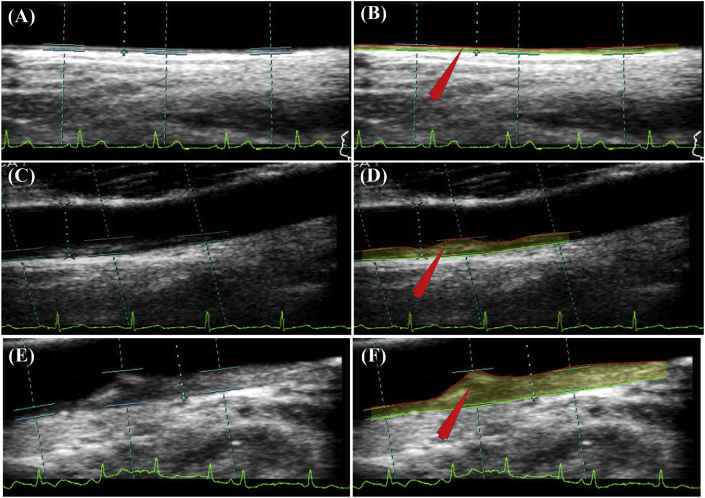
Machine learning (ML)-based stroke risk stratification systems have typically focused on conventional risk factors (CRF) (AtheroRisk-conventional). Besides CRF, carotid ultrasound image phenotypes (CUSIP) have shown to be powerful phenotypes risk stratification. This is the first ML study of its kind that integrates CUSIP and CRF for risk stratification (AtheroRisk-integrated) and compares against AtheroRisk-conventional.
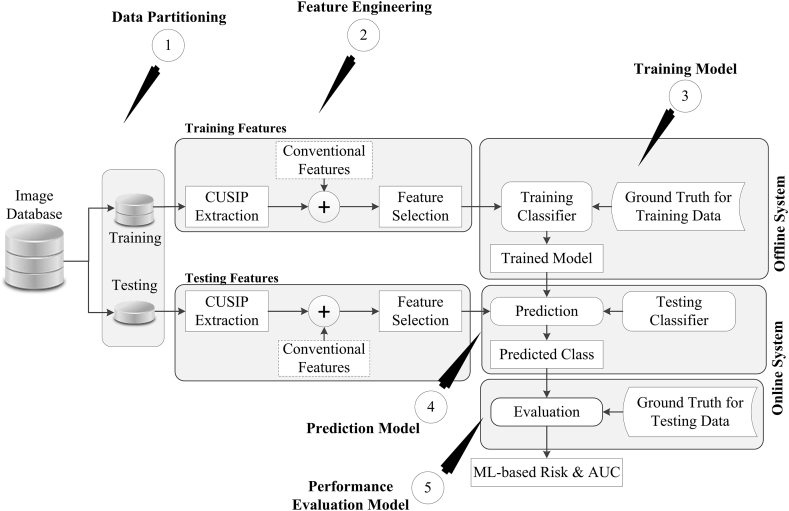
Two types of ML-based setups called (i) AtheroRisk-integrated and (ii) AtheroRisk-conventional were developed using random forest (RF) classifiers. AtheroRisk-conventional uses a feature set of 13 CRF such as age, gender, hemoglobin A1c, fasting blood sugar, low-density lipoprotein, and high-density lipoprotein (HDL) cholesterol, total cholesterol (TC), a ratio of TC and HDL, hypertension, smoking, family history, triglyceride, and ultrasound-based carotid plaque score. AtheroRisk-integrated system uses the feature set of 38 features with a combination of 13 CRF and 25 CUSIP features (6 types of current CUSIP, 6 types of 10-year CUSIP, 12 types of quadratic CUSIP (harmonics), and age-adjusted grayscale median). Logistic regression approach was used to select the significant features on which the RF classifier was trained. The performance of both ML systems was evaluated by area-under-the-curve (AUC) statistics computed using a leave-one-out cross-validation protocol.
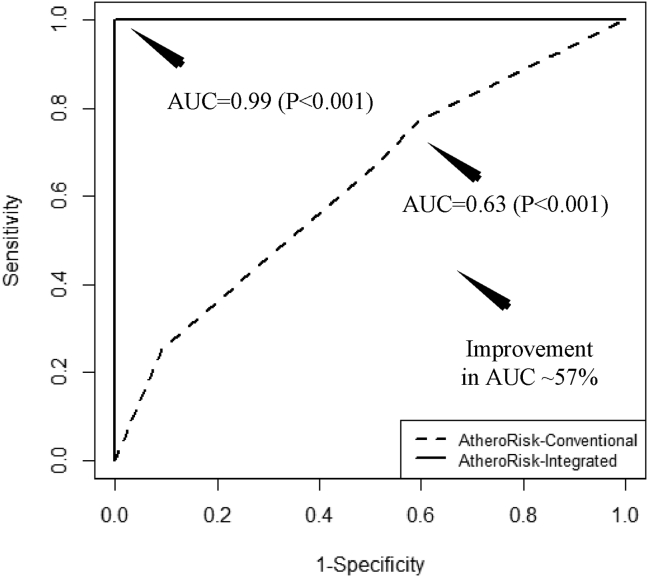
Left and right common carotid arteries of 202 Japanese patients were retrospectively examined to obtain 404 ultrasound scans. RF classifier showed higher improvement in AUC (~57%) for leave-one-out cross-validation protocol. Using RF classifier, AUC statistics for AtheroRisk-integrated system was higher (AUC = 0.99,p-value<0.001) compared to AtheroRisk-conventional (AUC = 0.63,p-value<0.001).
The AtheroRisk-integrated ML system outperforms the AtheroRisk-conventional ML system using RF classifier.
基于机器学习 (ML) 的中风风险分层系统通常侧重于传统风险因素 (AtheroRisk-conventional)。除了传统风险因素 (CRF) 之外,颈动脉超声图像表型 (CUSIP) 已被证明是强大的表型风险分层。这是第一项将 CUSIP 和 CRF 整合进行风险分层的 ML 研究 (AtheroRisk-integrated),并与 AtheroRisk-conventional 进行比较。
使用随机森林 (RF) 分类器开发了两种类型的基于 ML 的设置,称为 (i) AtheroRisk-integrated 和 (ii) AtheroRisk-conventional。AtheroRisk-conventional 使用了一组 13 个 CRF 特征,如年龄、性别、糖化血红蛋白、空腹血糖、低密度脂蛋白和高密度脂蛋白 (HDL) 胆固醇、总胆固醇 (TC)、TC 和 HDL 的比值、高血压、吸烟、家族史、甘油三酯和基于超声的颈动脉斑块评分。AtheroRisk-integrated 系统使用了一组 38 个特征,其中包括 13 个 CRF 和 25 个 CUSIP 特征 (6 种当前 CUSIP、6 种 10 年 CUSIP、12 种二次 CUSIP (谐波) 和年龄调整灰度中位数)。使用逻辑回归方法选择 RF 分类器训练所使用的显著特征。使用留一交叉验证协议计算曲线下面积 (AUC) 统计数据来评估两种 ML 系统的性能。
回顾性检查了 202 名日本患者的左右颈总动脉,共获得 404 次超声扫描。RF 分类器在留一交叉验证协议中显示出更高的 AUC 改善 (~57%)。使用 RF 分类器,AtheroRisk-integrated 系统的 AUC 统计数据更高 (AUC=0.99,p 值<0.001),而 AtheroRisk-conventional 系统的 AUC 统计数据较低 (AUC=0.63,p 值<0.001)。
使用 RF 分类器,AtheroRisk-integrated ML 系统优于 AtheroRisk-conventional ML 系统。