Nuffield Department of Clinical Neurosciences, University of Oxford, UK.
Institute of Biomedical Engineering, University of Oxford, UK.
Brain Stimul. 2020 Nov-Dec;13(6):1527-1534. doi: 10.1016/j.brs.2020.08.014. Epub 2020 Sep 4.
Transcranial ultrasound stimulation (TUS) is emerging as a potentially powerful, non-invasive technique for focal brain stimulation. Recent animal work suggests, however, that TUS effects may be confounded by indirect stimulation of early auditory pathways.
We aimed to investigate in human participants whether TUS elicits audible sounds and if these can be masked by an audio signal.
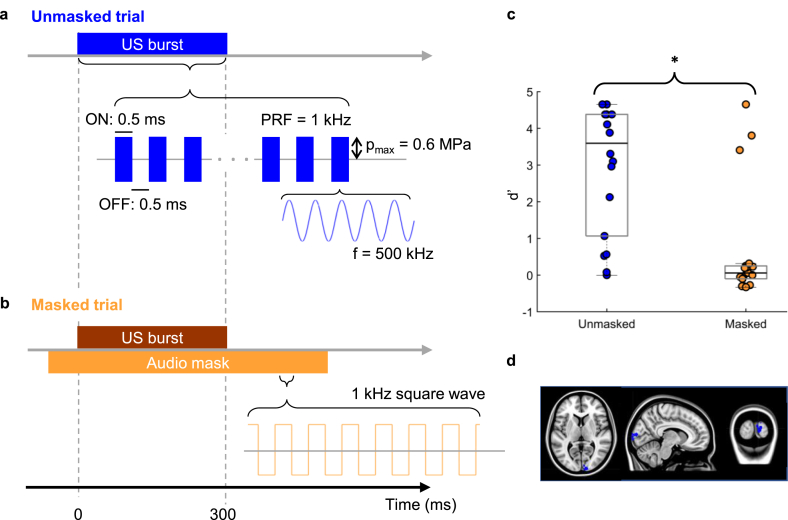
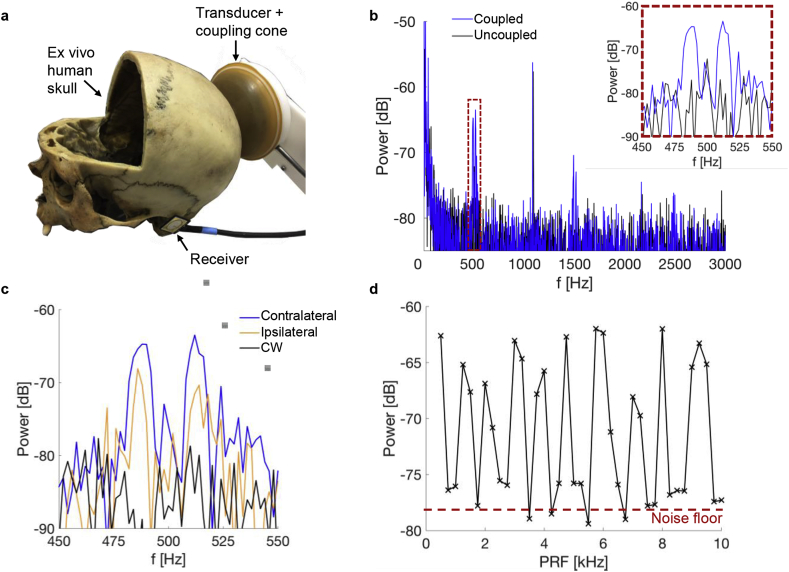
In 18 healthy participants, T1-weighted magnetic resonance brain imaging was acquired for 3D ultrasound simulations to determine optimal transducer placements and source amplitudes. Thermal simulations ensured that temperature rises were <0.5 °C at the target and <3 °C in the skull. To test for non-specific auditory activation, TUS (500 kHz, 300 ms burst, modulated at 1 kHz with 50% duty cycle) was applied to primary visual cortex and participants were asked to distinguish stimulation from non-stimulation trials. EEG was recorded throughout the task. Furthermore, ex-vivo skull experiments tested for the presence of skull vibrations during TUS.
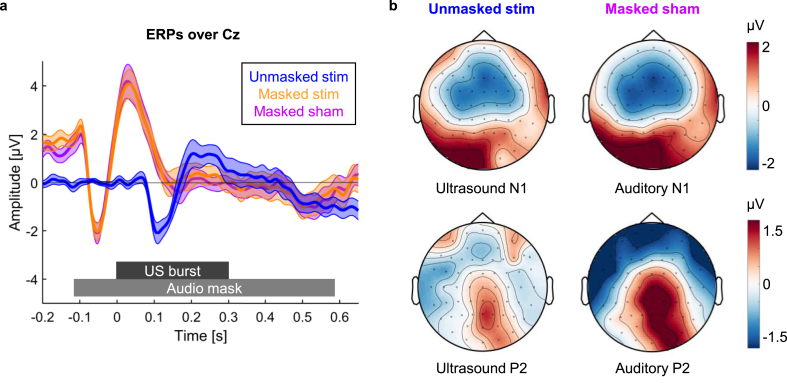
We found that participants can hear sound during TUS and can distinguish between stimulation and non-stimulation trials. This was corroborated by EEG recordings indicating auditory activation associated with TUS. Delivering an audio waveform to participants through earphones while TUS was applied reduced detection rates to chance level and abolished the TUS-induced auditory EEG signal. Ex vivo skull experiments demonstrated that sound is conducted through the skull at the pulse repetition frequency of the ultrasound.
Future studies using TUS in humans need to take this auditory confound into account and mask stimulation appropriately.
经颅超声刺激(TUS)作为一种潜在强大的、非侵入性的焦点脑刺激技术正在兴起。然而,最近的动物研究表明,TUS 的效果可能受到早期听觉通路间接刺激的影响。
我们旨在研究人类参与者是否会产生可听见的 TUS 声音,以及这些声音是否可以被音频信号掩盖。
在 18 名健康参与者中,进行 T1 加权磁共振脑成像以进行 3D 超声模拟,以确定最佳换能器放置和源振幅。热模拟确保目标处的温升<0.5°C,颅骨内的温升<3°C。为了测试非特异性听觉激活,将 TUS(500kHz,300ms 爆发,以 1kHz 调制,占空比为 50%)施加到初级视觉皮层,参与者被要求区分刺激和非刺激试验。在整个任务过程中记录 EEG。此外,在离体颅骨实验中测试了 TUS 期间颅骨振动的存在。
我们发现参与者可以在 TUS 期间听到声音,并可以区分刺激和非刺激试验。这通过 EEG 记录得到证实,表明 TUS 引起的听觉激活。当 TUS 施加时,通过耳机向参与者提供音频波形会将检测率降低到机会水平,并消除 TUS 诱导的听觉 EEG 信号。离体颅骨实验表明,声音可以通过颅骨在超声的脉冲重复频率下传播。
未来在人类中使用 TUS 的研究需要考虑到这种听觉干扰,并适当掩蔽刺激。