Institute for Health Research, Kaiser Permanente Colorado, Aurora, CO 80014, USA.
Department of Exercise Science, University of South Carolina, Columbia, SC 29208, USA.
Int J Environ Res Public Health. 2020 Sep 3;17(17):6421. doi: 10.3390/ijerph17176421.
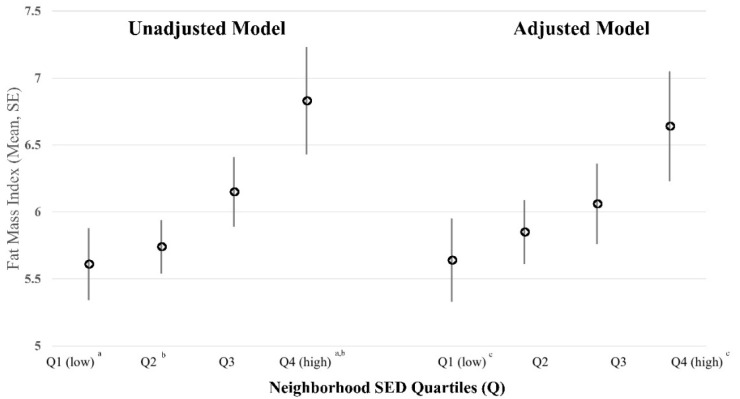
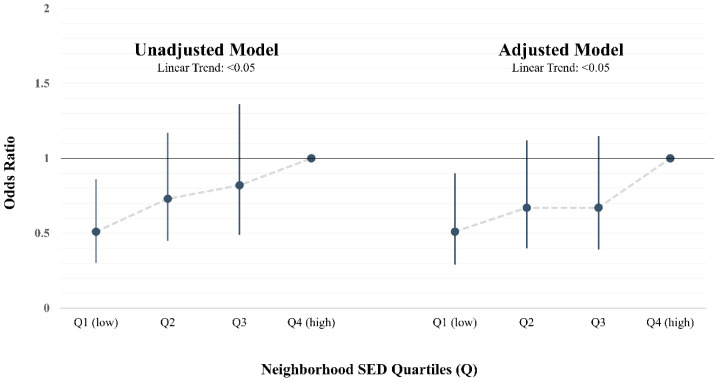
(1) Background: Few studies have examined the relationship between neighborhood socioeconomic deprivation (SED) and weight-related outcomes in youth, controlling for weight-related behaviors. Hence, the purpose of this study was to examine the association between neighborhood SED, weight status, and fat mass in a diverse sample of youth, before and after controlling for physical activity and diet. (2) Methods: The sample included 828 youth from the Transitions and Activity Changes in Kids study. Neighborhood SED was expressed as an index score at the census tract of residence. Height, weight, and body composition were measured and used to calculate fat mass index (FMI) and weight status. Moderate-to-vigorous physical activity (MVPA) and sedentary behavior (min/h) were measured via accelerometry. Diet quality was assessed via the Block Food Screener for Kids. Multilevel regression models were employed to examine these relationships. (3) Results: Neighborhood SED was significantly associated with FMI and weight status before and after controlling for MVPA, sedentary behavior, and diet. Notably, youth residing in the most deprived neighborhoods had significantly higher FMI and were 30% more likely to be overweight/obese (OR = 1.30; 95% CI = 1.03-1.65). (4) Conclusions: Greater neighborhood SED was consistently and significantly associated with higher fat mass index and increased likelihood of overweight/obesity among youth.
(1) 背景:很少有研究在控制与体重相关的行为后,考察邻里社会经济剥夺(SED)与青年体重相关结果之间的关系。因此,本研究的目的是在控制体力活动和饮食后,在一个多样化的青年样本中,检验邻里 SED 与体重状况和体脂肪之间的关系。
(2) 方法:该样本包括来自“儿童过渡和活动变化研究”的 828 名青少年。邻里 SED 用居住的普查地段指数得分来表示。身高、体重和身体成分均进行了测量,用于计算体脂肪指数(FMI)和体重状况。通过加速度计测量中度到剧烈的体力活动(MVPA)和久坐行为(分钟/小时)。通过“儿童膳食筛检器”评估饮食质量。采用多层次回归模型来检验这些关系。
(3) 结果:在控制 MVPA、久坐行为和饮食后,邻里 SED 与 FMI 和体重状况显著相关。值得注意的是,居住在最贫困社区的青少年的 FMI 明显更高,超重/肥胖的可能性增加了 30%(OR=1.30;95% CI=1.03-1.65)。
(4) 结论:邻里 SED 越高,青少年的体脂肪指数越高,超重/肥胖的可能性越大。