Laboratory for Intestinal Ecosystem, RIKEN Center for Integrative Medical Sciences, 1-7-22 Suehiro-cho, Tsurumi-ku, Yokohama, Kanagawa, 230-0045, Japan.
Intestinal Microbiota Project, Kanagawa Institute of Industrial Science and Technology, 3-2-1 Sakado, Takatsu-ku, Kawasaki, Kanagawa, 213-0012, Japan.
Exp Mol Med. 2020 Sep;52(9):1377-1382. doi: 10.1038/s12276-020-00485-8. Epub 2020 Sep 10.
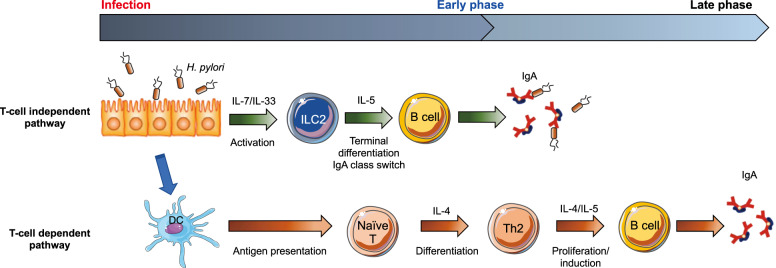
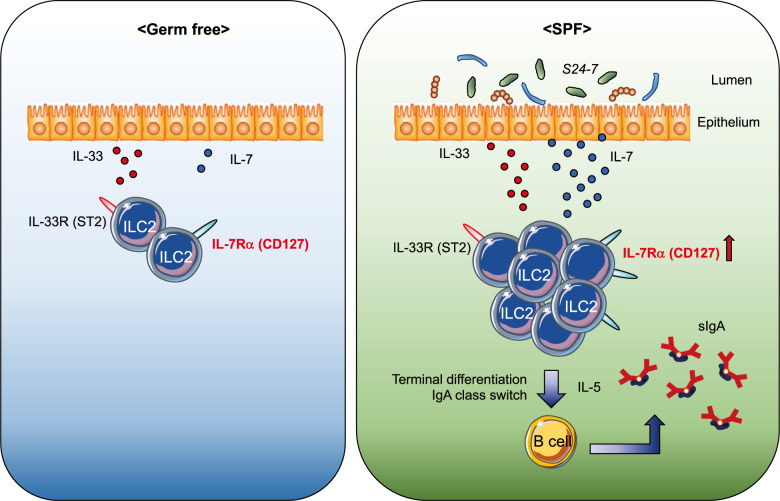
The stomach has been thought to host few commensal bacteria because of the existence of barriers, such as gastric acid. However, recent culture-independent, sequencing-based microbial analysis has shown that the stomach also harbors a wide diversity of microbiota. Although the stomach immune system, especially innate lymphoid cells (ILCs), has not been well elucidated, recent studies have shown that group 2 ILCs (ILC2s) are the dominant subtype in the stomach of both humans and mice. Stomach ILC2s are unique in that their existence is dependent on stomach microbiota, in sharp contrast to the lack of an impact of commensal microbiota on ILC2s in other tissues. The microbiota dependency of stomach ILC2s is partly explained by their responsiveness to interleukin (IL)-7. Stomach ILC2s express significantly higher IL-7 receptor protein levels on their surface and proliferate more in response to IL-7 stimulation in vitro than small intestinal ILC2s. Consistently, the stomach expresses much higher IL-7 protein levels than the small intestine. IL-5 secreted from stomach ILC2s promotes immunoglobulin (Ig) A production by plasma B cells. In a murine model, stomach ILC2s are important in containing Helicobacter pylori infection, especially in the early phase of infection, by promoting IgA production.
胃被认为很少有共生菌,因为存在屏障,如胃酸。然而,最近基于非培养、测序的微生物分析表明,胃也存在广泛的微生物多样性。尽管胃免疫系统,特别是先天淋巴细胞 (ILC),尚未得到很好的阐明,但最近的研究表明,2 型 ILC(ILC2)是人类和小鼠胃中的主要亚型。胃 ILC2 的独特之处在于其存在依赖于胃微生物群,与其他组织中共生微生物群对 ILC2 没有影响形成鲜明对比。胃 ILC2 的微生物依赖性部分解释了它们对白细胞介素 (IL)-7 的反应性。胃 ILC2 表面表达更高水平的 IL-7 受体蛋白,并且在体外对 IL-7 刺激的增殖反应比小肠 ILC2 更强。一致的是,胃表达的 IL-7 蛋白水平远高于小肠。胃 ILC2 分泌的白细胞介素 5 (IL-5) 促进浆细胞产生免疫球蛋白 (Ig) A。在小鼠模型中,胃 ILC2 通过促进 IgA 产生,在控制幽门螺杆菌感染方面尤为重要,尤其是在感染的早期阶段。