Department of Psychology, New York University, 6 Washington Pl, New York, NY, 10003, USA.
Psychology Department, Ben Gurion University of the Negev, 1 Shderot Ben Gurion, Be'er Sheva, 8410501, Israel.
Nat Commun. 2020 Sep 14;11(1):4590. doi: 10.1038/s41467-020-18364-1.
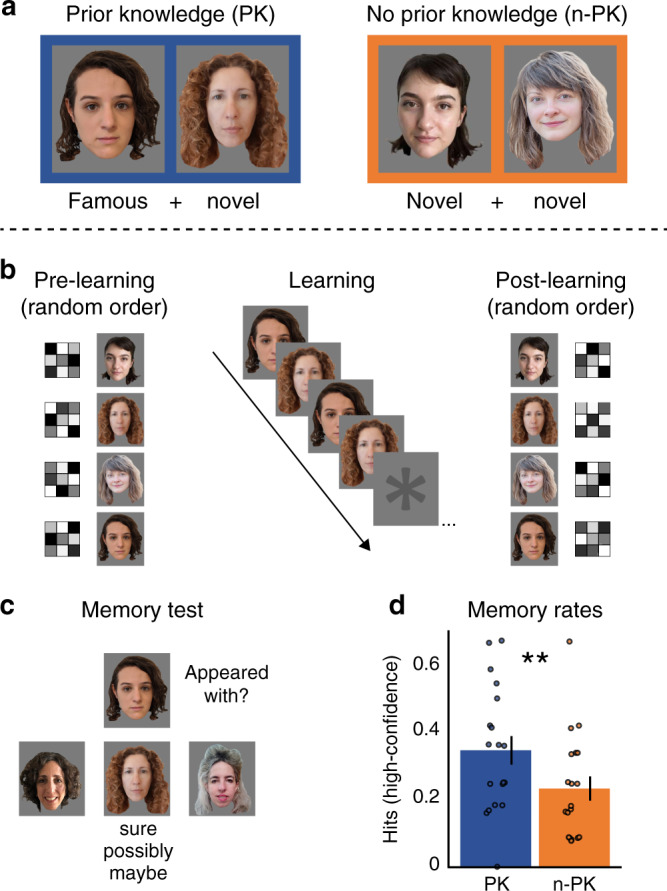
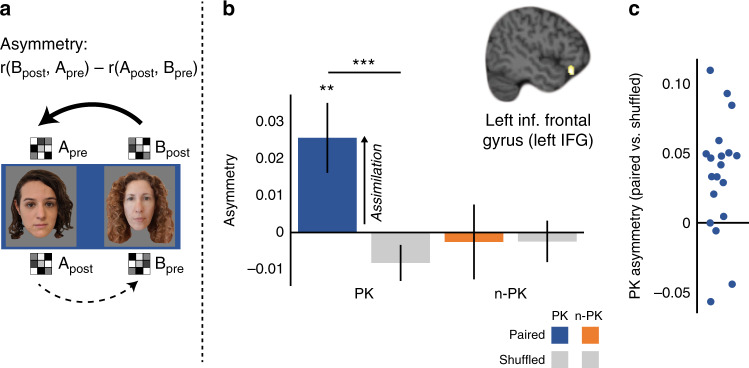
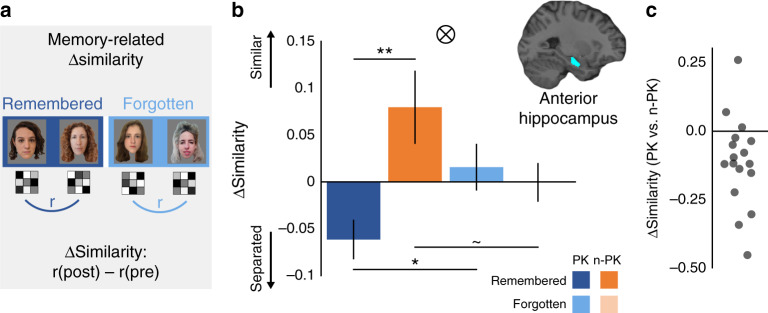
An adaptive memory system rarely learns information tabula rasa, but rather builds on prior knowledge to facilitate learning. How prior knowledge influences the neural representation of novel associations remains unknown. Here, participants associated pairs of faces in two conditions: a famous, highly familiar face with a novel face or two novel faces while undergoing fMRI. We examine multivoxel activity patterns corresponding to individual faces before and after learning. The activity patterns representing members of famous-novel pairs becomes separated in the hippocampus, that is, more distinct from one another through learning, in striking contrast to paired novel faces that become similar. In the left inferior frontal gyrus, however, prior knowledge leads to integration, and in a specific direction: the representation of the novel face becomes similar to that of the famous face after learning, suggesting assimilation of new into old memories. We propose that hippocampal separation might resolve interference between existing and newly learned information, allowing cortical assimilation. Thus, associative learning with versus without prior knowledge relies on radically different computations.
自适应记忆系统很少从零开始学习信息,而是在已有知识的基础上进行学习,以促进学习。先前的知识如何影响新关联的神经表示形式尚不清楚。在这里,参与者在两种条件下将面孔对进行关联:一张著名的、高度熟悉的面孔和一张新面孔,或两张新面孔,同时进行 fMRI 扫描。我们检查了学习前后对应单个面孔的多体素活动模式。代表著名-新颖对成员的活动模式在海马体中变得分离,也就是说,通过学习彼此之间变得更加不同,与成对的新颖面孔形成鲜明对比,后者变得相似。然而,在左侧额下回,先前的知识导致了整合,并且是在特定的方向上:学习后,新面孔的表示变得与著名面孔的表示相似,这表明新记忆被同化到旧记忆中。我们提出,海马体的分离可能会解决现有信息和新学习信息之间的干扰,从而允许皮质同化。因此,有和没有先前知识的联想学习依赖于完全不同的计算。