Clavreul Anne, Menei Philippe
Département de Neurochirurgie, CHU, 49933 Angers, France.
Université d'Angers, CHU d'Angers, CRCINA, F-49000 Angers, France.
Cancers (Basel). 2020 Sep 15;12(9):2628. doi: 10.3390/cancers12092628.
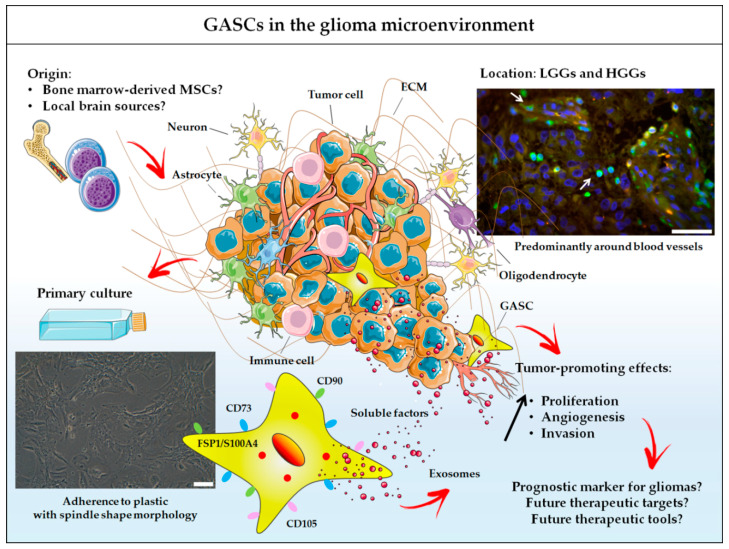
The glioma microenvironment is a critical regulator of tumor progression. It contains different cellular components such as blood vessels, immune cells, and neuroglial cells. It also contains non-cellular components, such as the extracellular matrix, extracellular vesicles, and cytokines, and has certain physicochemical properties, such as low pH, hypoxia, elevated interstitial pressure, and impaired perfusion. This review focuses on a particular type of cells recently identified in the glioma microenvironment: glioma-associated stromal cells (GASCs). This is just one of a number of names given to these mesenchymal stromal-like cells, which have phenotypic and functional properties similar to those of mesenchymal stem cells and cancer-associated fibroblasts. Their close proximity to blood vessels may provide a permissive environment, facilitating angiogenesis, invasion, and tumor growth. Additional studies are required to characterize these cells further and to analyze their role in tumor resistance and recurrence.
胶质瘤微环境是肿瘤进展的关键调节因子。它包含不同的细胞成分,如血管、免疫细胞和神经胶质细胞。它还包含非细胞成分,如细胞外基质、细胞外囊泡和细胞因子,并具有某些物理化学特性,如低pH值、缺氧、间质压力升高和灌注受损。本综述重点关注最近在胶质瘤微环境中发现的一种特殊类型的细胞:胶质瘤相关基质细胞(GASC)。这只是赋予这些间充质基质样细胞的众多名称之一,它们具有与间充质干细胞和癌症相关成纤维细胞相似的表型和功能特性。它们与血管的紧密接近可能提供一个有利的环境,促进血管生成、侵袭和肿瘤生长。需要进一步的研究来更全面地描述这些细胞,并分析它们在肿瘤耐药性和复发中的作用。