de Oliveira Haroldo C, Castelli Rafael F, Reis Flavia C G, Rizzo Juliana, Rodrigues Marcio L
Instituto Carlos Chagas, Fundação Oswaldo Cruz (Fiocruz), Rua Prof. Algacyr Munhoz Mader, 3775 CIC Curitiba/PR, Curitiba 81350-010, Brasil.
Programa de Pós-Graduação em Biologia Parasitária, Instituto Oswaldo Cruz, Fiocruz, Avenida Brasil, 4.365, Pavilhão Arthur Neiva-Manguinhos, Rio de Janeiro 21040-360, Brasil.
Pathogens. 2020 Sep 16;9(9):754. doi: 10.3390/pathogens9090754.
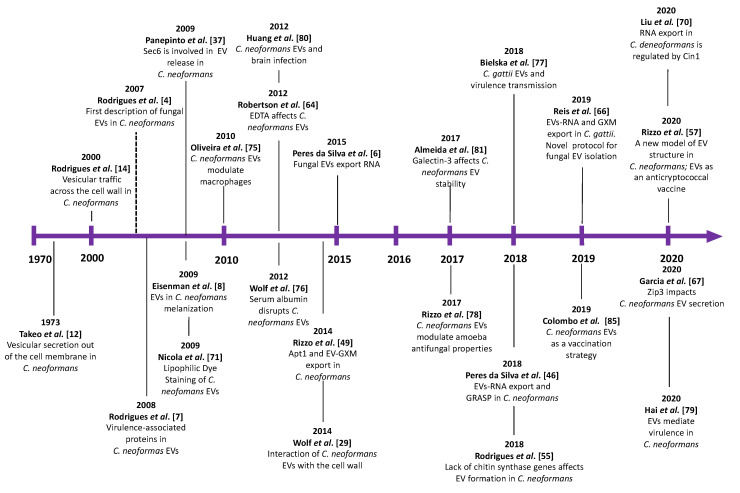
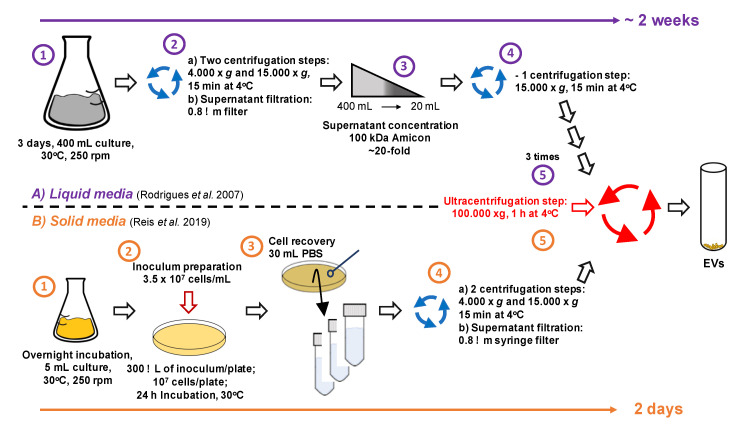
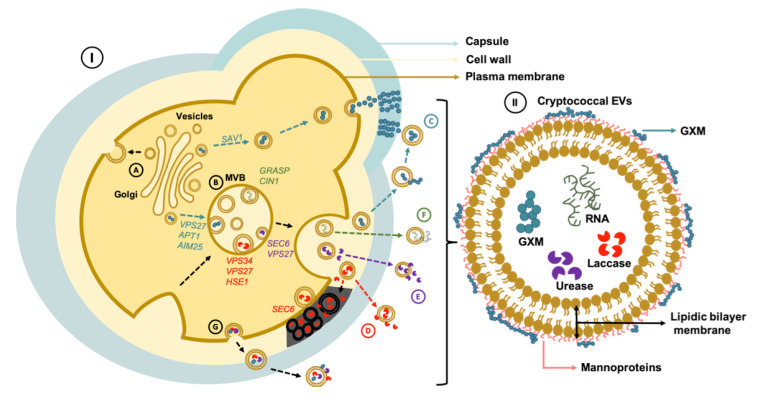
Extracellular vesicles (EVs) are produced by all domains of life. In fungi, these structures were first described in and, since then, they were characterized in several pathogenic and non-pathogenic fungal species. Cryptococcal EVs participate in the export of virulence factors that directly impact the -host interaction. Our knowledge of the biogenesis and pathogenic roles of EVs is still limited, but recent methodological and scientific advances have improved our understanding of how cryptococcal EVs participate in both physiological and pathogenic events. In this review, we will discuss the importance of cryptococcal EVs, including early historical studies suggesting their existence in , their putative mechanisms of biogenesis, methods of isolation, and possible roles in the interaction with host cells.
细胞外囊泡(EVs)由所有生命域产生。在真菌中,这些结构最早于[具体时间]被描述,从那时起,它们在几种致病和非致病真菌物种中得到了表征。隐球菌EVs参与毒力因子的输出,这些毒力因子直接影响宿主相互作用。我们对隐球菌EVs的生物发生和致病作用的了解仍然有限,但最近的方法学和科学进展提高了我们对隐球菌EVs如何参与生理和致病事件的理解。在这篇综述中,我们将讨论隐球菌EVs的重要性,包括早期表明它们存在的历史研究、其假定的生物发生机制、分离方法以及在与宿主细胞相互作用中的可能作用。