IEEE Trans Med Imaging. 2021 Jan;40(1):228-238. doi: 10.1109/TMI.2020.3025064. Epub 2020 Dec 29.
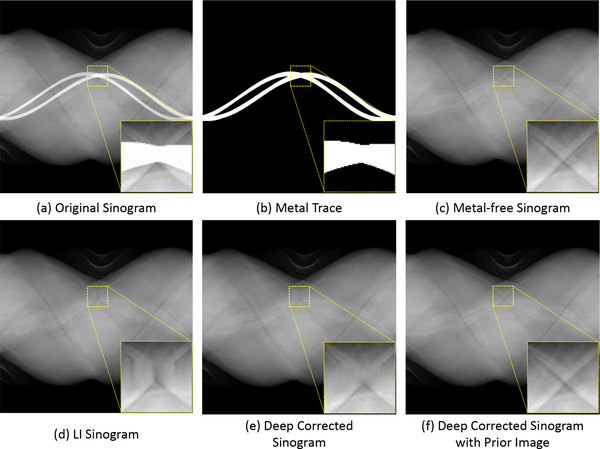
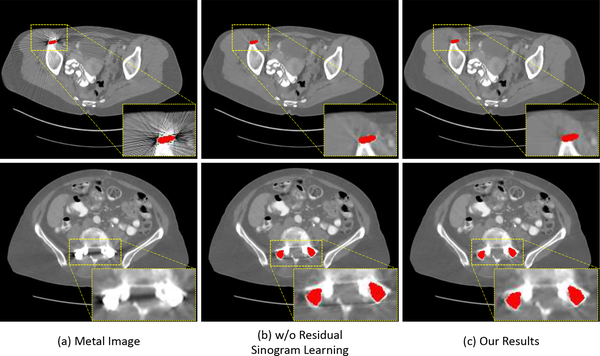
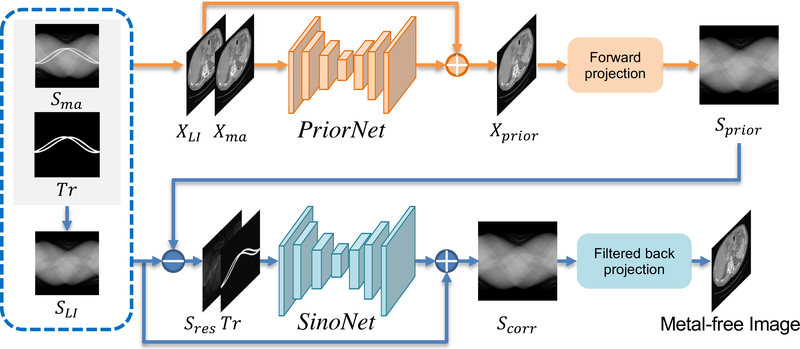
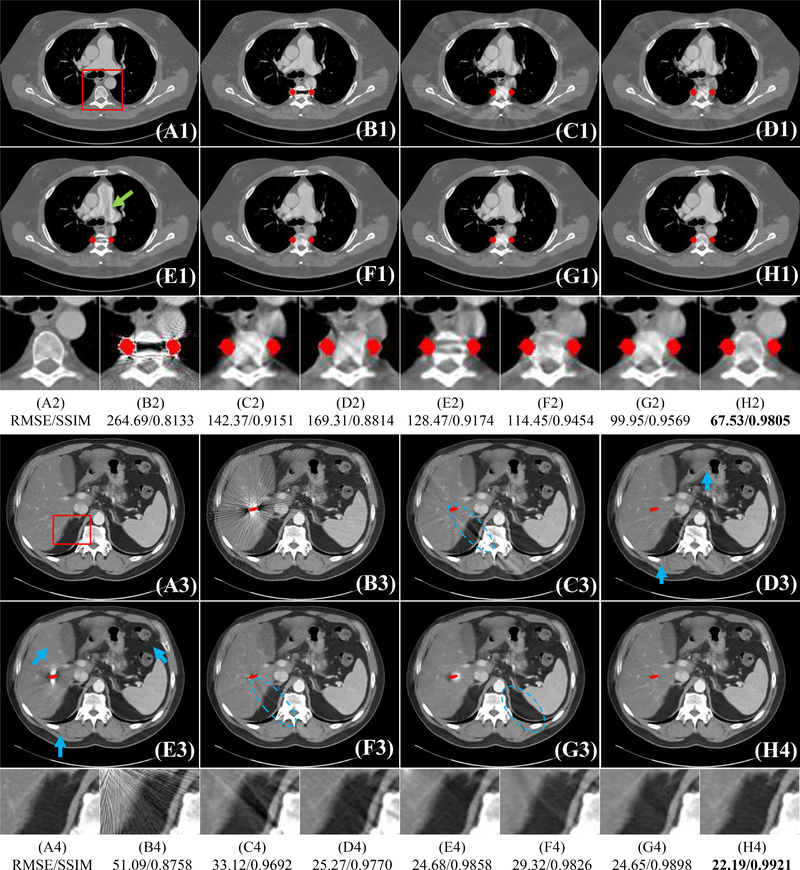
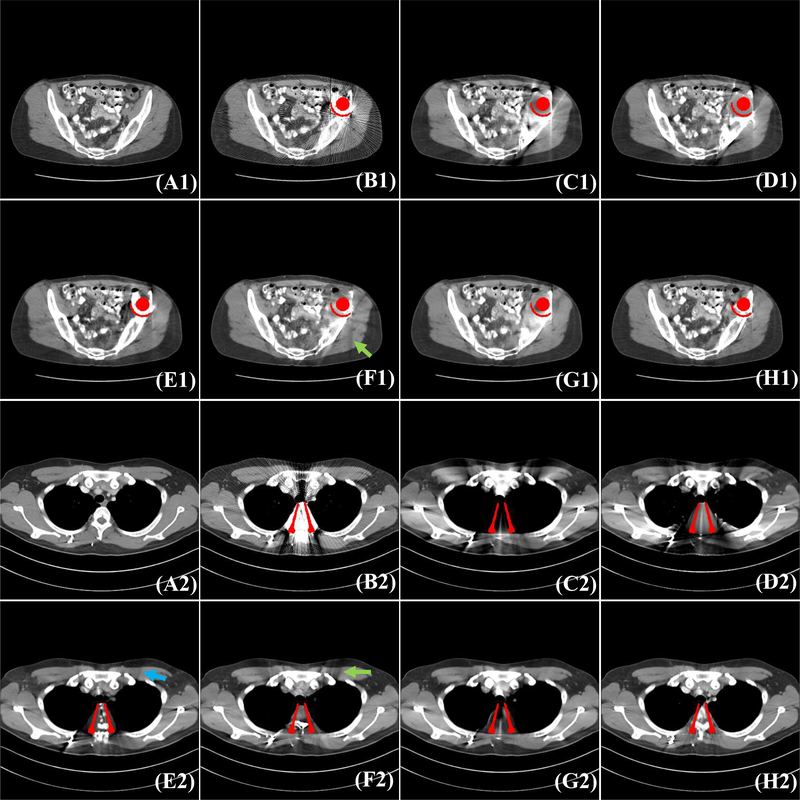
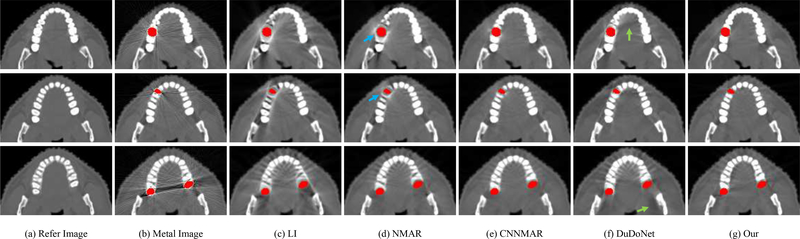
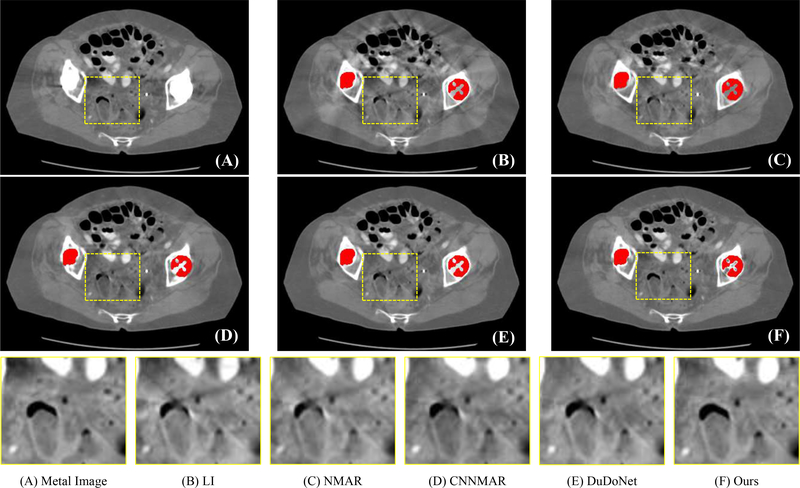
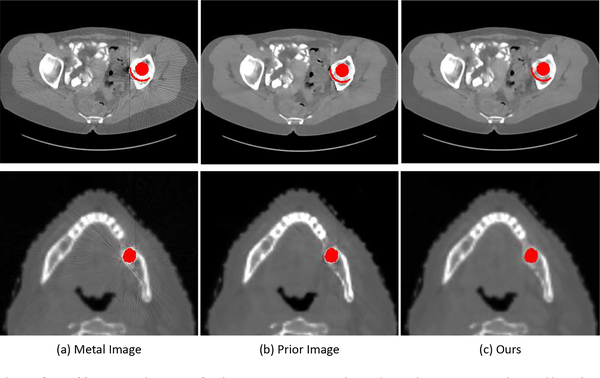
Computed tomography (CT) has been widely used for medical diagnosis, assessment, and therapy planning and guidance. In reality, CT images may be affected adversely in the presence of metallic objects, which could lead to severe metal artifacts and influence clinical diagnosis or dose calculation in radiation therapy. In this article, we propose a generalizable framework for metal artifact reduction (MAR) by simultaneously leveraging the advantages of image domain and sinogram domain-based MAR techniques. We formulate our framework as a sinogram completion problem and train a neural network (SinoNet) to restore the metal-affected projections. To improve the continuity of the completed projections at the boundary of metal trace and thus alleviate new artifacts in the reconstructed CT images, we train another neural network (PriorNet) to generate a good prior image to guide sinogram learning, and further design a novel residual sinogram learning strategy to effectively utilize the prior image information for better sinogram completion. The two networks are jointly trained in an end-to-end fashion with a differentiable forward projection (FP) operation so that the prior image generation and deep sinogram completion procedures can benefit from each other. Finally, the artifact-reduced CT images are reconstructed using the filtered backward projection (FBP) from the completed sinogram. Extensive experiments on simulated and real artifacts data demonstrate that our method produces superior artifact-reduced results while preserving the anatomical structures and outperforms other MAR methods.
计算机断层扫描(CT)已广泛应用于医学诊断、评估和治疗计划与指导。实际上,在存在金属物体的情况下,CT 图像可能会受到不利影响,这可能导致严重的金属伪影,并影响放射治疗中的临床诊断或剂量计算。在本文中,我们提出了一种通过同时利用图像域和基于正弦图域的 MAR 技术的优势来减少金属伪影(MAR)的通用框架。我们将框架表述为一个正弦图完成问题,并训练一个神经网络(SinoNet)来恢复受金属影响的投影。为了提高金属痕迹边界处完成投影的连续性,从而减轻重建 CT 图像中的新伪影,我们训练另一个神经网络(PriorNet)来生成一个良好的先验图像来指导正弦图学习,并进一步设计一种新颖的残差正弦图学习策略,以有效地利用先验图像信息,从而更好地完成正弦图。两个网络以端到端的方式联合训练,带有可微分的正向投影(FP)操作,以便先验图像生成和深度正弦图完成过程能够相互受益。最后,从完成的正弦图使用滤波反向投影(FBP)重建减少伪影的 CT 图像。对模拟和真实伪影数据的广泛实验表明,我们的方法在保留解剖结构的同时产生了优越的减少伪影的结果,并优于其他 MAR 方法。