Tabernero Antonio, Cardea Stefano
Department of Chemical Engineering, University of Salamanca, Plaza los Caídos s/n, 37008 Salamanca, Spain.
Department of Industrial Engineering, University of Salerno, Via Giovanni Paolo II, 132, 84084 Fisciano, Italy.
Polymers (Basel). 2020 Sep 19;12(9):2142. doi: 10.3390/polym12092142.
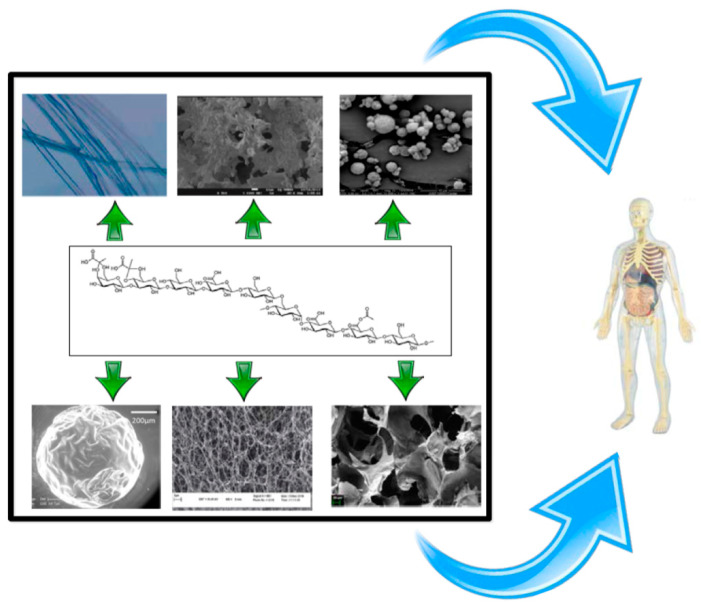
Microbial exopolysaccharides are peculiar polymers that are produced by living organisms and protect them against environmental factors. These polymers are industrially recovered from the medium culture after performing a fermentative process. These materials are biocompatible and biodegradable, possessing specific and beneficial properties for biomedical drug delivery systems. They can have antitumor activity, they can produce hydrogels with different characteristics due to their molecular structure and functional groups, and they can even produce nanoparticles via a self-assembly phenomenon. This review studies the potential use of exopolysaccharides as carriers for drug delivery systems, covering their versatility and their vast possibilities to produce particles, fibers, scaffolds, hydrogels, and aerogels with different strategies and methodologies. Moreover, the main properties of exopolysaccharides are explained, providing information to achieve an adequate carrier selection depending on the final application.
微生物胞外多糖是由生物体产生的特殊聚合物,可保护它们免受环境因素的影响。这些聚合物是在进行发酵过程后从培养基中工业回收的。这些材料具有生物相容性和可生物降解性,对生物医学药物递送系统具有特定且有益的特性。它们可以具有抗肿瘤活性,由于其分子结构和官能团,可以产生具有不同特性的水凝胶,甚至可以通过自组装现象产生纳米颗粒。本综述研究了胞外多糖作为药物递送系统载体的潜在用途,涵盖了它们的多功能性以及通过不同策略和方法生产颗粒、纤维、支架、水凝胶和气凝胶的巨大可能性。此外,还解释了胞外多糖的主要特性,为根据最终应用选择合适的载体提供信息。