MRC Epidemiology Unit and Centre for Diet and Activity Research, University of Cambridge, Cambridge, UK.
Norwich Medical School and Centre for Diet and Activity Research, University of East Anglia, Norwich, UK.
Int J Behav Nutr Phys Act. 2020 Sep 22;17(1):120. doi: 10.1186/s12966-020-01025-3.
This study assessed the feasibility and acceptability of FRESH (Families Reporting Every Step to Health), a theory-based child-led family physical activity (PA) intervention delivered online. We also assessed the preliminary effectiveness of the intervention on outcomes of interest and whether pre-specified criteria were met to progress to a full-scale definitive trial.
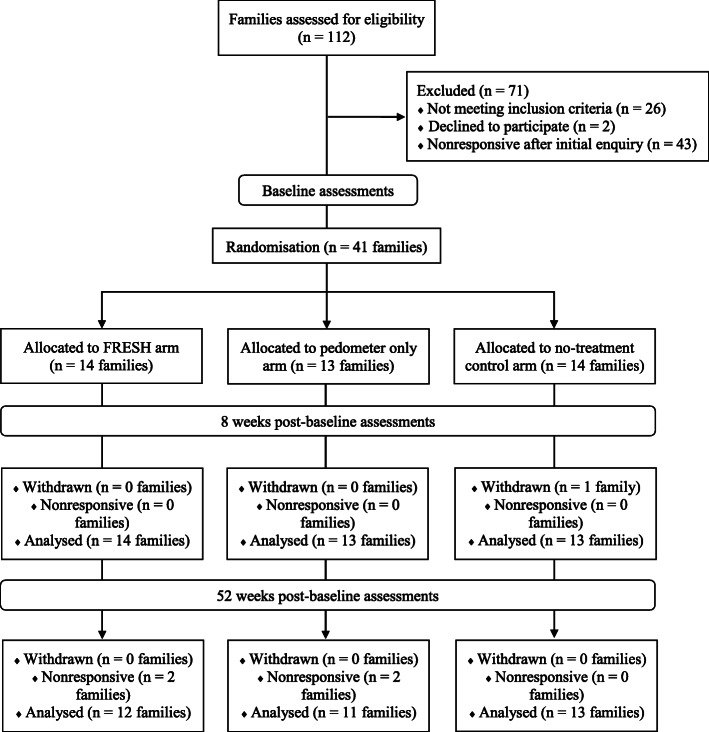
In a three-armed randomised pilot trial, 41 families (with a 7-11-year-old index child) were allocated to a: 'family' (FAM), 'pedometer-only' (PED), or a no-treatment control (CON) arm. The FAM arm received access to the FRESH website, allowing participants to select step challenges to 'travel' to target cities around the world, log their steps, and track progress as families virtually globetrot. FAM and PED arms also received family sets of pedometers. All family members could participate in the evaluation. Physical (e.g., fitness, blood pressure), psychosocial (e.g., social support), behavioural (e.g., objectively-measured PA), and economic (e.g., expenditure for PA) data were collected at baseline, 8- and 52-weeks.
At 8- and 52-weeks, 98 and 88% of families were retained, respectively. Most children liked participating in the study (> 90%) and thought it was fun (> 80%). Compared to the PED (45%) and CON (39%) arms, a higher percentage of children in the FAM (81%) arm reported doing more activities with their family. Adults agreed that FRESH encouraged their family do more PA and made their family more aware of the amount of PA they do. No notable between-group differences were found for childrens' minutes in moderate-to-vigorous PA. Sizeable changes of 9.4 (95%CI: 0.4, 18.4) and 15.3 (95%CI: 6.0, 24.5) minutes in moderate-to-vigorous PA was found for adults in the FAM group compared to those in the PED or CON groups, respectively. No other notable differences were found.
This study demonstrates feasibility and acceptability of the FRESH intervention. All progression criteria were at least partially satisfied. However, we failed to recruit the target sample size and did not find a signal of effectiveness on PA particularly long-term or in children. Further refinements are required to progress to a full-scale trial.
This study was prospectively registered ( ISRCTN12789422 ) on 16/03/2016.
本研究评估了基于理论的儿童主导家庭体育活动(PA)干预措施 FRESH(家庭报告每一步健康)在线实施的可行性和可接受性。我们还评估了干预措施对感兴趣结果的初步有效性,以及是否满足了预先设定的标准,以推进到全面的确定性试验。
在一项三臂随机试点试验中,41 个家庭(有 7-11 岁的索引儿童)被分配到“家庭”(FAM)、“计步器仅”(PED)或无治疗对照(CON)臂。FAM 臂可访问 FRESH 网站,允许参与者选择前往世界各地目标城市的挑战,记录他们的步数,并随着家庭虚拟环球旅行跟踪进度。FAM 和 PED 臂还收到了家庭计步器。所有家庭成员都可以参与评估。收集了身体(例如,健康、血压)、心理社会(例如,社会支持)、行为(例如,客观测量的 PA)和经济(例如,PA 支出)数据,基线、8 周和 52 周。
在 8 周和 52 周时,分别有 98%和 88%的家庭保留下来。大多数孩子喜欢参与研究(>90%),并认为这很有趣(>80%)。与 PED(45%)和 CON(39%)臂相比,FAM(81%)臂中有更高比例的儿童报告与家人一起进行了更多的活动。成年人同意 FRESH 鼓励他们的家人进行更多的 PA 活动,并使他们的家人更了解他们所进行的 PA 活动量。在儿童的中到剧烈 PA 分钟数方面,未发现组间有明显差异。与 PED 或 CON 组相比,FAM 组的成年人分别发现中到剧烈 PA 有 9.4(95%CI:0.4,18.4)和 15.3(95%CI:6.0,24.5)分钟的大幅变化。未发现其他明显差异。
本研究表明 FRESH 干预措施具有可行性和可接受性。所有进展标准至少部分得到满足。然而,我们未能招募到目标样本量,并且没有发现 PA 特别是长期或在儿童中的有效性信号。需要进一步改进才能推进到全面试验。
本研究于 2016 年 3 月 16 日前瞻性注册(ISRCTN81534536)。