Lang Xuye, Besada-Lombana Pamela B, Li Mengwan, Da Silva Nancy A, Wheeldon Ian
Department of Chemical and Environmental Engineering, UC Riverside, United States.
Department of Chemical and Biomolecular Engineering, UC Irvine, United States.
Metab Eng Commun. 2020 Sep 3;11:e00145. doi: 10.1016/j.mec.2020.e00145. eCollection 2020 Dec.
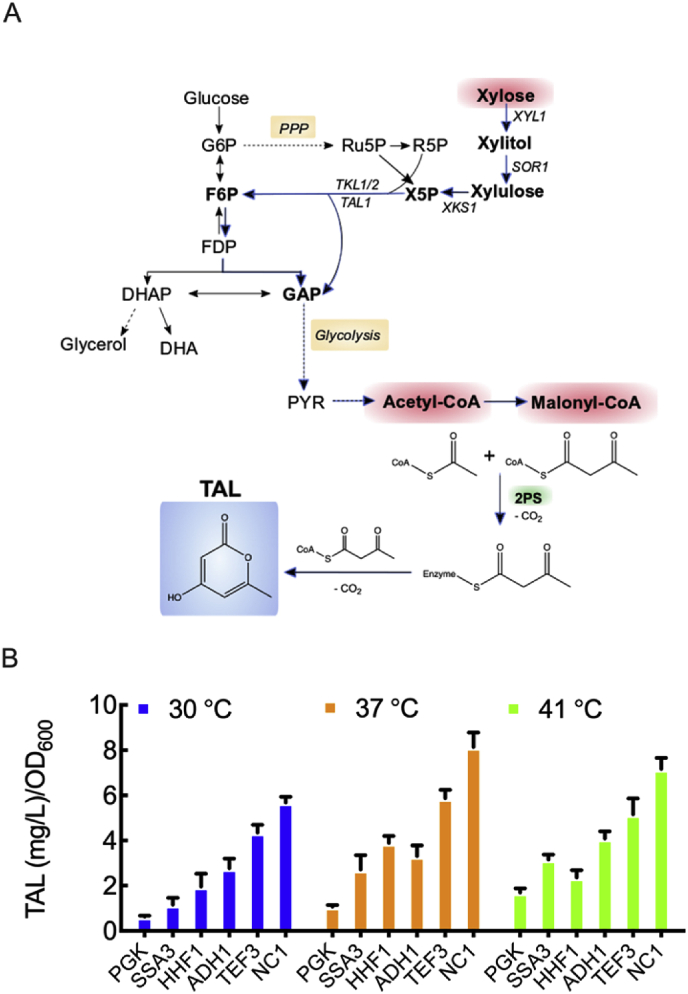
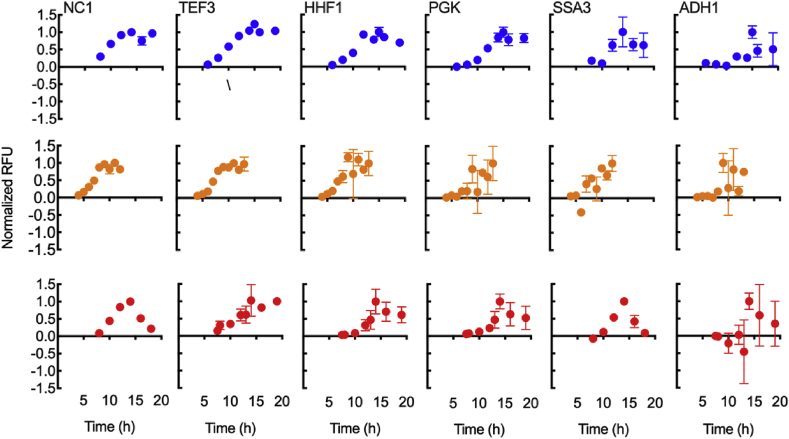
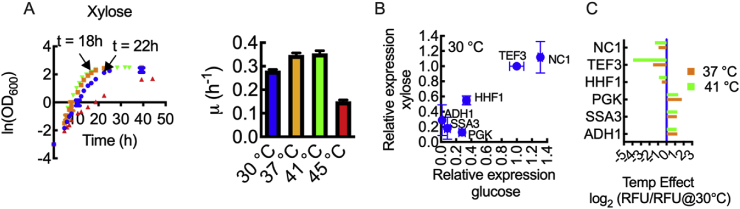
is an emerging host for metabolic engineering. This thermotolerant yeast is the fastest growing eukaryote, has high flux through the TCA cycle, and can metabolize a broad range of C5, C6, and C12 carbon sources. In comparison to the common host , this non-conventional yeast suffers from a lack of metabolic engineering tools to control gene expression over a wide transcriptional range. To address this issue, we designed a library of 25 native-derived promoters from CBS6556 that spans 87-fold transcriptional strength under glucose metabolism. Six promoters from the library were further characterized in both glucose and xylose as well as across various temperatures from 30 to 45 °C. The temperature study revealed that in most cases EGFP expression decreased with elevating temperature; however, two promoters, P and P , increased expression above 40 °C in both xylose and glucose. The six-promoter set was also validated in xylose for triacetic acid lactone (TAL) production. By controlling the expression level of heterologous 2-pyrone synthase (2-PS), the specific TAL titer increased over 8-fold at 37 °C. Cultures at 41 °C exhibited a similar TAL biosynthesis capability, while at 30 °C TAL levels were lower. Taken together, these results advance the metabolic engineering tool set in and further develop this new host for chemical biosynthesis.
是代谢工程领域新兴的宿主。这种耐热酵母是生长最快的真核生物,通过三羧酸循环具有高通量,并且能够代谢多种C5、C6和C12碳源。与常见宿主相比,这种非常规酵母缺乏在广泛转录范围内控制基因表达的代谢工程工具。为了解决这个问题,我们设计了一个由来自CBS6556的25个天然启动子组成的文库,该文库在葡萄糖代谢下的转录强度跨度为87倍。文库中的六个启动子在葡萄糖和木糖中以及在30至45℃的不同温度下进一步进行了表征。温度研究表明,在大多数情况下,绿色荧光蛋白(EGFP)表达随温度升高而降低;然而,两个启动子P 和P ,在木糖和葡萄糖中40℃以上时表达增加。这六个启动子组合在木糖中用于三乙酸内酯(TAL)生产也得到了验证。通过控制异源2-吡喃合酶(2-PS)的表达水平,在37℃时特定TAL滴度增加了8倍以上。41℃培养物表现出类似的TAL生物合成能力,而在30℃时TAL水平较低。综上所述,这些结果推进了[具体物种名称未给出]中的代谢工程工具集,并进一步开发了这种用于化学生物合成的新宿主。