Hızır-Kadı İlayda, Gültekin-Özgüven Mine, Altin Gokce, Demircan Evren, Özçelik Beraat
Department of Food Engineering, Faculty of Chemical and Metallurgical Engineering, Istanbul Technical University, Maslak, TR-34469, Istanbul, Turkey.
Molecular Engineering & Sciences Institute, University of Washington, 3946 W Stevens Way NE, 98105, Seattle, WA, USA.
Heliyon. 2020 Sep 22;6(9):e05030. doi: 10.1016/j.heliyon.2020.e05030. eCollection 2020 Sep.
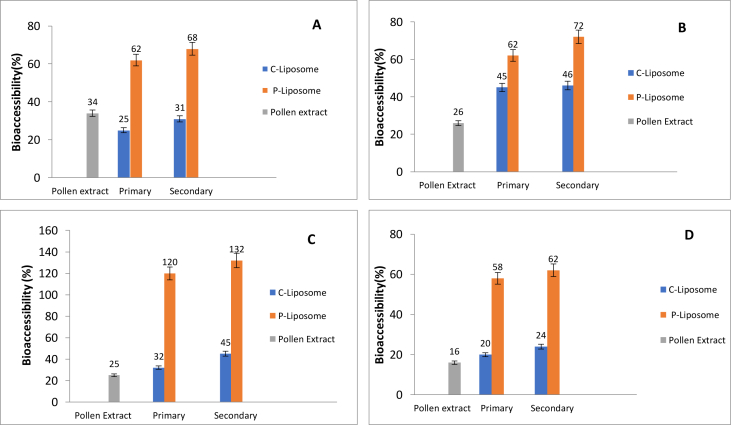
This study offers a suitable and easy proliposome-liposome method that enhances the encapsulation ability of liposome structures on poor water-soluble extracts. Pollen phenolic extract (PPE) was studied to show applicability in the proposed method. The poor water-soluble PPE (0.2%, w/v) was encapsulated by liposomes generated from proliposomes (P-liposomes) that were prepared via high-pressure homogenization technique without using any organic solvents and high temperature. Only a few drops of ethanol were used to dissolve poor water-soluble compounds in PPE during the preparation of P-liposomes. The trace amount of ethanol maintained the improvement of PPE solubility in P-liposome dispersion, hence the bioaccessibility and bioactivity of PPE incorporated in P-liposomes increased. Thus, higher encapsulation efficiency was found in P-liposomes compared to conventional liposomes (C-liposomes) in which the EE was 75 and 73%, respectively. To increase the physical stability of liposome structures, the surface of both P-liposomes and C-liposomes was covered with chitosan. There were found small changes between P-liposomes and C-liposomes in terms of mean diameter size and zeta potential. On the other hand, the bioactivity of encapsulated PPE showed differences in P-liposomes and C-liposomes. The antioxidant capacity of PPE in P-liposomes enhanced approximately two times in CUPRAC and three times in DPPH assays. Also, bioaccessibility of PPE in P-liposomes increased approximately 4 and 2 folds, respectively, regarding total phenolics and flavonoids. To our knowledge, this is the first report about the increment of encapsulation behavior of liposome structures on low water-soluble extract within an aqueous media.
本研究提供了一种合适且简便的前体脂质体-脂质体方法,该方法可增强脂质体结构对水溶性差的提取物的包封能力。以花粉酚类提取物(PPE)为例,展示了该方法的适用性。通过高压均质技术制备的前体脂质体(P-脂质体)产生的脂质体对水溶性差的PPE(0.2%,w/v)进行了包封,制备过程中未使用任何有机溶剂和高温。在制备P-脂质体时,仅使用了几滴乙醇来溶解PPE中水溶性差的化合物。痕量乙醇维持了PPE在P-脂质体分散体中的溶解度提高,因此,P-脂质体中PPE的生物可及性和生物活性增加。因此,与传统脂质体(C-脂质体)相比,P-脂质体的包封效率更高,其中C-脂质体和P-脂质体的包封率分别为75%和73%。为提高脂质体结构的物理稳定性,P-脂质体和C-脂质体的表面均用壳聚糖进行了覆盖。在平均直径大小和zeta电位方面,P-脂质体和C-脂质体之间的变化较小。另一方面,包封的PPE的生物活性在P-脂质体和C-脂质体中表现出差异。在CUPRAC法中,P-脂质体中PPE的抗氧化能力提高了约两倍,在DPPH法中提高了三倍。此外,就总酚类和黄酮类而言,P-脂质体中PPE的生物可及性分别提高了约4倍和2倍。据我们所知,这是关于水性介质中脂质体结构对低水溶性提取物包封行为增加的首次报道。