Department of Neurology, Medical University Innsbruck, Innsbruck, Austria.
4th Medical Department with Infectious Diseases and Tropical Medicine, Kaiser Franz Josef Hospital, Vienna, Austria.
Eur J Neurol. 2021 Oct;28(10):3411-3417. doi: 10.1111/ene.14564. Epub 2020 Oct 25.
Since the outbreak of the severe acute respiratory syndrome coronavirus-2 (SARS-CoV-2) pandemic, several reports indicated neurological involvement in COVID-19 disease. Muscle involvement has also been reported as evidenced by creatine kinase (CK) elevations and reports of myalgia.
Creatine kinase, markers of inflammation, pre-existing diseases and statin use were extracted from records of Austrian hospitalised COVID-19 patients. Disease severity was classified as severe in case of intensive care unit (ICU) admission or mortality. COVID-19 patients were additionally compared to an historical group of hospitalised influenza patients.
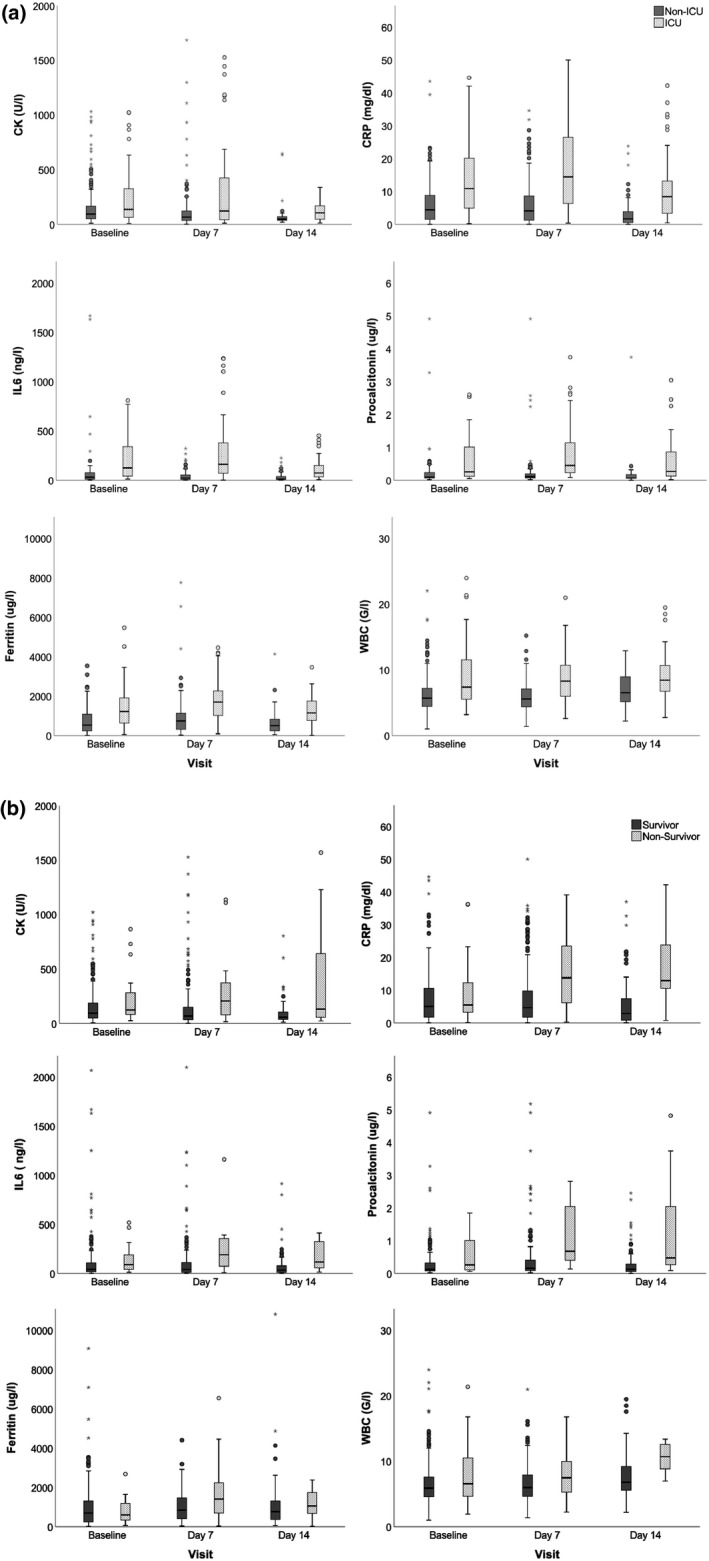
Three hundred fifty-one patients with SARS-CoV-2 and 258 with influenza were included in the final analysis. CK was elevated in 27% of COVID-19 and in 28% of influenza patients. CK was higher in severe COVID-19 as were markers of inflammation. CK correlated significantly with inflammation markers, which had an independent impact on CK when adjusted for demographic variables and disease severity. Compared to influenza patients, COVID-19 patients were older, more frequently male, had more comorbidities, and more frequently had a severe disease course. Nevertheless, influenza patients had higher baseline CK than COVID-19, and 35.7% of intensive care unit (ICU)-admitted patients had CK levels >1,000 U/L compared to only 4.7% of ICU-admitted COVID-19 patients.
HyperCKemia occurs in a similar frequency in COVID-19 and influenza infection. CK levels were lower in COVID-19 than in influenza in mild and severe disease. CK levels strongly correlate with disease severity and markers of inflammation. To date, it remains unclear whether hyperCKemia is due to a virus-triggered inflammatory response or direct muscle toxicity.
自严重急性呼吸综合征冠状病毒 2(SARS-CoV-2)大流行爆发以来,有几项报告表明 COVID-19 疾病存在神经系统受累。肌病也有报道,表现为肌酸激酶(CK)升高和肌痛报告。
从奥地利住院 COVID-19 患者的记录中提取肌酸激酶、炎症标志物、既往疾病和他汀类药物使用情况。疾病严重程度分类为 ICU 入院或死亡的重症。COVID-19 患者还与住院流感患者的历史组进行了比较。
最终分析纳入了 351 例 SARS-CoV-2 和 258 例流感患者。COVID-19 患者中有 27%和流感患者中有 28%的 CK 升高。重症 COVID-19 患者的 CK 更高,炎症标志物也更高。CK 与炎症标志物显著相关,当调整人口统计学变量和疾病严重程度时,CK 具有独立的影响。与流感患者相比,COVID-19 患者年龄更大,男性更多,合并症更多,疾病严重程度更高。然而,流感患者的 CK 基线水平更高,35.7%的 ICU 收治患者的 CK 水平>1000 U/L,而 ICU 收治的 COVID-19 患者仅为 4.7%。
CK 血症在 COVID-19 和流感感染中发生的频率相似。在轻症和重症疾病中,COVID-19 的 CK 水平低于流感。CK 水平与疾病严重程度和炎症标志物密切相关。迄今为止,CK 血症是否是由于病毒引发的炎症反应还是直接的肌肉毒性仍不清楚。