Shanghai University of Medicine & Health Sciences Affiliated Zhoupu Hospital, No. 1500 Zhouyuan Rd., Pudong New Area, Shanghai, 201318, China.
Obstetrics and Gynecology Hospital of Fudan University, 419 Fangxie Road, Shanghai, 200011, China.
BMC Public Health. 2020 Oct 1;20(1):1489. doi: 10.1186/s12889-020-09593-6.
The increasing aging population has been posing a significant challenge to disease burden in developing countries. In particular, the contribution of population aging to and long term changes of disease burden of malignant neoplasm of female genital organs (MNFGO) have not been quantitatively demonstrated.
Data were collected from the Shanghai Vital Statistics System of Pudong New Area (PNA). Crude mortality rate (CMR), age-standardized mortality rate by Segi's world standard population (ASMRW), and years of life lost (YLL) of MNFGO as the underlying cause of death in age and pathology types from 1995 to 2018 were calculated. The joinpoint regression was used to estimate the trends of those rates by identifying the annual percent changes (APCs), and the decomposition method was used to calculate the increased rates and the contribution resulting from demographic and non-demographic factors.
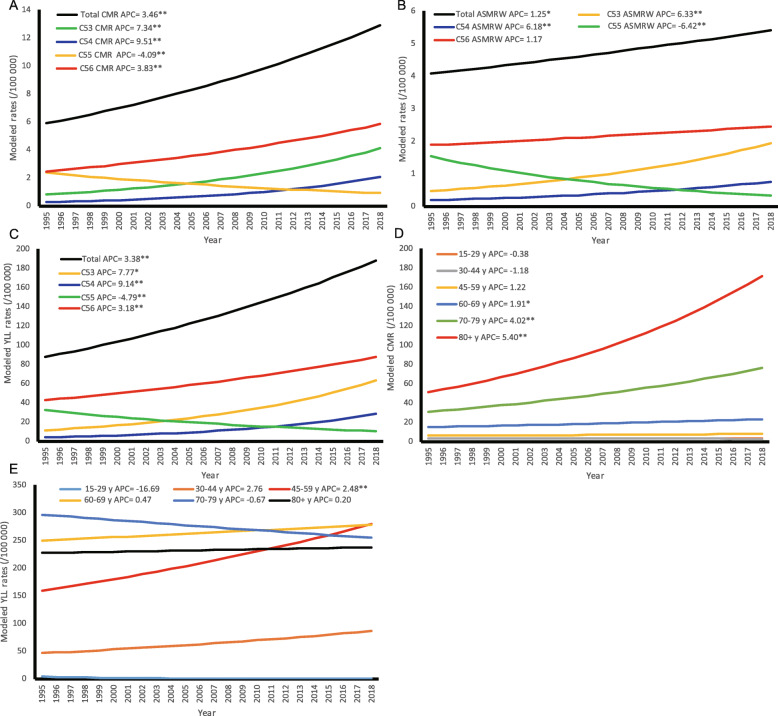
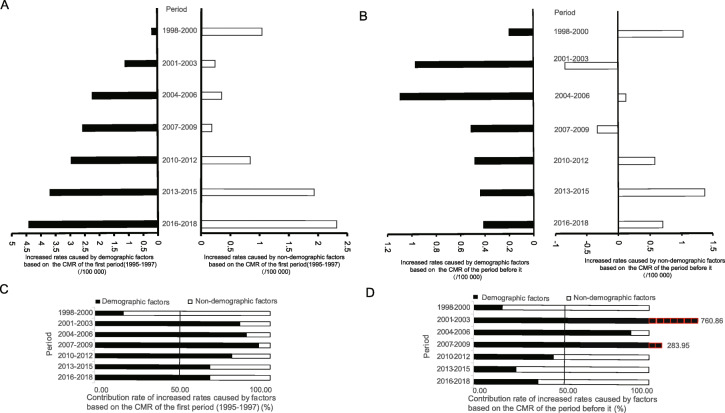
From 1995 to 2018, a total of 2869 MNFGO-specific deaths were reported in PNA, accounting for 0.64% of the total deaths. The CMR and ASMRW of MNFGO were 9.23/10 person-years and 4.80/10 person-years, respectively. Ovary cancer was the most common cause of MNFGO death, accounting for 43.9% (1260/2869) of all MNFGO death. Other common causes of MNFGO death included cervix uteri cancer, uterus unspecified cancer, and corpus uteri cancer. With the increase of age, the mortality rate of MNFGO in residents had shown an upward trend ([APC (95%CI) = 3.46 (2.74, 4.18), P < 0.001)] for each five-year age group from 0 to 4 to 85+ years. From 1995 to 2018, YLL of MNFGO in Shanghai PNA was 42,152.82 years, and the rate of YLL was 135.56 /10. The top three MNFGO types in YLLs were ovary cancer, cervix uteri cancer and uterus unspecified cancer. Demographic factors contributed significantly to the upward trends of CMR, ASMRW, and YLL rates of MNFGO.
With aggravated population aging in Shanghai, MNFGO is and will continue to be a serious threat to women's health. More precise and effective prevention strategies are needed to target high risk population, to achieve efficient health resource allocation and to improve women's health in particular.
人口老龄化的加剧给发展中国家的疾病负担带来了重大挑战。特别是,人口老龄化对女性生殖器官恶性肿瘤(MNFGO)疾病负担的长期变化的贡献尚未得到定量证明。
数据来自浦东新区上海生命统计系统。计算了 1995 年至 2018 年年龄和病理类型的 MNFGO 作为根本死因的粗死亡率(CMR)、Segi 世界标准人口年龄标准化死亡率(ASMRW)和寿命损失年(YLL)。通过确定年度百分比变化(APC),使用连接点回归估计这些比率的趋势,使用分解方法计算人口统计学和非人口统计学因素导致的增加率和贡献。
1995 年至 2018 年,浦东新区共报告 2869 例 MNFGO 特异性死亡,占总死亡人数的 0.64%。MNFGO 的 CMR 和 ASMRW 分别为 9.23/10 人年和 4.80/10 人年。卵巢癌是 MNFGO 死亡的最常见原因,占所有 MNFGO 死亡的 43.9%(1260/2869)。MNFGO 死亡的其他常见原因包括宫颈癌、子宫未特指癌症和子宫内膜癌。随着年龄的增长,居民中 MNFGO 的死亡率呈上升趋势([APC(95%CI)=3.46(2.74, 4.18),P<0.001)],每 5 岁年龄组从 0 到 4 到 85+岁。1995 年至 2018 年,上海浦东新区 MNFGO 的 YLL 为 42,152.82 年,YLL 率为 135.56/10。YLL 排名前三的 MNFGO 类型为卵巢癌、宫颈癌和子宫未特指癌症。人口统计学因素对 MNFGO 的 CMR、ASMRW 和 YLL 率的上升趋势有显著贡献。
随着上海人口老龄化的加剧,MNFGO 现在是并将继续对女性健康构成严重威胁。需要更精确和有效的预防策略针对高危人群,以实现有效卫生资源分配,并特别改善妇女健康。