National Institute for Medical Research-Mbeya Medical Research Centre (NIMR-MMRC), Mbeya, Tanzania.
University of Dar es Salaam -Mbeya College of Health and Allied Sciences (UDSM-MCHAS), Mbeya, Tanzania.
PLoS One. 2020 Oct 2;15(10):e0240154. doi: 10.1371/journal.pone.0240154. eCollection 2020.
The burden of HPV-associated premalignant and malignant cervical lesions remains high in HIV+ women even under ART treatment. In order to identify possible underlying pathophysiologic mechanisms, we studied activation and HIV co-receptor expression in cervical T-cell populations in relation to HIV, HPV and cervical lesion status.
Cervical cytobrush (n = 468: 253 HIV- and 215 HIV+; 71% on ART) and blood (in a subset of 39 women) was collected from women in Mbeya, Tanzania. Clinical data on HIV and HPV infection, as well as ART status was collected. T cell populations were characterized using multiparametric flow cytometry-based on their expression of markers for cellular activation (HLA-DR), and memory (CD45RO), as well as HIV co-receptors (CCR5, α4β7).
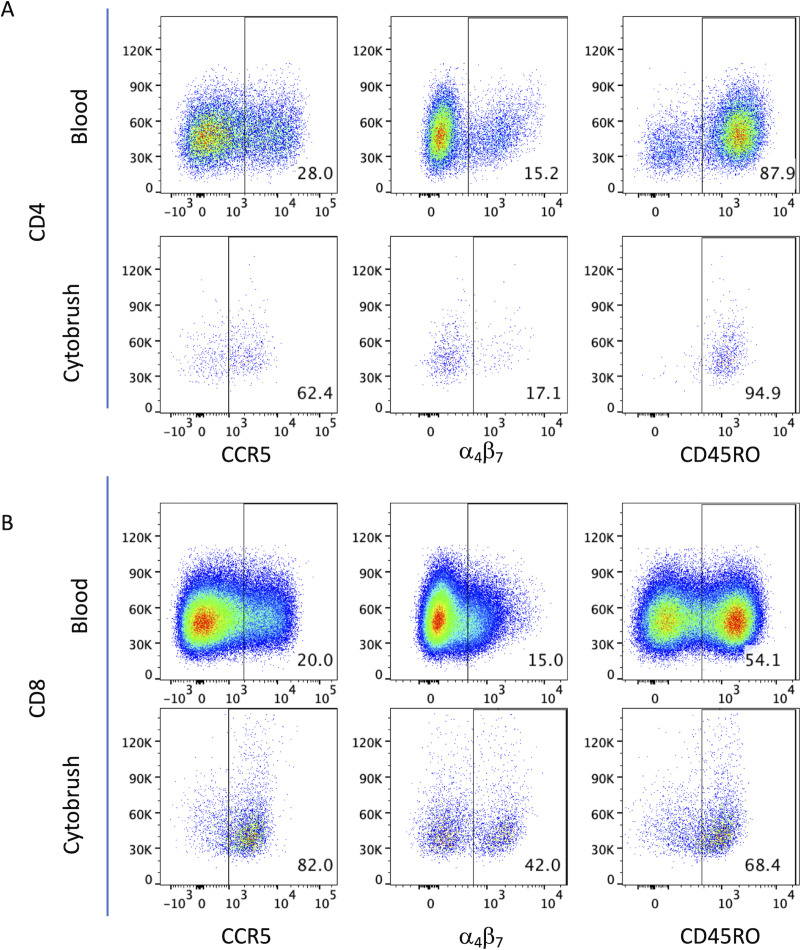
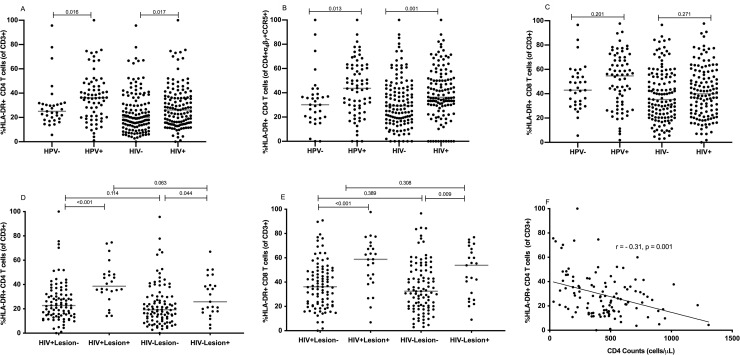
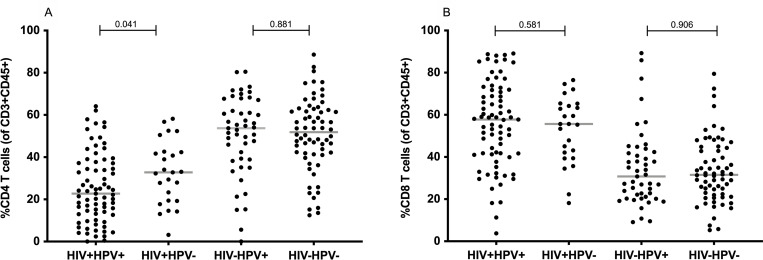
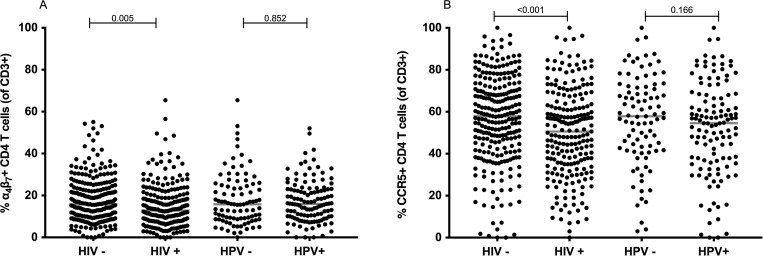
Cervical and blood T cells differed significantly, with higher frequencies of T cells expressing CD45RO, as well as the HIV co-receptors CCR5 and α4β7 in the cervical mucosa. The skewed CD4/CD8 T cell ratio in blood of HIV+ women was mirrored in the cervical mucosa and HPV co-infection was linked to lower levels of mucosal CD4 T cells in HIV+ women (%median: 22 vs 32; p = 0.04). In addition, HIV and HPV infection, and especially HPV-associated cervical lesions were linked to significantly higher frequencies of HLA-DR+ CD4 and CD8 T cells (p-values < 0.05). Interestingly, HPV infection did not significantly alter frequencies of CCR5+ or α4β7+ CD4 T cells.
The increased proportion of activated cervical T cells associated with HPV and HIV infection, as well as HPV-associated lesions, together with the HIV-induced depletion of cervical CD4 T cells, may increase the risk for HPV infection, associated premalignant lesions and cancer in HIV+ women. Further, high levels of activated CD4 T cells associated with HPV and HPV-associated lesions could contribute to a higher susceptibility to HIV in HPV infected women.
即使在接受抗逆转录病毒治疗(ART)的情况下,HIV 阳性妇女的 HPV 相关癌前和恶性宫颈病变负担仍然很高。为了确定可能的潜在病理生理机制,我们研究了与 HIV、HPV 和宫颈病变状况相关的宫颈 T 细胞群的激活和 HIV 共受体表达。
从坦桑尼亚姆贝亚的妇女中采集了宫颈刷(n=468:253 名 HIV-和 215 名 HIV+;71%在接受 ART)和血液(39 名女性中的一部分)。收集了有关 HIV 和 HPV 感染以及 ART 状况的临床数据。使用基于细胞活化标志物(HLA-DR)和记忆标志物(CD45RO)以及 HIV 共受体(CCR5、α4β7)表达的基于多参数流式细胞术的方法对 T 细胞群进行了特征描述。
宫颈和血液 T 细胞存在显著差异,宫颈黏膜中表达 CD45RO 以及 HIV 共受体 CCR5 和 α4β7 的 T 细胞频率更高。HIV+女性血液中 CD4/CD8 T 细胞比例的偏斜在宫颈黏膜中得到了反映,HPV 合并感染与 HIV+女性宫颈黏膜中 CD4 T 细胞水平降低有关(%中位数:22 与 32;p=0.04)。此外,HIV 和 HPV 感染,尤其是 HPV 相关的宫颈病变,与 HLA-DR+CD4 和 CD8 T 细胞的频率显著增加有关(p 值<0.05)。有趣的是,HPV 感染并未显著改变 CCR5+或 α4β7+CD4 T 细胞的频率。
与 HPV 和 HIV 感染以及 HPV 相关病变相关的激活宫颈 T 细胞的比例增加,以及 HIV 诱导的宫颈 CD4 T 细胞耗竭,可能会增加 HIV 阳性妇女中 HPV 感染、相关癌前病变和癌症的风险。此外,与 HPV 和 HPV 相关病变相关的高水平激活的 CD4 T 细胞可能会导致 HPV 感染的女性对 HIV 的易感性增加。