Center for Advanced Laser Technologies (CETAL), National Institute for Laser, Plasma and Radiation Physics, 077125, Magurele-Ilfov, Romania.
Faculty of Applied Sciences, University Politehnica of Bucharest, 060042, Bucharest, Romania.
Sci Rep. 2020 Oct 2;10(1):16418. doi: 10.1038/s41598-020-73414-4.
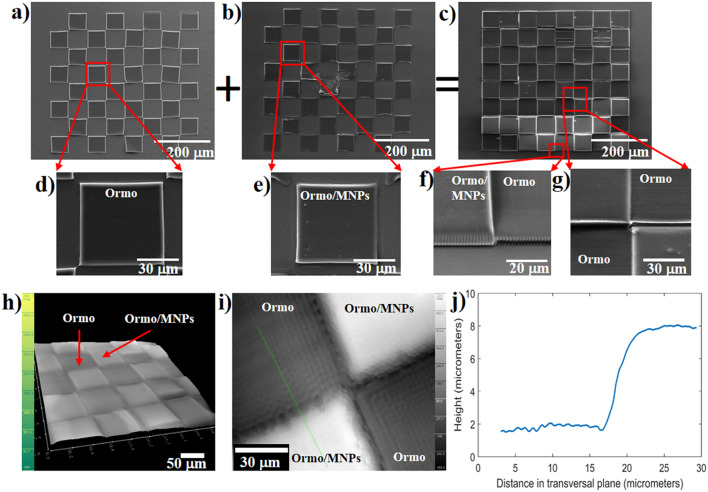
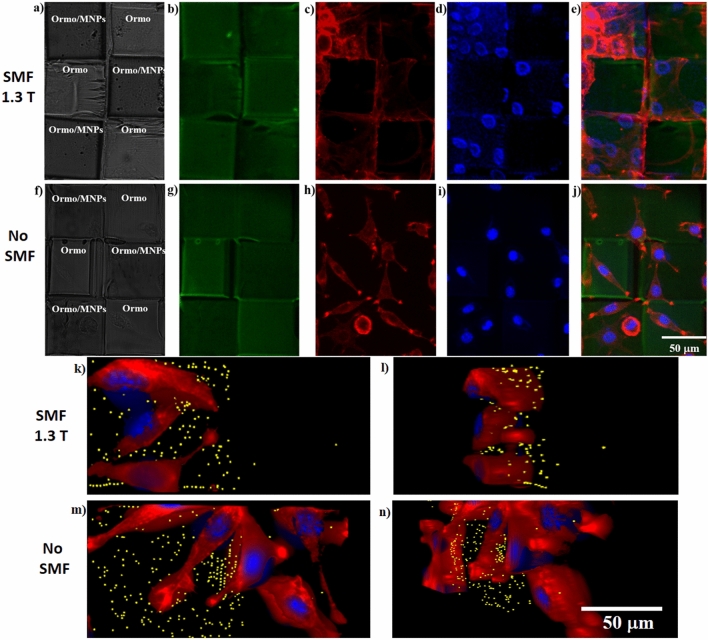
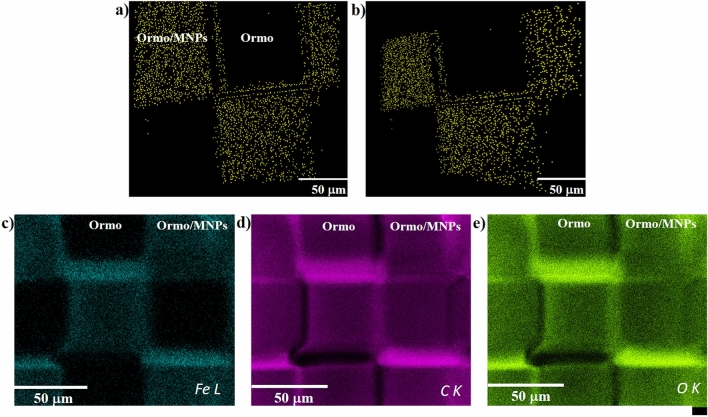
We demonstrate a proof of concept for magnetically-driven 2D cells organization on superparamagnetic micromagnets fabricated by laser direct writing via two photon polymerization (LDW via TPP) of a photopolymerizable superparamagnetic composite. The composite consisted of a commercially available, biocompatible photopolymer (Ormocore) mixed with 4 mg/mL superparamagnetic nanoparticles (MNPs). The micromagnets were designed in the shape of squares with 70 µm lateral dimension. To minimize the role of topographical cues on the cellular attachment, we fabricated 2D microarrays similar with a chessboard: the superparamagnetic micromagnets alternated with non-magnetic areas of identical shape and lateral size as the micromagnets, made from Ormocore by LDW via TPP. The height difference between the superparamagnetic and non-magnetic areas was of ~ 6 µm. In the absence of a static magnetic field, MNPs-free fibroblasts attached uniformly on the entire 2D microarray, with no preference for the superparamagnetic or non-magnetic areas. Under a static magnetic field of 1.3 T, the fibroblasts attached exclusively on the superparamagnetic micromagnets, resulting a precise 2D cell organization on the chessboard-like microarray. The described method has significant potential for fabricating biocompatible micromagnets with well-defined geometries for building skin grafts adapted for optimum tissue integration, starting from single cell manipulation up to the engineering of whole tissues.
我们通过双光子聚合(TPP 激光直写)的方法,用可光聚合的超顺磁复合材料制造了超顺磁微磁铁,证明了通过磁场驱动二维细胞在超顺磁微磁铁上排列的概念验证。复合材料由市售的、可生物相容的光聚合体(Ormocore)和 4mg/ml 的超顺磁纳米颗粒(MNPs)混合而成。微磁铁的形状为 70μm 边长的正方形。为了最小化细胞附着的形貌学线索的作用,我们制造了类似于棋盘的二维微阵列:超顺磁微磁铁与具有相同形状和横向尺寸的非磁性区域交替排列,这些非磁性区域由 Ormocore 通过 TPP 激光直写制成。超顺磁和非磁性区域之间的高度差约为 6μm。在没有静磁场的情况下,无 MNPs 的成纤维细胞均匀地附着在整个二维微阵列上,对超顺磁或非磁性区域没有偏好。在 1.3T 的静磁场下,成纤维细胞仅附着在超顺磁微磁铁上,从而在棋盘状微阵列上实现了精确的二维细胞排列。该方法具有显著的潜力,可以制造具有明确定义几何形状的生物相容性微磁铁,用于构建适应最佳组织整合的皮肤移植物,从单细胞操纵到整个组织的工程。