Clinical Pharmacology and Pharmacotherapy, Department of Pharmaceutical and Pharmacological Sciences, KU Leuven, Leuven, Belgium.
Section of Hygiene, University Department of Life Sciences and Public Health, Università Cattolica del Sacro Cuore, Roma, Italy.
J Med Internet Res. 2020 Oct 8;22(10):e19129. doi: 10.2196/19129.
Informed consent is one of the key elements in biomedical research. The introduction of electronic informed consent can be a way to overcome many challenges related to paper-based informed consent; however, its novel opportunities remain largely unfulfilled due to several barriers.
We aimed to provide an overview of the ethical, legal, regulatory, and user interface perspectives of multiple stakeholder groups in order to assist responsible implementation of electronic informed consent in biomedical research.
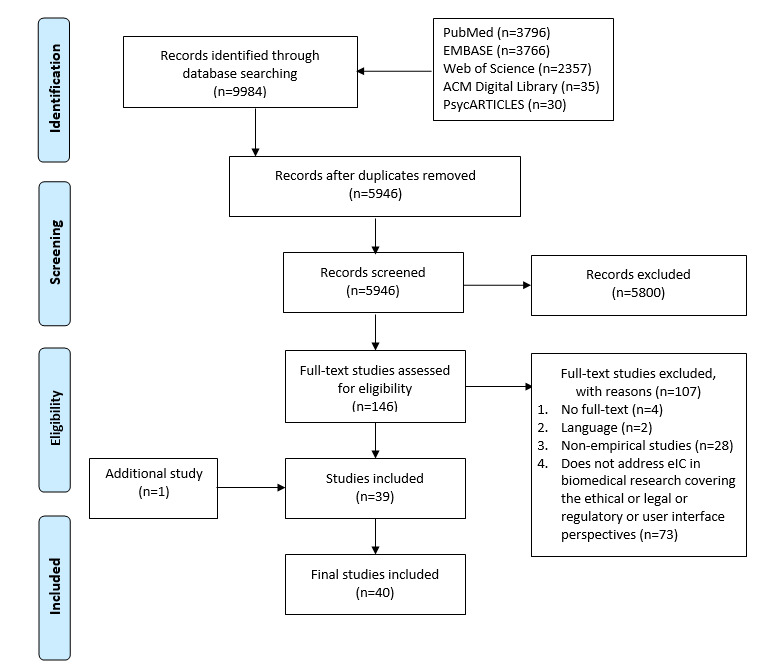
We conducted a systematic literature search using Web of Science (Core collection), PubMed, EMBASE, ACM Digital Library, and PsycARTICLES. PRISMA (Preferred Reporting Items for Systematic Reviews and Meta-Analyses) guidelines were used for reporting this work. We included empirical full-text studies focusing on the concept of electronic informed consent in biomedical research covering the ethical, legal, regulatory, and user interface domains. Studies written in English and published from January 2010 onward were selected. We explored perspectives of different stakeholder groups, in particular researchers, research participants, health authorities, and ethics committees. We critically appraised literature included in the systematic review using the Newcastle-Ottawa scale for cohort and cross-sectional studies, Critical Appraisal Skills Programme for qualitative studies, Mixed Methods Appraisal Tool for mixed methods studies, and Jadad tool for randomized controlled trials.
A total of 40 studies met our inclusion criteria. Overall, the studies were heterogeneous in the type of study design, population, intervention, research context, and the tools used. Most of the studies' populations were research participants (ie, patients and healthy volunteers). The majority of studies addressed barriers to achieving adequate understanding when using electronic informed consent. Concerns shared by multiple stakeholder groups were related to the security and legal validity of an electronic informed consent platform and usability for specific groups of research participants.
Electronic informed consent has the potential to improve the informed consent process in biomedical research compared to the current paper-based consent. The ethical, legal, regulatory, and user interface perspectives outlined in this review might serve to enhance the future implementation of electronic informed consent.
PROSPERO International Prospective Register of Systematic Reviews CRD42020158979; https://www.crd.york.ac.uk/prospero/display_record.php?RecordID=158979.
知情同意是生物医学研究的关键要素之一。电子知情同意的引入可以是克服与基于纸张的知情同意相关的许多挑战的一种方式; 然而,由于存在若干障碍,其新颖的机会在很大程度上仍未得到实现。
我们旨在提供对多个利益相关者群体的伦理、法律、监管和用户界面观点的概述,以协助在生物医学研究中负责任地实施电子知情同意。
我们使用 Web of Science(核心集)、PubMed、EMBASE、ACM 数字图书馆和 PsycARTICLES 进行了系统文献搜索。本研究报告遵循 PRISMA(系统评价和荟萃分析的首选报告项目)指南。我们纳入了关注生物医学研究中电子知情同意概念的实证全文研究,涵盖伦理、法律、监管和用户界面领域。选择以英文撰写且发表于 2010 年 1 月以后的研究。我们探讨了不同利益相关者群体的观点,特别是研究人员、研究参与者、卫生当局和伦理委员会。我们使用纽卡斯尔-渥太华量表(针对队列和横断面研究)、批判性评估技能计划(针对定性研究)、混合方法评估工具(针对混合方法研究)和 Jadad 工具(针对随机对照试验)对系统评价中纳入的文献进行了批判性评估。
共有 40 项研究符合我们的纳入标准。总体而言,这些研究在研究设计类型、人群、干预措施、研究背景和使用的工具方面存在异质性。大多数研究的人群是研究参与者(即患者和健康志愿者)。大多数研究涉及使用电子知情同意时难以实现充分理解的障碍。多个利益相关者群体共同关注的问题与电子知情同意平台的安全性和法律有效性以及特定研究参与者群体的可用性有关。
与当前基于纸张的同意相比,电子知情同意有可能改善生物医学研究中的知情同意过程。本综述中概述的伦理、法律、监管和用户界面观点可能有助于增强电子知情同意的未来实施。
PROSPERO 国际前瞻性系统评价注册库 CRD42020158979; https://www.crd.york.ac.uk/prospero/display_record.php?RecordID=158979。