Department of Midwifery, Faculty of Nursing and Midwifery, Tabriz University of Medical Sciences, Tabriz, Iran.
Social Determinants of Health Research Center, Tabriz University of Medical Sciences, Tabriz, Iran.
BMC Womens Health. 2020 May 5;20(1):94. doi: 10.1186/s12905-020-00947-1.
Breastfeeding is one of the most important interfering factors in infants' health. Monitoring mothers' performance and providing them with the feedback helps to increase their self-efficacy, interest in learning, and level of performance. The present research evaluates the effect of prenatal counseling on the breastfeeding self-efficacy and frequency of breastfeeding problems in mothers with previous unsuccessful breastfeeding.
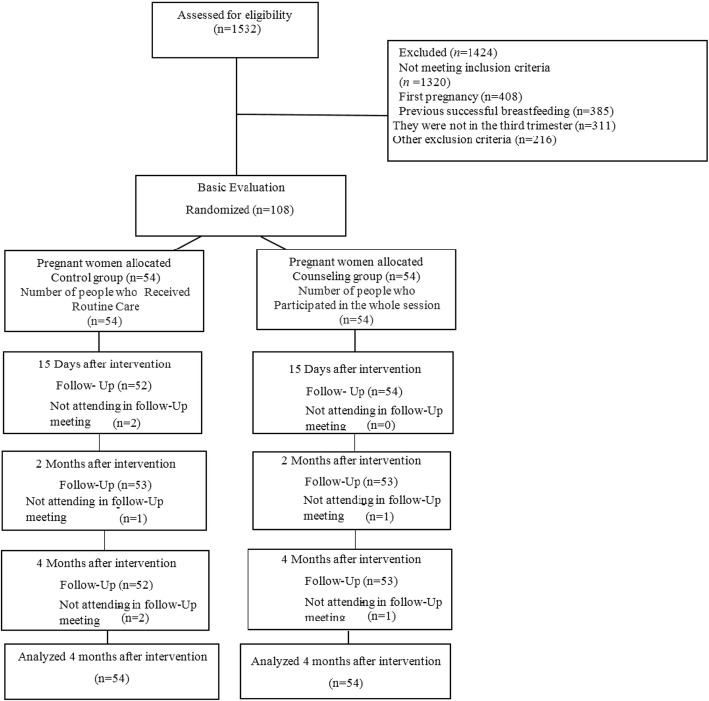
This randomized controlled clinical trial was conducted on 108 pregnant women with unsuccessful breastfeeding in Tabriz health centers during 2017-2018. The participants were randomly assigned to intervention and control groups. The intervention group had four prenatal counseling sessions and the controls only received routine care. Then, the mothers who gave birth to their children received a counseling session up to 4 months after the delivery. The Breastfeeding Self-Efficacy (BSES) questionnaire and the frequency of breast feeding problems checklist on the 15th day, and 2nd and 4th month were completed both by the intervention and control groups.
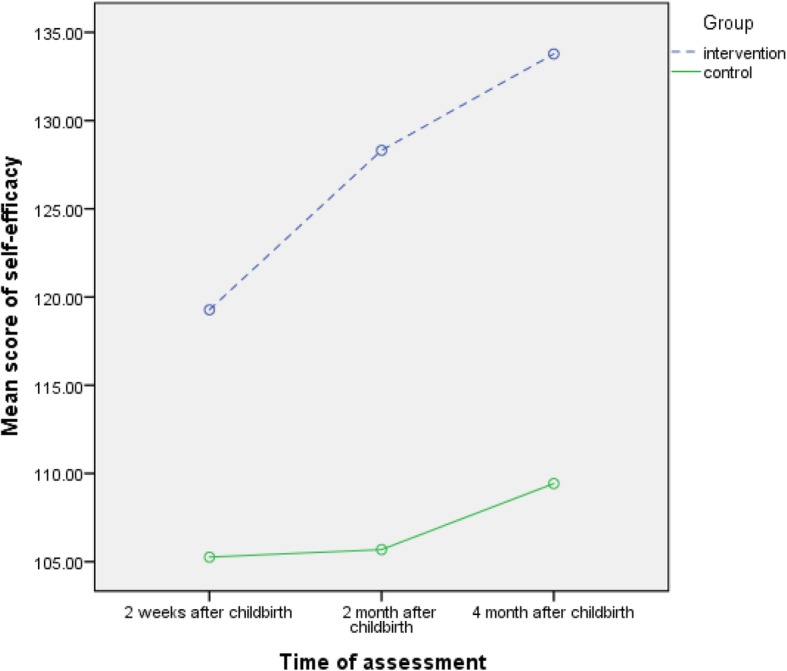
The mean (SD) of breastfeeding self-efficacy was 119.3 (10.5), 128.3 (8.3) and 133.8 (10.3) in the intervention group and 105.3 (16.1), 105.7 (19.7) and 109.4 (24.7) in the control group on the 15th day, 2nd and 4th month after the delivery, respectively. There was a significant difference in terms of breastfeeding self-efficacy between intervention and control group on the 15th day (p < 0.001), and 2nd (p < 0.001) and 4th (p < 0.001) month after the delivery. The frequency of breastfeeding problems on the 15th (p = 0.008), 2nd (p < 0.001) and 4th (p < 0.001) after the delivery was significantly different in most cases of the intervention group when compared to the controls.
The results indicated that prenatal counseling can increase mothers' breastfeeding self-efficacy and solves most breastfeeding problems during postpartum period.
IRCT20100109003027N19.
母乳喂养是影响婴儿健康的最重要的干预因素之一。监测母亲的表现并为其提供反馈有助于提高她们的自我效能感、学习兴趣和表现水平。本研究评估了产前咨询对有既往母乳喂养失败史的母亲母乳喂养自我效能感和母乳喂养问题频率的影响。
本随机对照临床试验于 2017-2018 年在大不里士卫生中心对 108 名母乳喂养失败的孕妇进行,参与者被随机分配到干预组和对照组。干预组进行了 4 次产前咨询,而对照组仅接受常规护理。然后,在分娩后 4 个月内,给分娩后的母亲进行一次咨询。干预组和对照组均在第 15 天、第 2 个月和第 4 个月完成母乳喂养自我效能(BSES)问卷和母乳喂养问题频率检查表。
干预组在第 15 天、第 2 个月和第 4 个月的母乳喂养自我效能均值(SD)分别为 119.3(10.5)、128.3(8.3)和 133.8(10.3),对照组分别为 105.3(16.1)、105.7(19.7)和 109.4(24.7)。在第 15 天(p<0.001)、第 2 个月(p<0.001)和第 4 个月(p<0.001),干预组和对照组之间的母乳喂养自我效能存在显著差异。在第 15 天(p=0.008)、第 2 个月(p<0.001)和第 4 个月(p<0.001),干预组的母乳喂养问题频率在大多数情况下与对照组相比均有显著差异。
结果表明,产前咨询可以提高母亲的母乳喂养自我效能感,并在产后解决大多数母乳喂养问题。
IRCT20100109003027N19。