
参与中低收入国家母婴和幼儿营养活动的家庭成员:系统范围审查。
Engaging family members in maternal, infant and young child nutrition activities in low- and middle-income countries: A systematic scoping review.
机构信息
Department of Nutrition, Gillings School of Global Public Health, University of North Carolina at Chapel Hill, Chapel Hill, North Carolina, USA.
Carolina Population Center, University of North Carolina at Chapel Hill, Chapel Hill, North Carolina, USA.
出版信息
Matern Child Nutr. 2021 Jul;17 Suppl 1(Suppl 1):e13158. doi: 10.1111/mcn.13158.
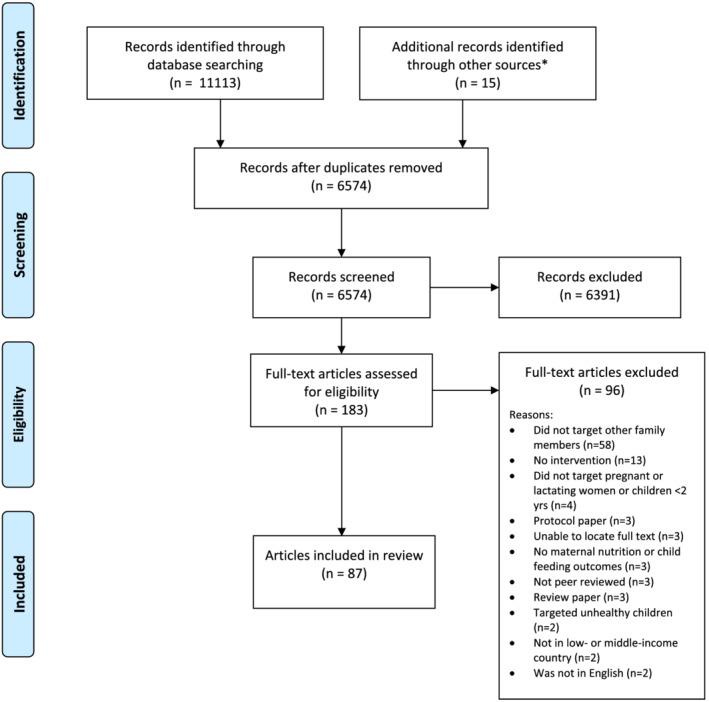
The influence of fathers, grandmothers and other family members on maternal, infant and young child nutrition practices has been well documented for decades, yet many social and behavioural interventions continue to reach only mothers. While recent guidelines recommend involving fathers, grandmothers and other family members in maternal and child nutrition, we lack a comprehensive review of interventions that have engaged them. This scoping review aimed to address this gap by describing social and behavioural interventions to engage family members in maternal and child nutrition in low- and middle-income countries. We systematically searched PubMed, Scopus, Web of Science, Global Health and CINAHL for peer-reviewed studies meeting inclusion criteria. We screened 6,570 abstracts, evaluated 179 full-text articles, and included 87 articles from 63 studies. Studies reported a broad range of approaches to engage fathers, grandmothers and other family members to support maternal nutrition (n = 6); breastfeeding (n = 32); complementary feeding (n = 6) and multiple maternal and child nutrition practices (n = 19). Interventions were facility and community based; included individual and group-based interpersonal communication, community mobilization, mass media and mHealth; and reached mothers and family members together or separately. Most interventions were located within the health sector; rare exceptions included nutrition-sensitive agriculture, social protection, early child development and community development interventions. Few interventions addressed gender norms, decision-making, and family dynamics or described formative research or theories informing intervention design. These diverse studies can shed light on innovative programme approaches to increase family support for maternal and child nutrition.
几十年来,父亲、祖母和其他家庭成员对孕产妇、婴儿和幼儿营养实践的影响已经有了充分的记录,但许多社会和行为干预措施仍然只针对母亲。虽然最近的指南建议让父亲、祖母和其他家庭成员参与孕产妇和儿童营养,但我们缺乏对参与其中的干预措施的全面审查。本范围审查旨在通过描述在中低收入国家让家庭成员参与孕产妇和儿童营养的社会和行为干预措施来解决这一差距。我们系统地在 PubMed、Scopus、Web of Science、全球卫生和 CINAHL 中搜索符合纳入标准的同行评审研究。我们筛选了 6570 篇摘要,评估了 179 篇全文文章,并从 63 项研究中纳入了 87 篇文章。这些研究报告了广泛的方法来让父亲、祖母和其他家庭成员参与支持孕产妇营养(n=6);母乳喂养(n=32);补充喂养(n=6)和多种孕产妇和儿童营养实践(n=19)。干预措施是基于机构和社区的;包括个人和小组人际沟通、社区动员、大众媒体和移动健康;并将母亲和家庭成员一起或分别纳入其中。大多数干预措施都在卫生部门内进行;极少数例外包括营养敏感型农业、社会保护、幼儿发展和社区发展干预措施。很少有干预措施涉及性别规范、决策和家庭动态,或描述形成性研究或为干预设计提供信息的理论。这些多样化的研究可以揭示创新的方案方法,以增加家庭对孕产妇和儿童营养的支持。


 Zotero 插件