National Centre for Immunisation Research and Surveillance, The Children's Hospital at Westmead and The University of Sydney, Sydney, New South Wales, Australia.
Department of Family and Community Medicine, Faculty of Medicine in Rabigh, King Abdulaziz University, Jeddah, Saudi Arabia.
PLoS One. 2020 Oct 13;15(10):e0240287. doi: 10.1371/journal.pone.0240287. eCollection 2020.
In this large-scale cluster-randomized controlled trial (cRCT) we sought to assess the effectiveness of facemasks against viral respiratory infections.
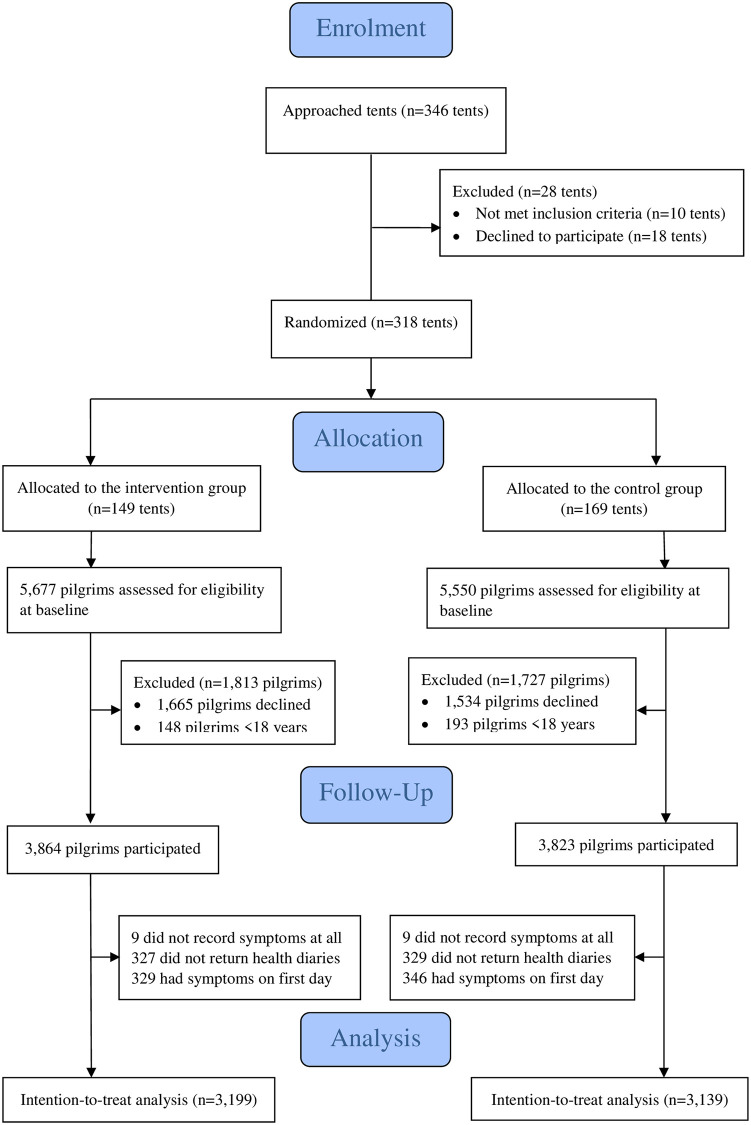
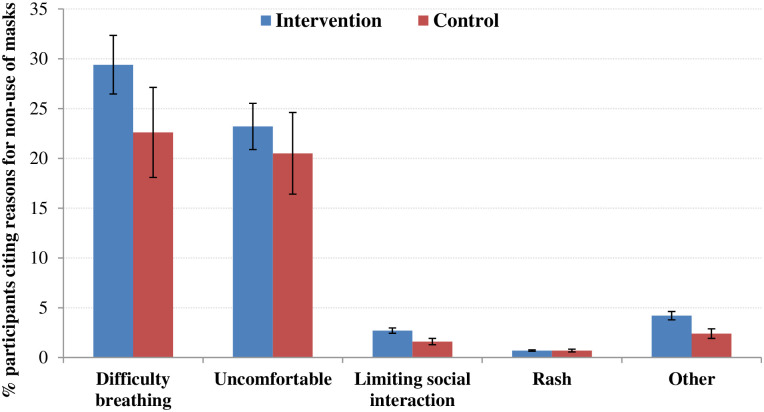
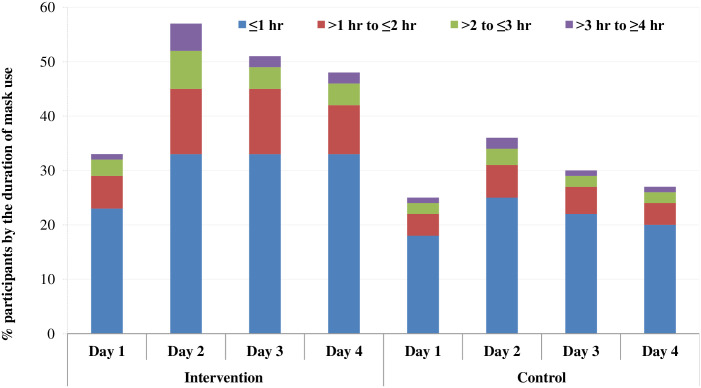
Over three consecutive Hajj seasons (2013, 2014, 2015) pilgrims' tents in Makkah were allocated to 'facemask' or 'no facemask' group. Fifty facemasks were offered to participants in intervention tents, to be worn over four days, and none were offered to participants in control tents. All participants recorded facemask use and respiratory symptoms in health diaries. Nasal swabs were collected from the symptomatic for virus detection by reverse transcription polymerase chain reaction. Clinical symptoms and laboratory results were analyzed by 'intention- to-treat' and 'per-protocol'. A total of 7687 adult participants from 318 tents were randomized: 3864 from 149 tents to the intervention group, and 3823 from 169 tents to the control group. Participants were aged 18 to 95 (median 34, mean 37) years, with a male to female ratio of 1:1.2. Overall, respiratory viruses were detected in 277 of 650 (43%) nasal/pharyngeal swabs collected from symptomatic pilgrims. Common viruses were rhinovirus (35.1%), influenza (4.5%) and parainfluenza (1.7%). In the intervention arm, respectively 954 (24.7%) and 1842 (47.7%) participants used facemasks daily and intermittently, while in the control arm, respectively 546 (14.3%) and 1334 (34.9%) used facemasks daily and intermittently. By intention-to-treat analysis, facemask use did not seem to be effective against laboratory-confirmed viral respiratory infections (odds ratio [OR], 1.4; 95% confidence interval [CI], 0.9 to 2.1, p = 0.18) nor against clinical respiratory infection (OR, 1.1; 95% CI, 0.9 to 1.4, p = 0.40). Similarly, in a per-protocol analysis, facemask use did not seem to be effective against laboratory-confirmed viral respiratory infections (OR 1.2, 95% CI 0.9-1.7, p = 0.26) nor against clinical respiratory infection (OR 1.3, 95% CI 1.0-1.8, p = 0.06).
This trial was unable to provide conclusive evidence on facemask efficacy against viral respiratory infections most likely due to poor adherence to protocol.
在这项大规模的整群随机对照试验(cRCT)中,我们旨在评估口罩预防病毒呼吸道感染的效果。
在连续三个朝觐季节(2013 年、2014 年、2015 年)中,麦加的朝圣者帐篷被分配到“口罩”或“无口罩”组。在干预帐篷中向参与者提供了 50 个口罩,要求他们在四天内佩戴,而在对照帐篷中则不提供口罩。所有参与者都在健康日记中记录口罩使用情况和呼吸道症状。从有症状的参与者中采集鼻拭子,通过逆转录聚合酶链反应检测病毒。临床症状和实验室结果采用“意向治疗”和“方案治疗”进行分析。共有 318 个帐篷中的 7687 名成年参与者被随机分组:149 个帐篷中的 3864 名参与者被分配到干预组,169 个帐篷中的 3823 名参与者被分配到对照组。参与者年龄在 18 至 95 岁之间(中位数 34 岁,平均 37 岁),男女比例为 1:1.2。总的来说,在采集的 650 份有症状朝圣者的鼻/咽拭子中,有 277 份(43%)检测到呼吸道病毒。常见的病毒是鼻病毒(35.1%)、流感(4.5%)和副流感(1.7%)。在干预组中,分别有 954 名(24.7%)和 1842 名(47.7%)参与者每天和间歇性使用口罩,而在对照组中,分别有 546 名(14.3%)和 1334 名(34.9%)参与者每天和间歇性使用口罩。通过意向治疗分析,口罩的使用似乎对实验室确诊的病毒性呼吸道感染(比值比 [OR],1.4;95%置信区间 [CI],0.9 至 2.1,p = 0.18)或临床呼吸道感染(OR,1.1;95% CI,0.9 至 1.4,p = 0.40)均无效果。同样,在方案治疗分析中,口罩的使用似乎对实验室确诊的病毒性呼吸道感染(OR 1.2,95% CI 0.9-1.7,p = 0.26)或临床呼吸道感染(OR 1.3,95% CI 1.0-1.8,p = 0.06)均无效果。
本试验未能提供口罩对病毒性呼吸道感染有效性的确凿证据,可能主要是由于对方案的依从性差。