Science Experiment Center, China Medical University, 77 Puhe Road, Shenyang North New Area, Liaoning, 110122, Shenyang, China.
Department of Radiation Therapy, The First Hospital, China Medical University, 518 Chuangxin Road, Hunnan District, Shenyang, 110167, Liaoning, China.
BMC Cancer. 2020 Oct 14;20(1):996. doi: 10.1186/s12885-020-07509-6.
Angiogenesis is important for the progression of gastric cancer (GC). Y-box binding protein 1 (YB-1) predicts advanced disease and indicates neovasculature formation in GC tissues, while the related mechanisms remain elusive. Exosomes mediate intercellular communications via transferring various molecules including proteins, lipids, mRNAs, and microRNAs, while the cargos of GC exosomes and the related mechanisms in GC angiogenesis were rarely reported except for several microRNAs.
In this study, human umbilical vein endothelial cells (HUVECs) were, respectively, treated by the exosomes isolated from the YB-1 transfected and the control SGC-7901 cells (SGC-7901-OE-Exo and SGC-7901-NC-Exo), and their apoptosis, proliferation, migration, invasion, and angiogenesis were, sequentially, compared. The levels of angiogenic factors including VEGF, Ang-1, MMP-9 and IL-8 in the exosome-treated HUVECs and the GC-derived exosomes were, separately, detected using PCR and Western blotting as well as RNA sequencing assays.
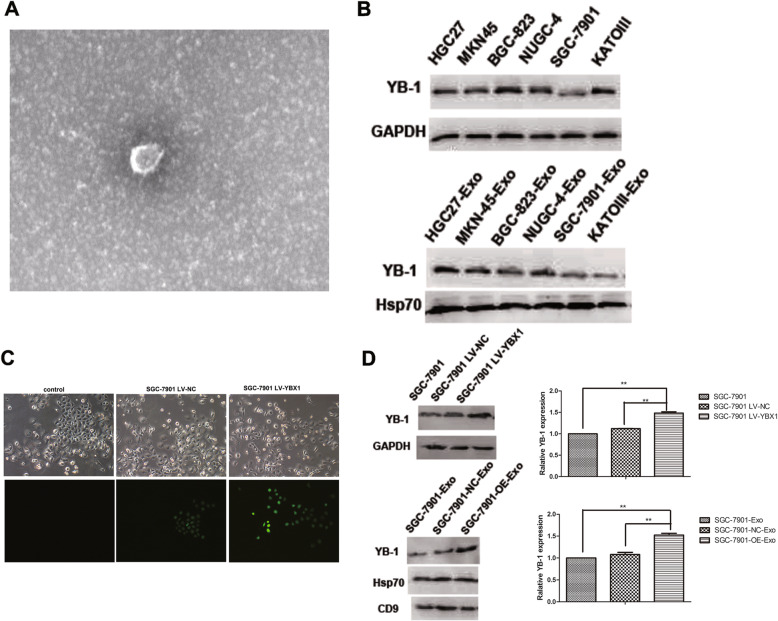
We observed the consistent level of YB-1 in the exosomes and their originated GC cells, and the internalization of exosomes into HUVECs. Comparing with SGC-7901-NC-Exo, SGC-7901-OE-Exo significantly inhibited the apoptosis but promoted the proliferation, migration, invasion, and angiogenesis of HUVECs, within which the increased mRNA and protein levels of VEGF, Ang-1, MMP-9 and IL-8 were demonstrated. Meanwhile, mRNA levels of VEGF, Ang-1, MMP-9 and IL-8 showed no significant difference between SGC-7901-NC-Exo and SGC-7901-OE-Exo, although statistically higher mRNA of YB-1 was detected in the SGC-7901-OE-Exo.
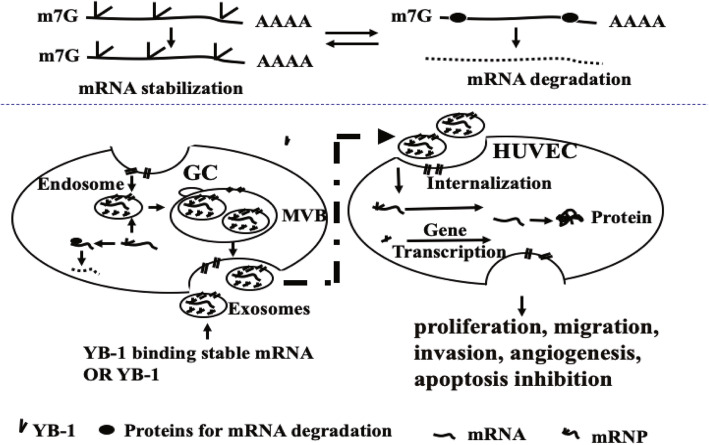
Our findings illustrate YB-1 as the key component of exosome to promote GC angiogenesis by upregulating specific angiogenic factors in the exosome-treated endothelial cells but not in the exosomes themselves.
血管生成对于胃癌(GC)的进展很重要。Y 盒结合蛋白 1(YB-1)可预测疾病的进展,并表明 GC 组织中新生血管的形成,但其相关机制尚不清楚。外泌体通过传递各种分子(包括蛋白质、脂质、mRNA 和 microRNA)来介导细胞间通讯,而 GC 外泌体的 cargo 及其在 GC 血管生成中的相关机制除了几种 microRNA 外,很少有报道。
在这项研究中,分别用转染 YB-1 的 SGC-7901 细胞(SGC-7901-OE-Exo 和 SGC-7901-NC-Exo)分离的外泌体处理人脐静脉内皮细胞(HUVECs),并依次比较它们的凋亡、增殖、迁移、侵袭和血管生成。使用 PCR、Western blot 和 RNA 测序检测外泌体处理的 HUVECs 和 GC 来源的外泌体中血管生成因子(包括 VEGF、Ang-1、MMP-9 和 IL-8)的水平。
我们观察到外泌体及其起源的 GC 细胞中 YB-1 的水平一致,并且外泌体被内化到 HUVECs 中。与 SGC-7901-NC-Exo 相比,SGC-7901-OE-Exo 显著抑制了 HUVECs 的凋亡,但促进了其增殖、迁移、侵袭和血管生成,其中 VEGF、Ang-1、MMP-9 和 IL-8 的 mRNA 和蛋白水平均升高。同时,SGC-7901-NC-Exo 和 SGC-7901-OE-Exo 之间的 VEGF、Ang-1、MMP-9 和 IL-8 的 mRNA 水平没有显著差异,尽管在 SGC-7901-OE-Exo 中检测到 YB-1 的 mRNA 水平更高。
我们的研究结果表明,YB-1 作为外泌体的关键成分,通过上调外泌体处理的内皮细胞中特定的血管生成因子来促进 GC 血管生成,而不是在外泌体本身中。