Chang Ying, Li Bo, Shi Qian, Geng Rui, Geng Shuaipeng, Liu Jinlei, Zhang Yuanyuan, Cai Yingfan
State Key Laboratory of Cotton Biology, Key Laboratory of Plant Stress Biology, School of Life Sciences, Henan University, Kaifeng, China.
Front Genet. 2020 Sep 11;11:788. doi: 10.3389/fgene.2020.00788. eCollection 2020.
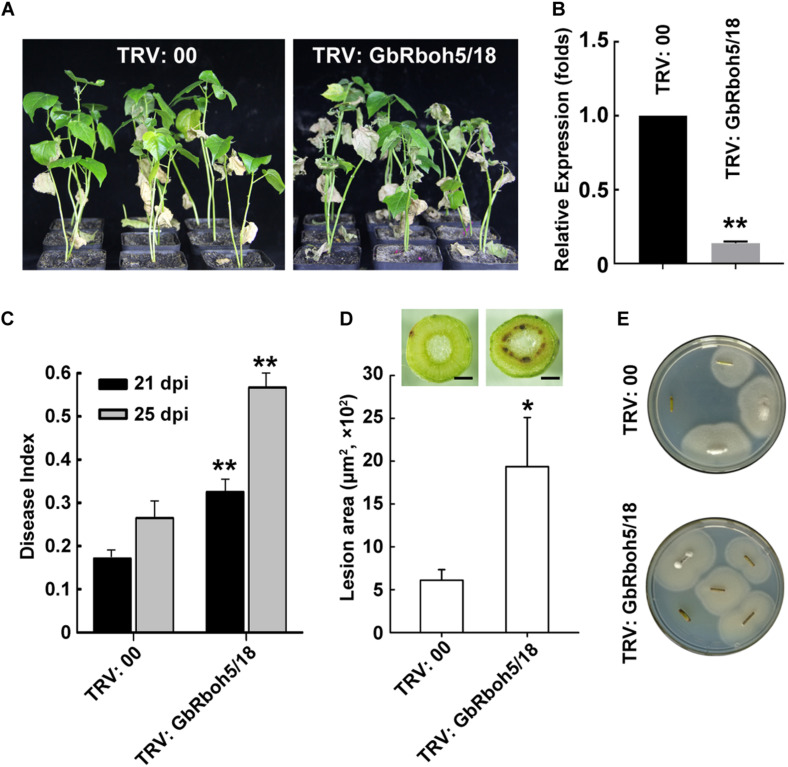
Respiratory burst oxidase homologs (Rbohs) play a predominant role in reactive oxygen species (ROS) production, which is crucial in plant growth, differentiation, as well as their responses to biotic and abiotic stresses. To date, however, there is little knowledge about the function of cotton genes. Here, we identified a total of 87 from five sequenced species (the diploids , , and , and the allotetraploids and ) via BLAST searching their genomes. Phylogenetic analysis of the putative 87 cotton revealed that they were divided into seven clades. All members within the same clade are generally similar to each other in terms of gene structure and conserved domain arrangement. In , the expression levels of in the CladeD were induced in response to a fungal pathogen and to hormones (i.e., jasmonic acid and abscisic acid), based upon which the main functional member in CladeD was discerned to be Further functional and physiological analyses showed that the knock-down of expression attenuates plant resistance to infection. Combined with the molecular and biochemical analyses, we found less ROS accumulation in plants than in control plants after infection. Overexpression of in resulted in more ROS accumulation than in control plants. These results suggest that enhances the cotton plants' resistance against by elevating the levels of ROS accumulation. By integrating phylogenetic, molecular, and biochemical approaches, this comprehensive study provides a detailed overview of the number, phylogeny, and evolution of the gene family from five sequenced species, as well as elucidating the function of for plant resistance against . This study sheds fresh light on the molecular evolutionary properties and function of genes in cotton, and provides a reference for improving cotton's responses to the pathogen .
呼吸爆发氧化酶同源物(Rbohs)在活性氧(ROS)产生中起主要作用,这在植物生长、分化以及它们对生物和非生物胁迫的反应中至关重要。然而,迄今为止,关于棉花基因的功能知之甚少。在这里,我们通过对五个已测序棉花物种(二倍体棉种雷蒙德氏棉、亚洲棉、瑟伯氏棉,以及异源四倍体陆地棉和海岛棉)的基因组进行BLAST搜索,共鉴定出87个(Rboh)基因。对推定的87个棉花Rboh基因进行系统发育分析表明,它们被分为七个进化枝。同一进化枝内的所有成员在基因结构和保守结构域排列方面通常彼此相似。在陆地棉中,进化枝D中的Rboh基因表达水平在受到真菌病原体和激素(即茉莉酸和脱落酸)刺激时被诱导,据此确定进化枝D中的主要功能成员为GhRbohD。进一步的功能和生理分析表明GhRbohD表达的敲低会减弱植物对病原菌的抗性。结合分子和生化分析,我们发现病原菌感染后,GhRbohD基因敲低的植株中ROS积累比对照植株少。在烟草中过表达GhRbohD导致ROS积累比对照植株多。这些结果表明,GhRbohD通过提高ROS积累水平增强了棉花植株对病原菌的抗性。通过整合系统发育、分子和生化方法,这项综合研究详细概述了五个已测序棉花物种中Rboh基因家族的数量、系统发育和进化,同时阐明了GhRbohD在植物抗病原菌方面的功能。这项研究为棉花中Rboh基因的分子进化特性和功能提供了新的线索,并为改善棉花对病原菌的反应提供了参考。