Attallah Omneya, Ragab Dina A, Sharkas Maha
Electronics and Communications Engineering Department, Arab Academy for Science, Technology, and Maritime Transport (AASTMT), Alexandria, Egypt.
PeerJ. 2020 Sep 30;8:e10086. doi: 10.7717/peerj.10086. eCollection 2020.
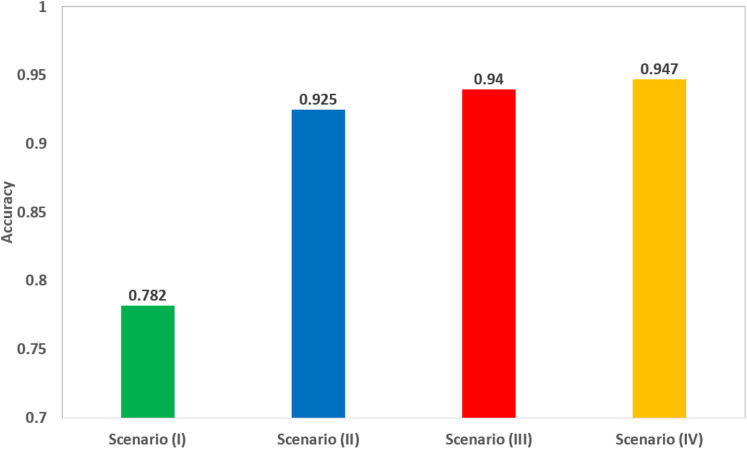
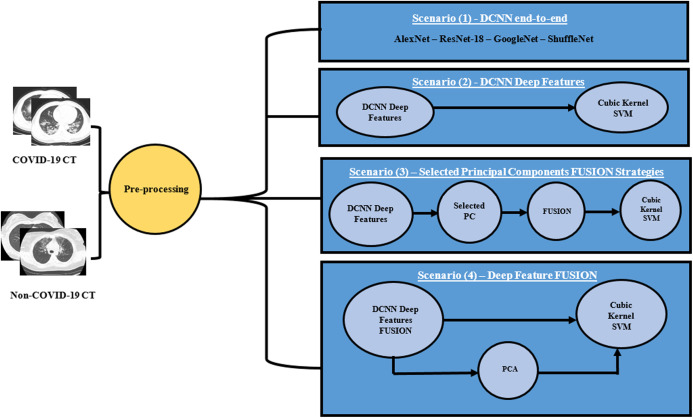
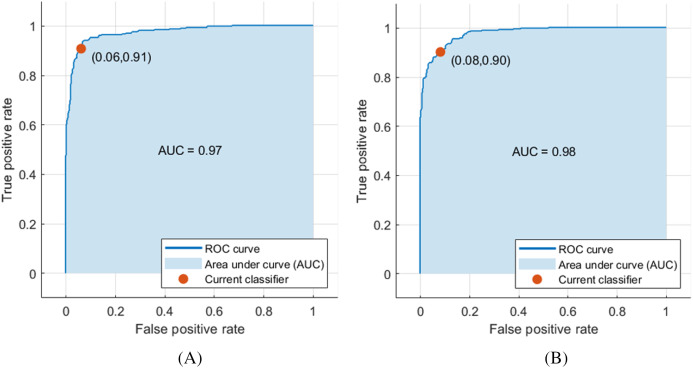
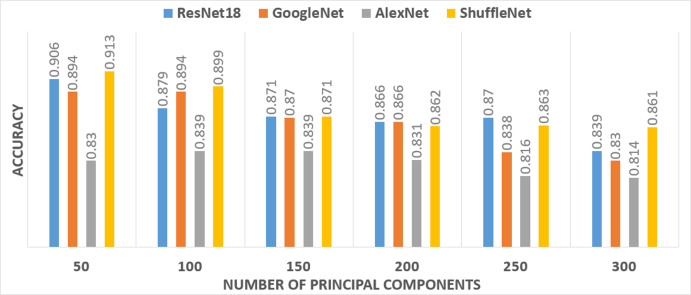
Coronavirus (COVID-19) was first observed in Wuhan, China, and quickly propagated worldwide. It is considered the supreme crisis of the present era and one of the most crucial hazards threatening worldwide health. Therefore, the early detection of COVID-19 is essential. The common way to detect COVID-19 is the reverse transcription-polymerase chain reaction (RT-PCR) test, although it has several drawbacks. Computed tomography (CT) scans can enable the early detection of suspected patients, however, the overlap between patterns of COVID-19 and other types of pneumonia makes it difficult for radiologists to diagnose COVID-19 accurately. On the other hand, deep learning (DL) techniques and especially the convolutional neural network (CNN) can classify COVID-19 and non-COVID-19 cases. In addition, DL techniques that use CT images can deliver an accurate diagnosis faster than the RT-PCR test, which consequently saves time for disease control and provides an efficient computer-aided diagnosis (CAD) system. The shortage of publicly available datasets of CT images, makes the CAD system's design a challenging task. The CAD systems in the literature are based on either individual CNN or two-fused CNNs; one used for segmentation and the other for classification and diagnosis. In this article, a novel CAD system is proposed for diagnosing COVID-19 based on the fusion of multiple CNNs. First, an end-to-end classification is performed. Afterward, the deep features are extracted from each network individually and classified using a support vector machine (SVM) classifier. Next, principal component analysis is applied to each deep feature set, extracted from each network. Such feature sets are then used to train an SVM classifier individually. Afterward, a selected number of principal components from each deep feature set are fused and compared with the fusion of the deep features extracted from each CNN. The results show that the proposed system is effective and capable of detecting COVID-19 and distinguishing it from non-COVID-19 cases with an accuracy of 94.7%, AUC of 0.98 (98%), sensitivity 95.6%, and specificity of 93.7%. Moreover, the results show that the system is efficient, as fusing a selected number of principal components has reduced the computational cost of the final model by almost 32%.
冠状病毒(COVID-19)最早在中国武汉被发现,并迅速在全球传播。它被认为是当今时代的最大危机,也是威胁全球健康的最关键危害之一。因此,COVID-19的早期检测至关重要。检测COVID-19的常用方法是逆转录聚合酶链反应(RT-PCR)检测,尽管它有几个缺点。计算机断层扫描(CT)扫描可以实现对疑似患者的早期检测,然而,COVID-19的影像特征与其他类型肺炎的影像特征存在重叠,这使得放射科医生难以准确诊断COVID-19。另一方面,深度学习(DL)技术,尤其是卷积神经网络(CNN),可以对COVID-19和非COVID-19病例进行分类。此外,使用CT图像的DL技术能够比RT-PCR检测更快地做出准确诊断,从而为疾病控制节省时间,并提供一个高效的计算机辅助诊断(CAD)系统。CT图像公开数据集的短缺使得CAD系统的设计成为一项具有挑战性的任务。文献中的CAD系统基于单个CNN或两个融合的CNN;一个用于分割,另一个用于分类和诊断。在本文中,提出了一种基于多个CNN融合的新型CAD系统来诊断COVID-19。首先,进行端到端分类。然后从每个网络中单独提取深度特征,并使用支持向量机(SVM)分类器进行分类。接下来,对从每个网络中提取的每个深度特征集应用主成分分析。然后使用这些特征集分别训练一个SVM分类器。之后,将从每个深度特征集中选择的一定数量的主成分进行融合,并与从每个CNN中提取的深度特征的融合结果进行比较。结果表明,所提出的系统是有效的,能够检测COVID-19并将其与非COVID-19病例区分开来,准确率为94.7%,曲线下面积(AUC)为0.98(98%),灵敏度为95.6%,特异性为93.7%。此外,结果表明该系统是高效的,因为融合一定数量的主成分使最终模型的计算成本降低了近32%。