Department of Pediatrics and Child Health, School of Medicine, College of Medicine and Health Science, University of Gondar, Gondar, Ethiopia.
Epidemiology and Biostatistics, Institute of Public Health, College of Medicine and Health Sciences, University of Gondar, Gondar, Ethiopia
BMJ Open. 2020 Oct 16;10(10):e036746. doi: 10.1136/bmjopen-2019-036746.
To determine the incidence and predictors of mortality among children admitted to the paediatric intensive care unit (PICU) at the University of Gondar comprehensive specialised hospital, northwest Ethiopia.
A single-centre prospective observational cohort study.
A total of 313 children admitted to the ICU of the University of Gondar comprehensive specialised hospital during a one-and-a-half-year period.
Data were collected using standard case record form, physical examination and patient document review. Clinical characteristics such as systolic blood pressure, pupillary light reflex, oxygen saturation and need for mechanical ventilation (MV) were assessed and documented within the first hour of admission and entered into an electronic application to calculate the modified Pediatric Index of Mortality 2 (PIM 2) Score. We fitted the Cox proportional hazards model to identify predictors of mortality.
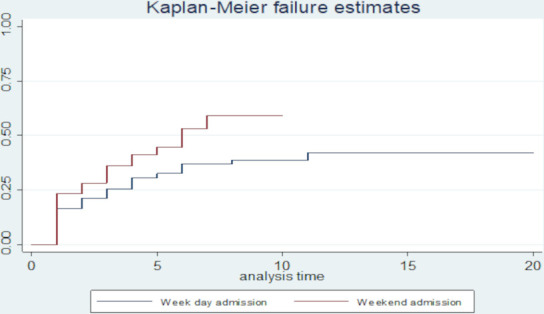
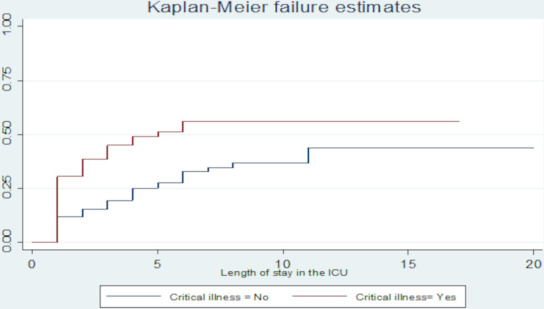
The median age at admission was 48 months with IQR: 12-122, 28.1% were infants and adolescents accounted for 21.4%. Of the total patients studied, 59.7% were males. The median observation time was 3 days with (IQR: 1-6). One hundred and two (32.6%) children died during the follow-up time, and the incidence of mortality was 6.9 deaths per 100 person-day observation. Weekend admission (adjusted HR (AHR)=1.63, 95% CI: 1.02 to 2.62), critical illness diagnoses (AHR=1.79, 95% CI: 1.13 to 2.85), need for MV (AHR=2.36, 95% CI: 1.39 to 4.01) and modified PIM 2 Score (AHR=1.53, 95% CI: 1.36 to 1.72) were the predictors of mortality.
The rate of mortality in the PICU was high, admission over weekends, need for MV, critical illness diagnoses and higher PIM 2 scores were significant and independent predictors of mortality.
确定在埃塞俄比亚西北部贡德尔大学综合专科医院儿科重症监护病房(PICU)入院儿童的死亡率及其预测因素。
单中心前瞻性观察队列研究。
在为期一年半的时间里,共有 313 名儿童入住贡德尔大学综合专科医院的 ICU。
使用标准病历表、体格检查和患者病历回顾收集数据。在入院后第一个小时内评估和记录临床特征,如收缩压、瞳孔光反射、氧饱和度和需要机械通气(MV),并将其输入电子应用程序以计算改良儿科死亡率 2 评分(PIM 2 评分)。我们拟合 Cox 比例风险模型以确定死亡率的预测因素。
中位入院年龄为 48 个月,IQR:12-122,28.1%为婴儿,青少年占 21.4%。在研究的总患者中,59.7%为男性。中位观察时间为 3 天,IQR:1-6。102 名(32.6%)儿童在随访期间死亡,死亡率为每 100 人日观察 6.9 例死亡。周末入院(调整后的 HR(AHR)=1.63,95%CI:1.02 至 2.62)、危重症诊断(AHR=1.79,95%CI:1.13 至 2.85)、需要 MV(AHR=2.36,95%CI:1.39 至 4.01)和改良 PIM 2 评分(AHR=1.53,95%CI:1.36 至 1.72)是死亡率的预测因素。
PICU 的死亡率很高,周末入院、需要 MV、危重症诊断和较高的 PIM 2 评分是死亡率的显著且独立的预测因素。