Department of Advanced Medical and Surgical Sciences, University of Campania "L. Vanvitelli", 80138 Naples, Italy.
Department of Experimental Medicine, Division of Pharmacology, University of Campania "L. Vanvitelli", 80138 Naples, Italy.
Int J Mol Sci. 2020 Oct 15;21(20):7615. doi: 10.3390/ijms21207615.
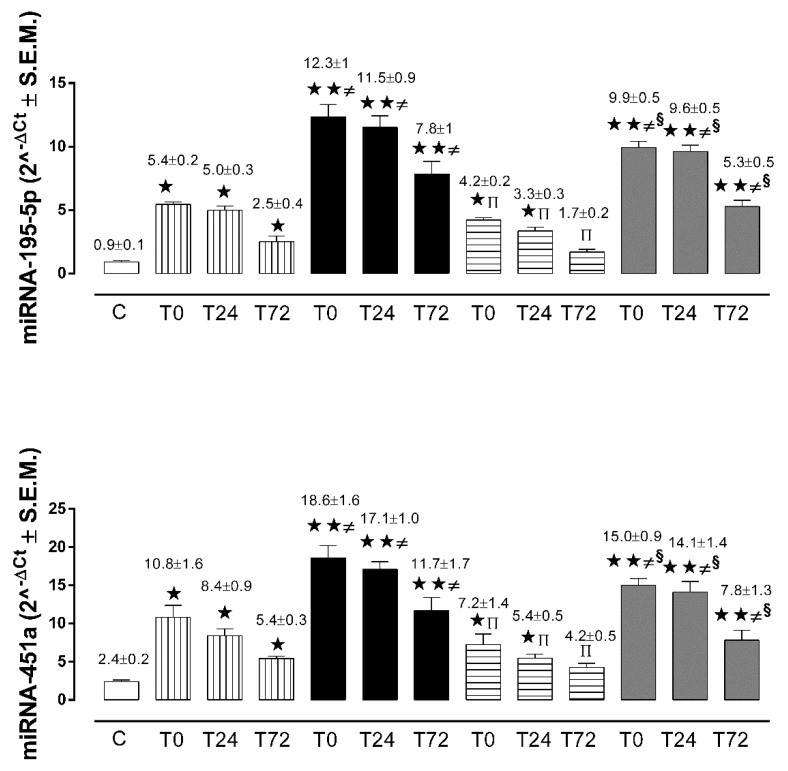
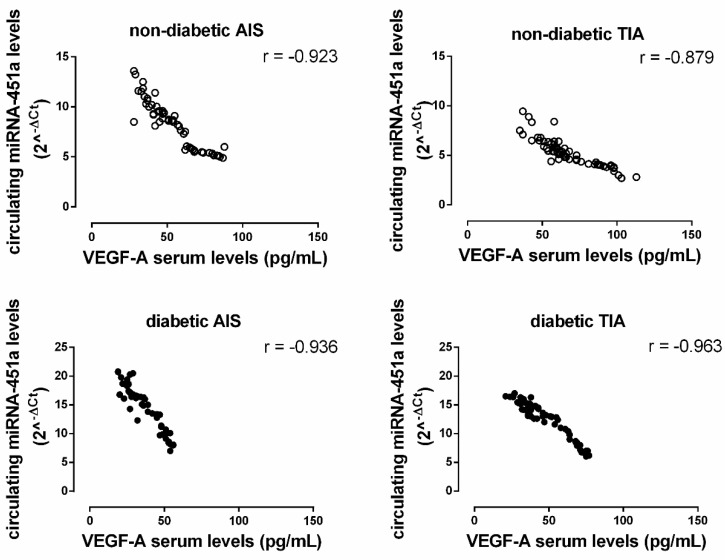
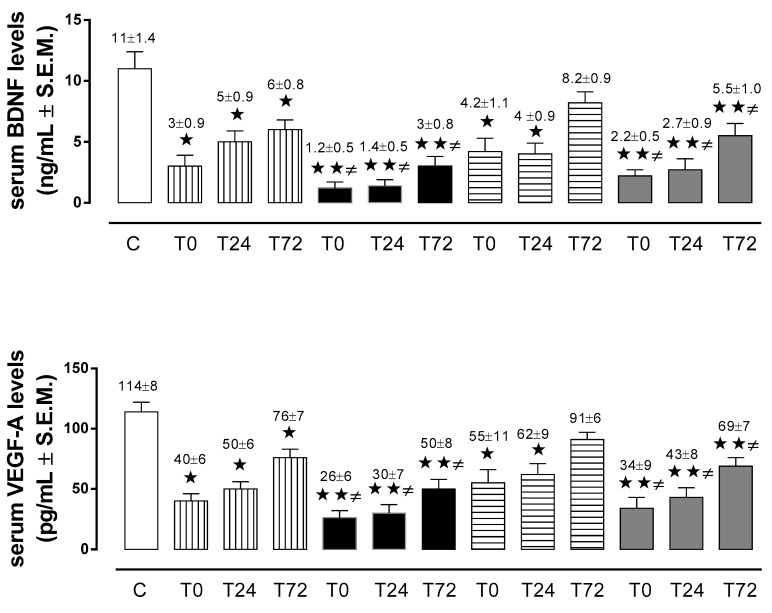
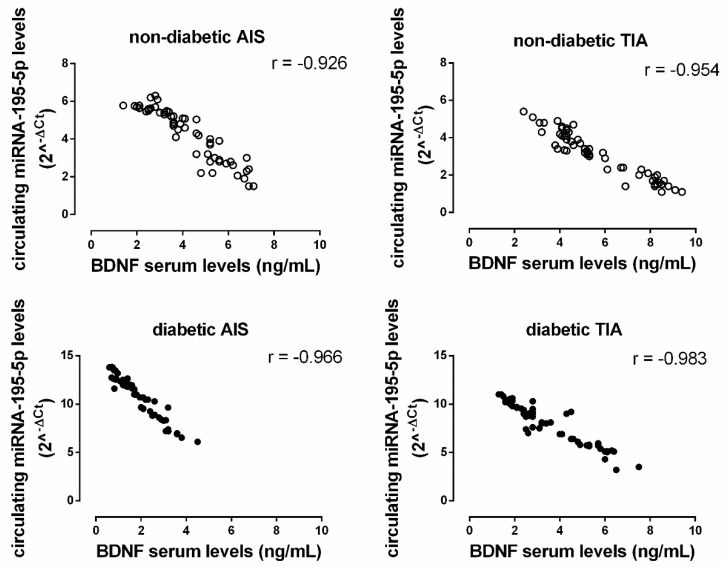
(1) Background: Circulating micro-RNAs (miRNAs) modulate the expression of molecules in diabetes. We evaluated the expression of serum miRNA-195-5p and -451a in diabetic patients with ischemic stroke and correlated them with two markers of brain tissue integrity. (2) Methods: Seventy-eight subjects with acute ischemic stroke (AIS) or transient ischemic attack (TIA) (40 with diabetes) were enrolled. Serum miRNA levels, brain-derived neurotrophic factor (BDNF) and vascular endothelial growth factor A (VEGF-A) were assessed at admission and 24 and 72 h after a post-ischemic stroke, and were compared to 20 controls. (3) Results: Both circulating miRNAs were two-fold up-regulated in diabetic AIS and TIA patients compared to non-diabetics. Their levels progressively decreased at 24 and 72 h in both AIS and TIA patients. Interestingly, in the non-diabetic TIA group, both circulating miRNAs, although higher than the controls, tended to achieve a complete decay after 72 h. Furthermore, miRNA-195-5p and miRNA-451a levels inversely correlated with both BDNF and VEGF-A serum levels. (4) Conclusions: These data show a different profile of both micro-RNAs in diabetic versus non-diabetic patients after acute ischemic stroke, suggesting their pivotal role in cerebrovascular ischemic attack.
(1) 背景:循环 microRNAs(miRNAs)调节糖尿病中分子的表达。我们评估了缺血性脑卒中糖尿病患者血清 miRNA-195-5p 和 -451a 的表达,并将其与两种脑组织完整性标志物相关联。
(2) 方法:共纳入 78 例急性缺血性脑卒中(AIS)或短暂性脑缺血发作(TIA)患者(40 例合并糖尿病)。在缺血后即刻以及 24 和 72 小时,评估血清 miRNA 水平、脑源性神经营养因子(BDNF)和血管内皮生长因子 A(VEGF-A),并与 20 例对照组进行比较。
(3) 结果:与非糖尿病患者相比,糖尿病 AIS 和 TIA 患者的两种循环 miRNA 均呈两倍上调。它们的水平在 AIS 和 TIA 患者中均在 24 和 72 小时逐渐下降。有趣的是,在非糖尿病 TIA 组中,尽管两种循环 miRNA 均高于对照组,但在 72 小时后趋于完全衰减。此外,miRNA-195-5p 和 miRNA-451a 的水平与 BDNF 和 VEGF-A 的血清水平呈负相关。
(4) 结论:这些数据表明,急性缺血性脑卒中后糖尿病患者与非糖尿病患者的两种 microRNAs 存在不同的特征,提示它们在脑血管缺血性攻击中具有关键作用。