Pôle gériatrie, Cité de la santé, Place Lange - TSA 60033, 31059, Toulouse Cedex 9, France.
INSERM UMR 1027, Toulouse, France; University of Toulouse III, Toulouse, France.
Alzheimers Res Ther. 2020 Oct 19;12(1):134. doi: 10.1186/s13195-020-00683-6.
The Multidomain Alzheimer Preventive Trial (MAPT) was designed to assess the efficacy of omega-3 fatty acid supplementation, multidomain intervention (MI), or a combination of both on cognition. Although the MAPT study was negative, an effect of MI in maintaining cognitive functions compared to placebo group was showed in positive amyloid subjects. A FDG PET study (MAPT-NI) was implemented to test the impact of MI on brain glucose metabolism.
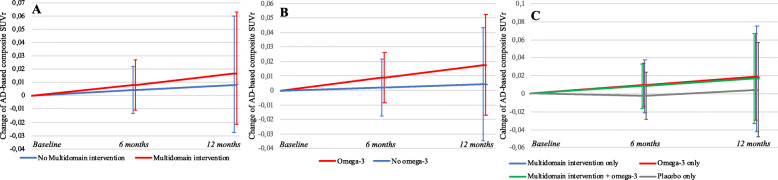
MAPT-NI was a randomized, controlled parallel-group single-center study, exploring the effect of MI on brain glucose metabolism. Participants were non-demented and had memory complaints, limitation in one instrumental activity of daily living, or slow gait. Participants were randomly assigned (1:1) to "MI group" or "No MI group." The MI consisted of group sessions focusing on 3 domains: cognitive stimulation, physical activity, nutrition, and a preventive consultation. [F]FDG PET scans were performed at baseline, 6 months, and 12 months, and cerebral magnetic resonance imaging scans at baseline. The primary objective was to evaluate the MI effect on brain glucose metabolism assessed by [F]FDG PET imaging at 6 months. The primary outcome was the quantification of regional metabolism rate for glucose in cerebral regions involved early in Alzheimer disease by relative semi-quantitative SUVr (FDG-based AD biomarker). An exploratory voxel-wise analysis was performed to assess the effect of MI on brain glucose metabolism without anatomical hypothesis.
The intention-to-treat population included 67 subjects (34 in the MI group and 33 in the No MI group. No significant MI effect was observed on primary outcome at 6 months. In the exploratory voxel-wise analysis, we observed a difference in favor of MI group on the change of cerebral glucose metabolism in limbic lobe (right hippocampus, right posterior cingulate, left posterior parahippocampal gyrus) at 6 months.
MI failed to show an effect on metabolism in FDG-based AD biomarker, but exploratory analysis suggested positive effect on limbic system metabolism. This finding could suggest a delay effect of MI on AD progression.
ClinicalTrials.gov Identifier, NCT01513252 .
多领域阿尔茨海默病预防试验(MAPT)旨在评估ω-3 脂肪酸补充剂、多领域干预(MI)或两者结合对认知的疗效。尽管 MAPT 研究结果为阴性,但在阳性淀粉样蛋白受试者中,MI 对维持认知功能的效果优于安慰剂组。实施了一项 FDG PET 研究(MAPT-NI),以测试 MI 对大脑葡萄糖代谢的影响。
MAPT-NI 是一项随机、对照、平行组的单中心研究,旨在探索 MI 对大脑葡萄糖代谢的影响。参与者为非痴呆且有记忆主诉、一项日常活动工具性能力受限或步态缓慢。参与者被随机分配(1:1)到“MI 组”或“无 MI 组”。MI 包括关注认知刺激、身体活动、营养和预防咨询三个领域的小组会议。在基线、6 个月和 12 个月进行 [F]FDG PET 扫描,并在基线时进行脑磁共振成像扫描。主要目标是评估 6 个月时 [F]FDG PET 成像评估的 MI 对大脑葡萄糖代谢的影响。主要结果是通过相对半定量 SUVr(基于 FDG 的 AD 生物标志物)量化阿尔茨海默病早期涉及的脑区的葡萄糖代谢率。进行了一项探索性的体素分析,在没有解剖学假设的情况下评估 MI 对大脑葡萄糖代谢的影响。
意向治疗人群包括 67 名受试者(MI 组 34 名,无 MI 组 33 名)。在 6 个月时,主要结局未见 MI 效应。在探索性的体素分析中,我们观察到 MI 组在 6 个月时大脑葡萄糖代谢的变化有利于边缘叶(右侧海马体、右侧后扣带回、左侧后旁海马回)。
MI 未能显示对 FDG 基于 AD 生物标志物的代谢的影响,但探索性分析表明对边缘系统代谢有积极影响。这一发现可能表明 MI 对 AD 进展有延迟作用。
ClinicalTrials.gov 标识符,NCT01513252。