Center of Excellence for Korsakoff and Alcohol-Related Cognitive Disorders, Vincent van Gogh Institute for Psychiatry, 5800 Venray, The Netherlands.
Nijmegen Institute for Scientist-Practitioners in Addiction (NISPA), Radboud University, 6500 Nijmegen, The Netherlands.
Alcohol Alcohol. 2021 Jan 4;56(1):89-100. doi: 10.1093/alcalc/agaa100.
In patients with a history of chronic alcohol abuse, neurocognitive disorders (NCD) are not uncommon. The current study aimed to explore the course of cognitive performance, as measured by the Montreal Cognitive Assessment (MoCA), and everyday cognitive functioning, as measured by the Patient Competency Rating Scale (PCRS), in a large group of patients with alcohol use disorder (AUD) admitted to the Center of Excellence for Korsakov and Alcohol-related Cognitive Impairments.
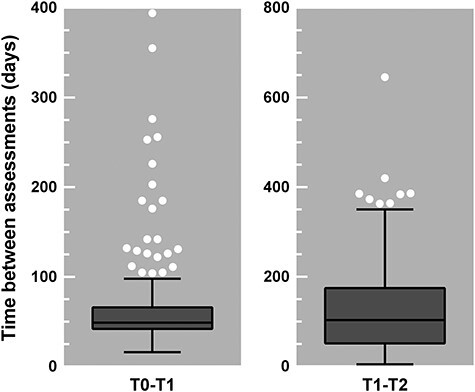
A multiple time-series design was used, in which the MoCA was administered at three time points of assessment, and the PCRS was completed by both the patient and a clinician at two time points, all during clinical treatment.
A total of 524 patients were included, 71 of whom were diagnosed with AUD only, 284 with AUD and mild NCD (ARCI) and 169 with AUD, major NCD and fulfilling criteria for Korsakoff's syndrome (KS).
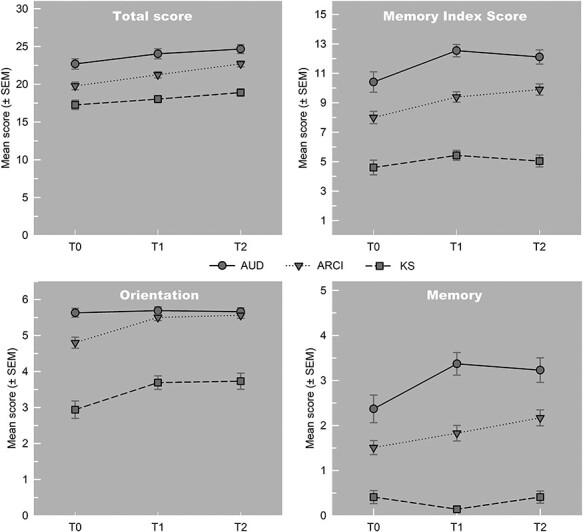
Cognitive performance improved for all three groups during treatment, sustained abstinence and recovery from AUD. A low memory performance on the MoCA without improvement over time was predictive for KS, while improvement on this domain did not differentiate between AUD and ARCI. Changes in overall cognitive performance and orientation in patients with KS were positively related to changes in everyday cognitive functioning.
在有慢性酒精滥用史的患者中,神经认知障碍(NCD)并不少见。本研究旨在探讨认知表现的变化,使用蒙特利尔认知评估(MoCA)进行测量,以及日常认知功能的变化,使用患者能力评定量表(PCRS)进行测量,在一个大型酒精使用障碍(AUD)患者群体中,这些患者被收入酒精相关认知障碍卓越中心。
使用多时间序列设计,在三个评估时间点进行 MoCA 测试,在两个时间点由患者和临床医生完成 PCRS,均在临床治疗期间进行。
共纳入 524 名患者,其中 71 名仅被诊断为 AUD,284 名 AUD 合并轻度 NCD(ARCI),169 名 AUD 合并重度 NCD 且符合柯萨科夫综合征(KS)的标准。
所有三组患者在治疗期间、持续戒断和 AUD 恢复期间认知表现均有所改善。MoCA 上的记忆表现较差且无随时间改善提示为 KS,而该领域的改善不能区分 AUD 和 ARCI。KS 患者整体认知表现和定向的变化与日常认知功能的变化呈正相关。