Internal Medicine, Landeskrankenhaus Hochzirl-Natters, Hochzirl 1, 6170, Zirl, Austria.
Department of Economics, University of Salzburg, 5010, Salzburg, Austria.
Wien Klin Wochenschr. 2021 Apr;133(7-8):331-335. doi: 10.1007/s00508-020-01754-2. Epub 2020 Oct 23.
Body temperature control is a frequently used screening test for infectious diseases, such as Covid-19 (Sars-CoV-2). We used this procedure to test the body temperature of staff members in a hospital in Tyrol (Austria), where the Covid-19 disease occurred in March 2020. The hospital is located in a mountain area at 995 m above sea level with low outdoor temperatures during early spring season. Under these conditions, we analyzed whether forehead temperature control offers a sufficient screening tool for infectious diseases.
Forehead temperature of 101 healthy male and female employees was measured with an infrared thermometer directly after entering the hospital (0 min), followed by further controls after 1 min, 3 min, 5 min and 60 min. We also tracked the outside temperature and the temperature at the entrance hall of the hospital.
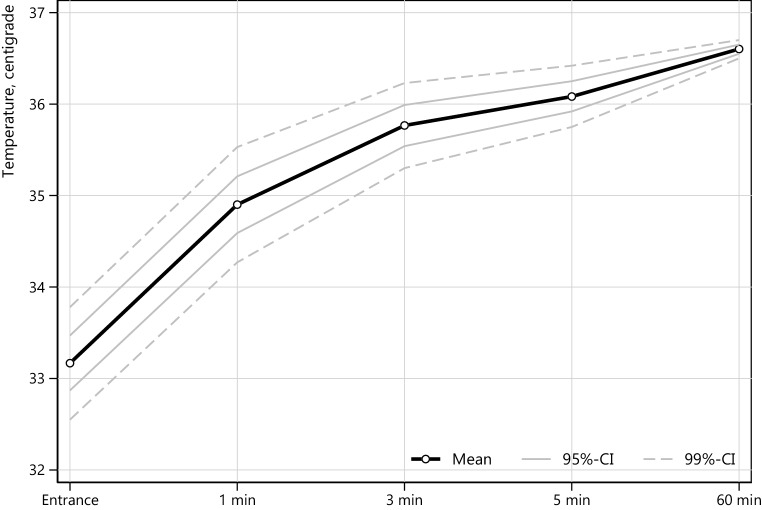
Complete data of body temperature were available for 46 female and 46 male study participants. The average forehead temperature measured directly after entrance to the hospital was the lowest (0 min) 33.17 ± 1.45 °C, and increased constantly to 34.90 ± 1.49 °C after 1 min, 35.77 ± 1.10 °C after 3 min, 36.08 ± 0.79 °C after 5 min, and 36.6 ± 0.24 °C after 60 min. The outside temperature ranged between -5.5 °C and 0 °C, the indoor temperature had a constant value of 20.5 °C.
Our results indicate that forehead infrared temperature control is not an appropriate tool to screen for infectious disease directly at the entrance of a building, at least during early spring season with cold outdoor temperatures.
体温控制是一种常用于筛查传染病的方法,例如新冠病毒(SARS-CoV-2)。我们使用该程序来测试 2020 年 3 月在奥地利蒂罗尔(Tyrol)一家医院的员工体温,该医院所在地区在早春时节室外温度较低。在这些条件下,我们分析了额温测量是否可以作为传染病的充分筛查工具。
用红外体温计直接测量 101 名健康男、女员工进入医院时的额温(0 分钟),随后在 1 分钟、3 分钟、5 分钟和 60 分钟时进行进一步的测量。我们还记录了室外温度和医院入口大厅的温度。
46 名女性和 46 名男性研究参与者的体温数据完整。直接进入医院后测量的平均额温最低(0 分钟),为 33.17±1.45°C,1 分钟后持续升高至 34.90±1.49°C,3 分钟后为 35.77±1.10°C,5 分钟后为 36.08±0.79°C,60 分钟后为 36.6±0.24°C。室外温度范围在-5.5°C 至 0°C 之间,室内温度恒定在 20.5°C。
我们的结果表明,在早春时节室外温度较低的情况下,额部红外体温控制不是在建筑物入口处筛查传染病的合适工具。