
利用驻波表面声波(SSAW)形成细胞球体。
Formation of cell spheroids using Standing Surface Acoustic Wave (SSAW).
作者信息
Sriphutkiat Yannapol, Kasetsirikul Surasak, Zhou Yufeng
机构信息
Singapore Centre for 3D Printing (SC3DP), School of Mechanical and Aerospace Engineering, Nanyang Technological University, Singapore.
出版信息
Int J Bioprint. 2017 Jan 17;4(1):130. doi: 10.18063/IJB.v4i1.130. eCollection 2018.
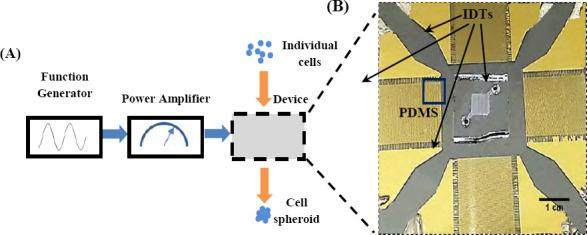
3D bioprinting becomes one of the popular approaches in the tissue engineering. In this emerging application, bioink is crucial for fabrication and functionality of constructed tissue. The use of cell spheroids as bioink can enhance the cell-cell interaction and subsequently the growth and differentiation of cells in the 3D printed construct with the minimum amount of other biomaterials. However, the conventional methods of preparing the cell spheroids have several limitations, such as long culture time, low-throughput, and medium modification. In this study, the formation of cell spheroids by SSAW was evaluated both numerically and experimentally in order to overcome the aforementioned limitations. The effects of excitation frequencies on the cell accumulation time, diameter of the formed cell spheroids, and subsequently, the growth and viability of cell spheroids in the culture medium over time were studied. Using the high-frequency (23.8 MHz) excitation, cell accumulation time to the pressure nodes could be reduced in comparison to that of the low-frequency (10.4 MHz) excitation, but in a smaller spheroid size. SSAW excitation at both frequencies does not affect the cell viability up to 7 days, > 90% with no statistical difference compared with the control group. In summary, SSAW can effectively prepare the cell spheroids as bioink for the future 3D bioprinting and various biotechnology applications ., pharmaceutical drug screening and tissue engineering).
3D生物打印成为组织工程中流行的方法之一。在这个新兴应用中,生物墨水对于构建组织的制造和功能至关重要。使用细胞球体作为生物墨水可以增强细胞间相互作用,进而在使用最少其他生物材料的情况下促进3D打印构建物中细胞的生长和分化。然而,传统的制备细胞球体的方法存在一些局限性,如培养时间长、通量低和培养基改性。在本研究中,为了克服上述局限性,对表面声波(SSAW)形成细胞球体进行了数值和实验评估。研究了激发频率对细胞聚集时间、形成的细胞球体直径以及随后细胞球体在培养基中随时间的生长和活力的影响。与低频(10.4 MHz)激发相比,使用高频(23.8 MHz)激发可减少细胞向压力节点的聚集时间,但形成的球体尺寸较小。两种频率的表面声波激发在长达7天的时间内均不影响细胞活力,与对照组相比,细胞活力>90%,无统计学差异。总之,表面声波可以有效地制备细胞球体作为生物墨水,用于未来的3D生物打印和各种生物技术应用(如药物筛选和组织工程)。



 Zotero 插件