Department of Molecular Biology and Genetics, Aarhus University, Aarhus, Denmark.
Department of Biomedicine, Aarhus University, Aarhus, Denmark.
EMBO Rep. 2020 Dec 3;21(12):e51252. doi: 10.15252/embr.202051252. Epub 2020 Oct 28.
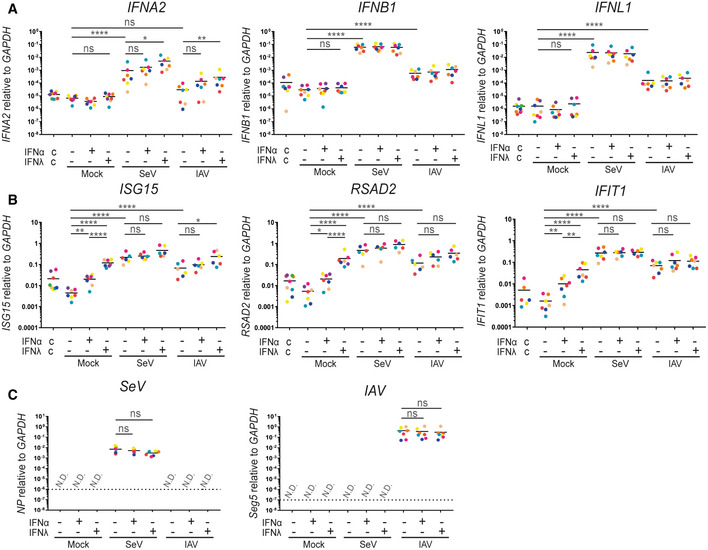
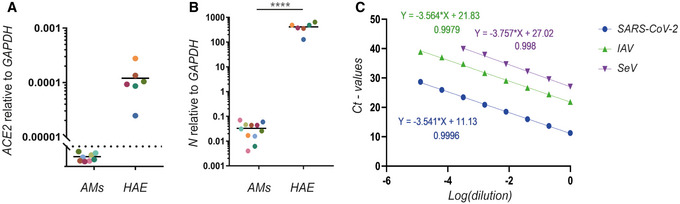
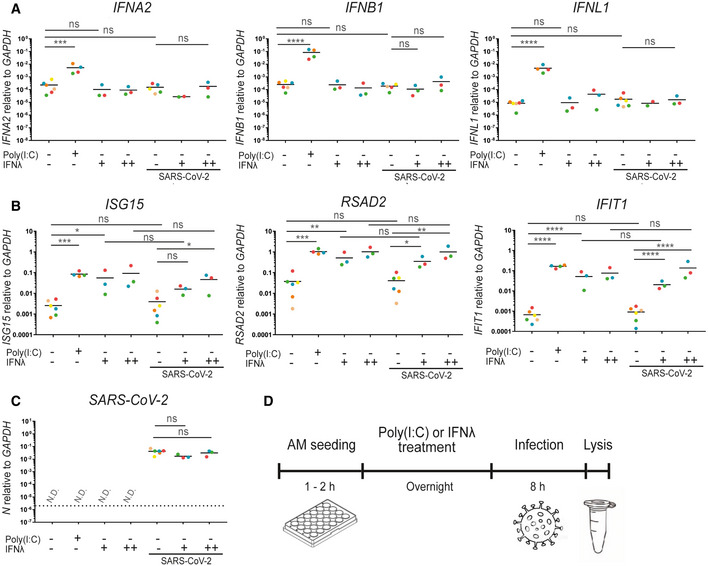
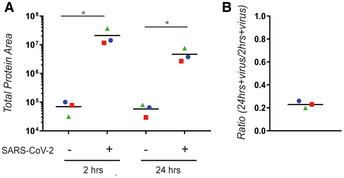
Respiratory infections, like the current COVID-19 pandemic, target epithelial cells in the respiratory tract. Alveolar macrophages (AMs) are tissue-resident macrophages located within the lung. They play a key role in the early phases of an immune response to respiratory viruses. AMs are likely the first immune cells to encounter SARS-CoV-2 during an infection, and their reaction to the virus will have a profound impact on the outcome of the infection. Interferons (IFNs) are antiviral cytokines and among the first cytokines produced upon viral infection. In this study, AMs from non-infectious donors are challenged with SARS-CoV-2. We demonstrate that challenged AMs are incapable of sensing SARS-CoV-2 and of producing an IFN response in contrast to other respiratory viruses, like influenza A virus and Sendai virus, which trigger a robust IFN response. The absence of IFN production in AMs upon challenge with SARS-CoV-2 could explain the initial asymptotic phase observed during COVID-19 and argues against AMs being the sources of pro-inflammatory cytokines later during infection.
呼吸道感染,如当前的 COVID-19 大流行,以呼吸道的上皮细胞为靶标。肺泡巨噬细胞(AMs)是位于肺部的组织驻留巨噬细胞。它们在呼吸道病毒的免疫反应的早期阶段发挥关键作用。AMs 很可能是在感染过程中首先遇到 SARS-CoV-2 的免疫细胞,它们对病毒的反应将对感染的结果产生深远影响。干扰素(IFNs)是抗病毒细胞因子,是病毒感染后产生的第一批细胞因子之一。在这项研究中,我们用 SARS-CoV-2 挑战非传染性供体的 AMs。我们证明,与其他呼吸道病毒(如甲型流感病毒和仙台病毒)相比,受挑战的 AMs 无法感知 SARS-CoV-2 并产生 IFN 反应,后两者会引发强烈的 IFN 反应。AMs 在受到 SARS-CoV-2 挑战时不产生 IFN 可能解释了 COVID-19 期间观察到的初始无症状期,并反对 AMs 是感染后期促炎细胞因子的来源。