• 文献检索
  • 文档翻译
  • 深度研究
  • 学术资讯
  • Suppr Zotero 插件Zotero 插件
  • 邀请有礼
  • 套餐&价格
  • 历史记录
应用&插件
Suppr Zotero 插件Zotero 插件浏览器插件Mac 客户端Windows 客户端微信小程序
定价
高级版会员购买积分包购买API积分包
服务
文献检索文档翻译深度研究API 文档MCP 服务
关于我们
关于 Suppr公司介绍联系我们用户协议隐私条款
关注我们

Suppr 超能文献

核心技术专利:CN118964589B侵权必究
粤ICP备2023148730 号-1Suppr @ 2026

文献检索

告别复杂PubMed语法,用中文像聊天一样搜索,搜遍4000万医学文献。AI智能推荐,让科研检索更轻松。

立即免费搜索

文件翻译

保留排版,准确专业,支持PDF/Word/PPT等文件格式,支持 12+语言互译。

免费翻译文档

深度研究

AI帮你快速写综述,25分钟生成高质量综述,智能提取关键信息,辅助科研写作。

立即免费体验

COVID-19大流行之前及期间拨打危机热线者的行为:定量数据分析

Behavior of Callers to a Crisis Helpline Before and During the COVID-19 Pandemic: Quantitative Data Analysis.

作者信息

Turkington Robin, Mulvenna Maurice, Bond Raymond, Ennis Edel, Potts Courtney, Moore Ciaran, Hamra Louise, Morrissey Jacqui, Isaksen Mette, Scowcroft Elizabeth, O'Neill Siobhan

机构信息

School of Computing, Ulster University, Newtownabbey, United Kingdom.

School of Psychology, Ulster University, Coleraine, United Kingdom.

出版信息

JMIR Ment Health. 2020 Nov 6;7(11):e22984. doi: 10.2196/22984.

DOI:10.2196/22984
PMID:33112759
原文链接:https://pmc.ncbi.nlm.nih.gov/articles/PMC7652595/
Abstract

BACKGROUND

The World Health Organization declared the outbreak of COVID-19 to be an international pandemic in March 2020. While numbers of new confirmed cases of the disease and death tolls are rising at an alarming rate on a daily basis, there is concern that the pandemic and the measures taken to counteract it could cause an increase in distress among the public. Hence, there could be an increase in need for emotional support within the population, which is complicated further by the reduction of existing face-to-face mental health services as a result of measures taken to limit the spread of the virus.

OBJECTIVE

The objective of this study was to determine whether the COVID-19 pandemic has had any influence on the calls made to Samaritans Ireland, a national crisis helpline within the Republic of Ireland.

METHODS

This study presents an analysis of calls made to Samaritans Ireland in a four-week period before the first confirmed case of COVID-19 (calls=41,648, callers=3752) and calls made to the service within a four-week period after a restrictive lockdown was imposed by the government of the Republic of Ireland (calls=46,043, callers=3147). Statistical analysis was conducted to explore any differences between the duration of calls in the two periods at a global level and at an hourly level. We performed k-means clustering to determine the types of callers who used the helpline based on their helpline call usage behavior and to assess the impact of the pandemic on the caller type usage patterns.

RESULTS

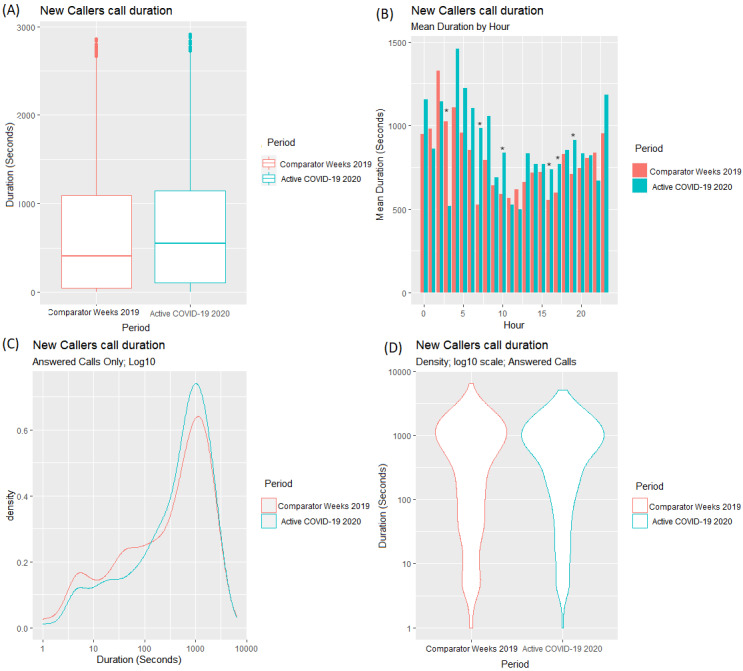
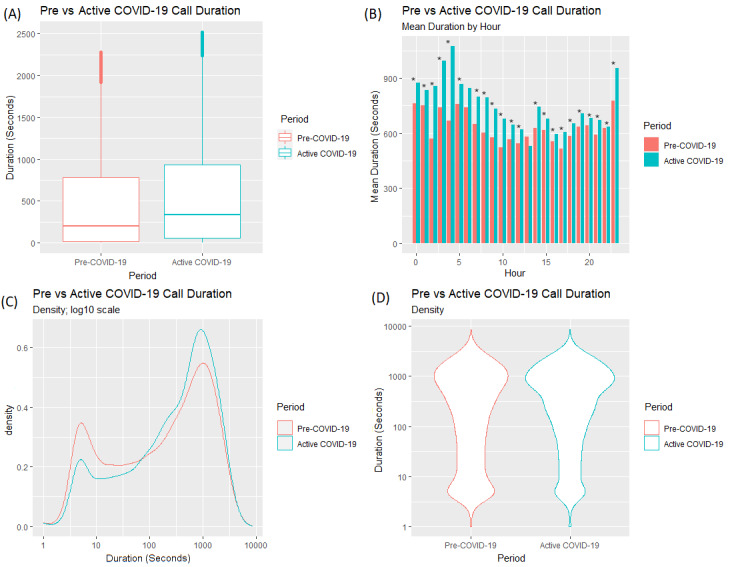
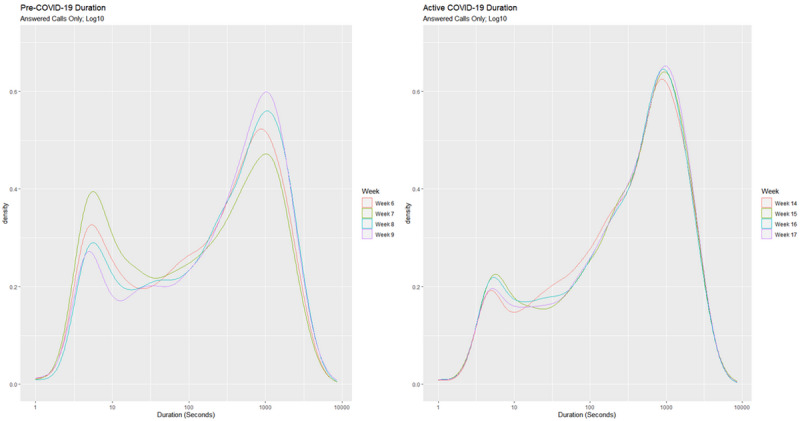
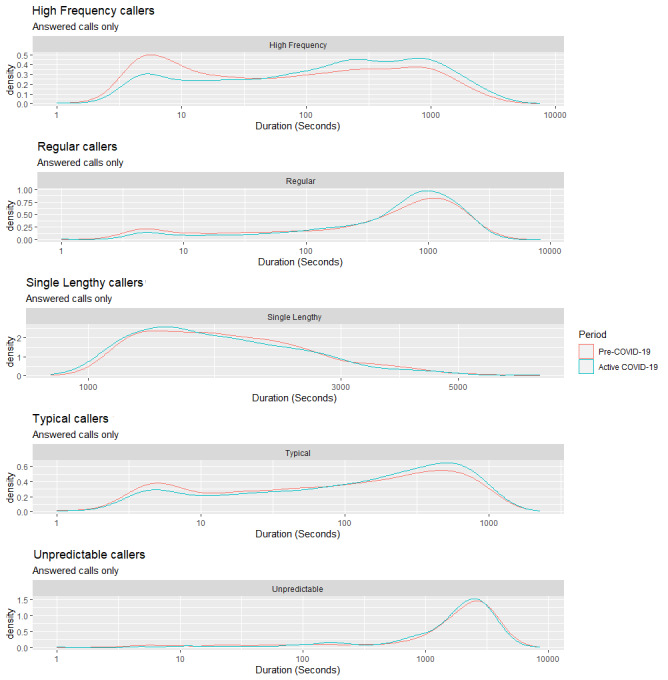
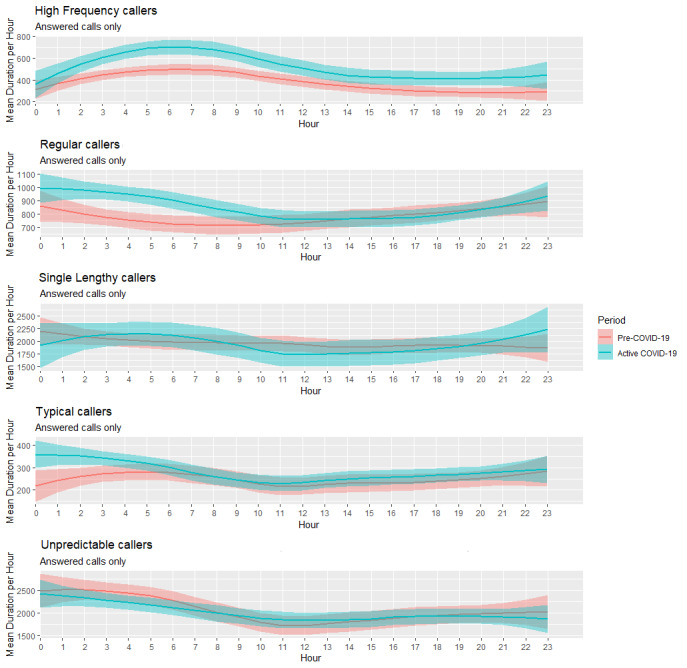
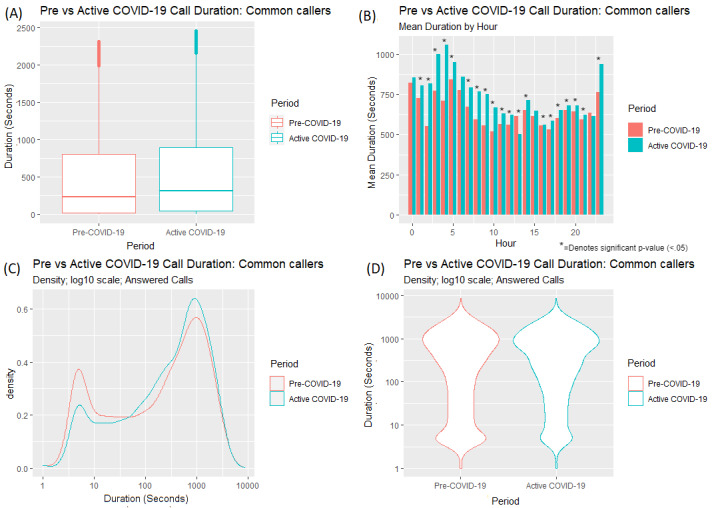
The analysis revealed that calls were of a longer duration in the postlockdown period in comparison with the pre-COVID-19 period. There were changes in the behavior of individuals in the cluster types defined by caller behavior, where some caller types tended to make longer calls to the service in the postlockdown period. There were also changes in caller behavior patterns with regard to the time of day of the call; variations were observed in the duration of calls at particular times of day, where average call durations increased in the early hours of the morning.

CONCLUSIONS

The results of this study highlight the impact of COVID-19 on a national crisis helpline service. Statistical differences were observed in caller behavior between the prelockdown and active lockdown periods. The findings suggest that service users relied on crisis helpline services more during the lockdown period due to an increased sense of isolation, worsening of underlying mental illness due to the pandemic, and reduction or overall removal of access to other support resources. Practical implications and limitations are discussed.

摘要

背景

世界卫生组织于2020年3月宣布新型冠状病毒肺炎疫情为国际大流行。虽然该疾病的新增确诊病例数和死亡人数每天都在以惊人的速度上升,但人们担心这场大流行及其应对措施可能导致公众的痛苦增加。因此,民众对情感支持的需求可能会增加,而由于为限制病毒传播而采取的措施,现有的面对面心理健康服务减少,这使得情况更加复杂。

目的

本研究的目的是确定新型冠状病毒肺炎疫情是否对爱尔兰共和国的全国危机求助热线“撒玛利亚人爱尔兰”的来电产生了任何影响。

方法

本研究对新型冠状病毒肺炎首例确诊病例出现前四周内拨打“撒玛利亚人爱尔兰”的电话(来电41648次,来电者3752人)以及爱尔兰共和国政府实施严格封锁后四周内拨打该服务的电话(来电46043次,来电者3147人)进行了分析。进行统计分析以探讨两个时期在全球层面和每小时层面来电时长的任何差异。我们进行了k均值聚类,以根据求助热线使用行为确定使用该求助热线的来电者类型,并评估疫情对来电者类型使用模式的影响。

结果

分析显示,与新型冠状病毒肺炎疫情前相比,封锁后时期的来电时长更长。在由来电者行为定义的聚类类型中,个体行为发生了变化,一些来电者类型在封锁后时期倾向于拨打更长时间的求助热线。来电时间的来电者行为模式也有变化;在一天中的特定时间观察到来电时长的差异,凌晨时段的平均来电时长增加。

结论

本研究结果突出了新型冠状病毒肺炎疫情对全国危机求助热线服务的影响。在封锁前和实际封锁期间,来电者行为存在统计学差异。研究结果表明,由于隔离感增加、疫情导致潜在精神疾病恶化以及获得其他支持资源的机会减少或完全消除,服务使用者在封锁期间更多地依赖危机求助热线服务。讨论了实际意义和局限性。
https://cdn.ncbi.nlm.nih.gov/pmc/blobs/ba75/7652595/ac7804713983/mental_v7i11e22984_fig8.jpg
https://cdn.ncbi.nlm.nih.gov/pmc/blobs/ba75/7652595/0e204ec62acb/mental_v7i11e22984_fig1.jpg
https://cdn.ncbi.nlm.nih.gov/pmc/blobs/ba75/7652595/0adb6709f471/mental_v7i11e22984_fig2.jpg
https://cdn.ncbi.nlm.nih.gov/pmc/blobs/ba75/7652595/e29ca6e843a7/mental_v7i11e22984_fig3.jpg
https://cdn.ncbi.nlm.nih.gov/pmc/blobs/ba75/7652595/d137953ce56f/mental_v7i11e22984_fig4.jpg
https://cdn.ncbi.nlm.nih.gov/pmc/blobs/ba75/7652595/1f758693d6ee/mental_v7i11e22984_fig5.jpg
https://cdn.ncbi.nlm.nih.gov/pmc/blobs/ba75/7652595/752edb8e681a/mental_v7i11e22984_fig6.jpg
https://cdn.ncbi.nlm.nih.gov/pmc/blobs/ba75/7652595/e34707cd9b44/mental_v7i11e22984_fig7.jpg
https://cdn.ncbi.nlm.nih.gov/pmc/blobs/ba75/7652595/ac7804713983/mental_v7i11e22984_fig8.jpg
https://cdn.ncbi.nlm.nih.gov/pmc/blobs/ba75/7652595/0e204ec62acb/mental_v7i11e22984_fig1.jpg
https://cdn.ncbi.nlm.nih.gov/pmc/blobs/ba75/7652595/0adb6709f471/mental_v7i11e22984_fig2.jpg
https://cdn.ncbi.nlm.nih.gov/pmc/blobs/ba75/7652595/e29ca6e843a7/mental_v7i11e22984_fig3.jpg
https://cdn.ncbi.nlm.nih.gov/pmc/blobs/ba75/7652595/d137953ce56f/mental_v7i11e22984_fig4.jpg
https://cdn.ncbi.nlm.nih.gov/pmc/blobs/ba75/7652595/1f758693d6ee/mental_v7i11e22984_fig5.jpg
https://cdn.ncbi.nlm.nih.gov/pmc/blobs/ba75/7652595/752edb8e681a/mental_v7i11e22984_fig6.jpg
https://cdn.ncbi.nlm.nih.gov/pmc/blobs/ba75/7652595/e34707cd9b44/mental_v7i11e22984_fig7.jpg
https://cdn.ncbi.nlm.nih.gov/pmc/blobs/ba75/7652595/ac7804713983/mental_v7i11e22984_fig8.jpg

相似文献

1
Behavior of Callers to a Crisis Helpline Before and During the COVID-19 Pandemic: Quantitative Data Analysis.COVID-19大流行之前及期间拨打危机热线者的行为:定量数据分析
JMIR Ment Health. 2020 Nov 6;7(11):e22984. doi: 10.2196/22984.
2
Talk Time Differences Between Interregional and Intraregional Calls to a Crisis Helpline: Statistical Analysis.区域间和区域内电话通话时间差异:统计分析
JMIR Ment Health. 2024 Sep 19;11:e58162. doi: 10.2196/58162.
3
Predicting Caller Type From a Mental Health and Well-Being Helpline: Analysis of Call Log Data.从心理健康与幸福热线预测来电者类型:通话记录数据分析
JMIR Ment Health. 2018 Jun 11;5(2):e47. doi: 10.2196/mental.9946.
4
The impact of the COVID-19 pandemic on calls to an alcohol and drug helpline in Victoria, Australia, for alcohol, methamphetamine and cannabis use concerns.澳大利亚维多利亚州因酒精、冰毒和大麻使用问题而致电酒精和毒品求助热线的人数受 COVID-19 大流行的影响。
Drug Alcohol Rev. 2024 Nov;43(7):2065-2076. doi: 10.1111/dar.13868. Epub 2024 May 15.
5
The Impact of the COVID-19 Pandemic on Calls to a National Suicide Prevention Hotline in Taiwan: An Analysis of Time Trend and Characteristics of Calls.2019冠状病毒病疫情对台湾地区全国自杀防治热线来电的影响:来电时间趋势与特征分析
Arch Suicide Res. 2023 Oct-Dec;27(4):1245-1260. doi: 10.1080/13811118.2022.2114867. Epub 2022 Aug 26.
6
Data analytics of call log data to identify caller behaviour patterns from a mental health and well-being helpline.从心理健康和福利热线中分析通话记录数据,以识别来电者的行为模式。
Health Informatics J. 2019 Dec;25(4):1722-1738. doi: 10.1177/1460458218792668. Epub 2018 Sep 17.
7
Frequent callers to crisis helplines: who are they and why do they call?危机热线的频繁来电者:他们是谁,为何致电?
Aust N Z J Psychiatry. 2015 Jan;49(1):54-64. doi: 10.1177/0004867414541154. Epub 2014 Jun 27.
8
A multicenter study of short-term changes in mental health emergency services use during lockdown in Kitchener-Waterloo, Ontario during the COVID-19 pandemic.安大略省滑铁卢地区 COVID-19 大流行期间封锁期间心理健康急救服务使用的短期变化的多中心研究。
BMC Public Health. 2021 Oct 12;21(1):1840. doi: 10.1186/s12889-021-11807-4.
9
Closing calls to a cancer helpline: Expressions of caller satisfaction.癌症求助热线的结束通话:来电者满意度的表达
Patient Educ Couns. 2015 Aug;98(8):943-53. doi: 10.1016/j.pec.2015.04.015. Epub 2015 Apr 28.
10
UK Breastfeeding Helpline support: An investigation of influences upon satisfaction.英国母乳喂养热线支持:对满意度影响因素的调查。
BMC Pregnancy Childbirth. 2012 Dec 13;12:150. doi: 10.1186/1471-2393-12-150.

引用本文的文献

1
Changes in Mental State for Help-Seekers of Lifeline Australia's Online Chat Service: Lexical Analysis Approach.澳大利亚生命线在线聊天服务求助者心理状态的变化:词汇分析方法
JMIR Form Res. 2025 Jun 20;9:e63257. doi: 10.2196/63257.
2
Will things feel better in the morning? A time-of-day analysis of mental health and wellbeing from nearly 1 million observations.早上情况会好转吗?基于近100万次观察的心理健康与幸福的时间分析。
BMJ Ment Health. 2025 Feb 4;28(1):e301418. doi: 10.1136/bmjment-2024-301418.
3
Talk Time Differences Between Interregional and Intraregional Calls to a Crisis Helpline: Statistical Analysis.

本文引用的文献

1
Coping behaviors associated with decreased anxiety and depressive symptoms during the COVID-19 pandemic and lockdown.与 COVID-19 大流行和封锁期间焦虑和抑郁症状减轻相关的应对行为。
J Affect Disord. 2020 Oct 1;275:80-81. doi: 10.1016/j.jad.2020.06.027. Epub 2020 Jul 2.
2
Digital Health Management During and Beyond the COVID-19 Pandemic: Opportunities, Barriers, and Recommendations.新冠疫情期间及之后的数字健康管理:机遇、障碍与建议
JMIR Ment Health. 2020 Jul 6;7(7):e19246. doi: 10.2196/19246.
3
COVID-19 effect on mental health: patients and workforce.
区域间和区域内电话通话时间差异:统计分析
JMIR Ment Health. 2024 Sep 19;11:e58162. doi: 10.2196/58162.
4
The analysis of telephone consultation contents of patients with bipolar disorder received by a self-help group.一个自助组织所接收的双相情感障碍患者电话咨询内容分析
PCN Rep. 2022 Jun 23;1(2):e20. doi: 10.1002/pcn5.20. eCollection 2022 Jun.
5
Assessing the social impacts of the COVID-19 crisis using phone helplines. The case of the Balearic Islands, Spain.使用电话求助热线评估 COVID-19 危机的社会影响。以西班牙巴利阿里群岛为例。
Front Public Health. 2024 Mar 13;12:1270906. doi: 10.3389/fpubh.2024.1270906. eCollection 2024.
6
Residential mobility restrictions and adverse mental health outcomes during the COVID-19 pandemic in the UK.英国 COVID-19 大流行期间的居住流动性限制与不良心理健康后果。
Sci Rep. 2024 Jan 20;14(1):1790. doi: 10.1038/s41598-024-51854-6.
7
Young people's mental and social distress in times of international crisis: evidence from helpline calls, 2019-2022.国际危机时期年轻人的心理和社会困扰:来自热线电话的证据,2019-2022。
Sci Rep. 2023 Jul 22;13(1):11858. doi: 10.1038/s41598-023-39064-y.
8
Self-Management of Subclinical Common Mental Health Disorders (Anxiety, Depression and Sleep Disorders) Using Wearable Devices.使用可穿戴设备对常见精神心理健康障碍(焦虑、抑郁和睡眠障碍)的亚临床状态进行自我管理。
Int J Environ Res Public Health. 2023 Feb 1;20(3):2636. doi: 10.3390/ijerph20032636.
9
Consumer Perspectives on the Use of Artificial Intelligence Technology and Automation in Crisis Support Services: Mixed Methods Study.消费者对危机支持服务中人工智能技术和自动化应用的看法:混合方法研究
JMIR Hum Factors. 2022 Aug 5;9(3):e34514. doi: 10.2196/34514.
10
Exploring Trauma and Resilience among NYS COVID-19 Pandemic Survivors.探索纽约州新冠疫情幸存者中的创伤与复原力
Behav Sci (Basel). 2022 Jul 23;12(8):249. doi: 10.3390/bs12080249.
新冠病毒病对心理健康的影响:患者与医护人员。
Lancet Psychiatry. 2020 Jun;7(6):e29-e30. doi: 10.1016/S2215-0366(20)30153-X. Epub 2020 May 20.
4
Suicide risk and prevention during the COVID-19 pandemic.2019冠状病毒病大流行期间的自杀风险与预防
Lancet Psychiatry. 2020 Jun;7(6):468-471. doi: 10.1016/S2215-0366(20)30171-1. Epub 2020 Apr 21.
5
Why do people call crisis helplines? Identifying taxonomies of presenting reasons and discovering associations between these reasons.为什么人们会拨打危机热线?确定呈现原因的分类,并发现这些原因之间的关联。
Health Informatics J. 2020 Dec;26(4):2597-2613. doi: 10.1177/1460458220913429. Epub 2020 Apr 18.
6
Multidisciplinary research priorities for the COVID-19 pandemic: a call for action for mental health science.2019冠状病毒病大流行的多学科研究重点:呼吁开展心理健康科学行动
Lancet Psychiatry. 2020 Jun;7(6):547-560. doi: 10.1016/S2215-0366(20)30168-1. Epub 2020 Apr 15.
7
The COVID-19 pandemic: The 'black swan' for mental health care and a turning point for e-health.新冠疫情:心理健康护理的“黑天鹅”与电子健康的转折点。
Internet Interv. 2020 Apr;20:100317. doi: 10.1016/j.invent.2020.100317. Epub 2020 Mar 19.
8
Dealing with sleep problems during home confinement due to the COVID-19 outbreak: Practical recommendations from a task force of the European CBT-I Academy.应对 COVID-19 疫情期间居家隔离导致的睡眠问题:欧洲 CBT-I 学院专家组的实用建议。
J Sleep Res. 2020 Aug;29(4):e13052. doi: 10.1111/jsr.13052. Epub 2020 May 4.
9
Digital Mental Health and COVID-19: Using Technology Today to Accelerate the Curve on Access and Quality Tomorrow.数字心理健康与新冠疫情:利用当下技术加速提升未来的可及性与质量曲线。
JMIR Ment Health. 2020 Mar 26;7(3):e18848. doi: 10.2196/18848.
10
The novel coronavirus (COVID-2019) outbreak: Amplification of public health consequences by media exposure.新型冠状病毒(COVID-2019)爆发:媒体接触对公共卫生后果的放大。
Health Psychol. 2020 May;39(5):355-357. doi: 10.1037/hea0000875. Epub 2020 Mar 23.