Department of Pharmaceutics, China Pharmaceutical University, Nanjing 210009, People's Republic of China.
Department of Pediatrics, Critical Care Division, Stanley Manne Children's Research Institute, Ann & Robert H. Lurie Children's Hospital of Chicago, Northwestern University Feinberg School of Medicine, Chicago, IL, USA.
Int J Nanomedicine. 2020 Oct 23;15:8201-8215. doi: 10.2147/IJN.S261671. eCollection 2020.
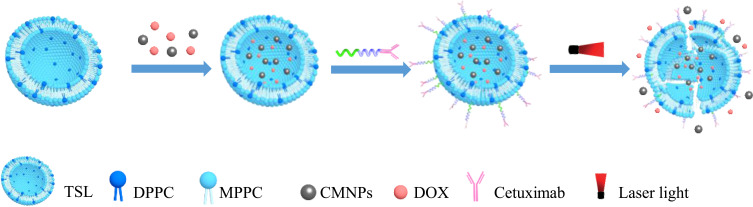
One major limitation of cancer chemotherapy is a failure to specifically target a tumor, potentially leading to side effects such as systemic cytotoxicity. In this case, we have generated a cancer cell-targeting nanoparticle-liposome drug delivery system that can be activated by near-infrared laser light to enable local photo-thermal therapy and the release of chemotherapeutic agents, which could achieve combined therapeutic efficiency.
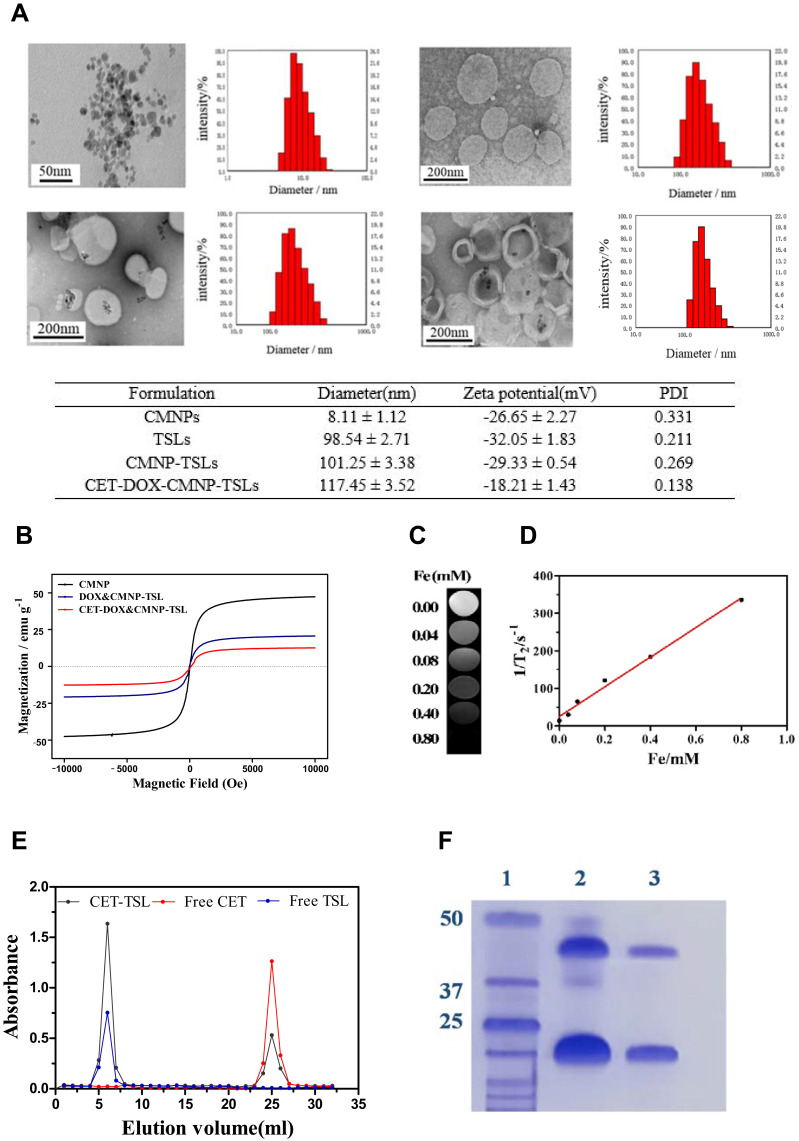
To exploit the magnetic potential of iron oxide, we prepared and characterized citric acid-coated iron oxide magnetic nanoparticles (CMNPs) and encapsulated them into thermo-sensitive liposomes (TSLs). The chemotherapeutic drug, doxorubicin (DOX), was then loaded into the CMNP-TSLs, which were coated with an antibody against the epidermal growth factor receptor (EGFR), cetuximab (CET), to target EGFR-expressing breast cancer cells in vitro and in vivo studies in mouse model.
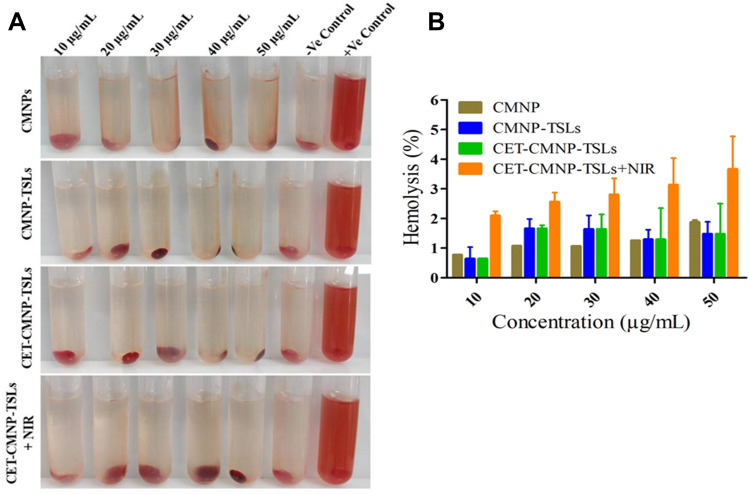
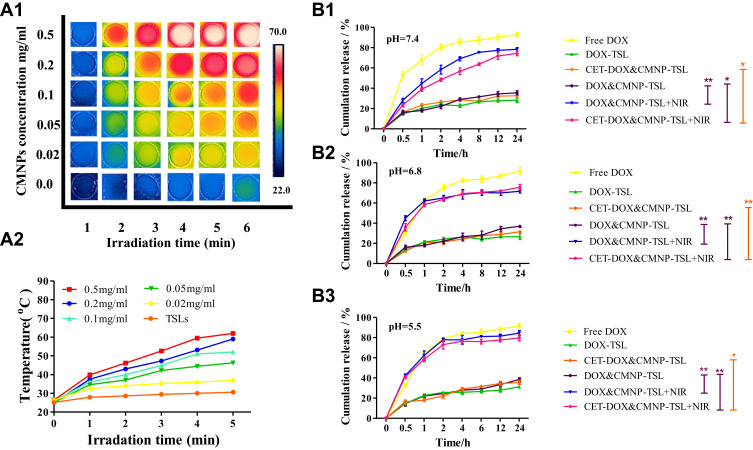
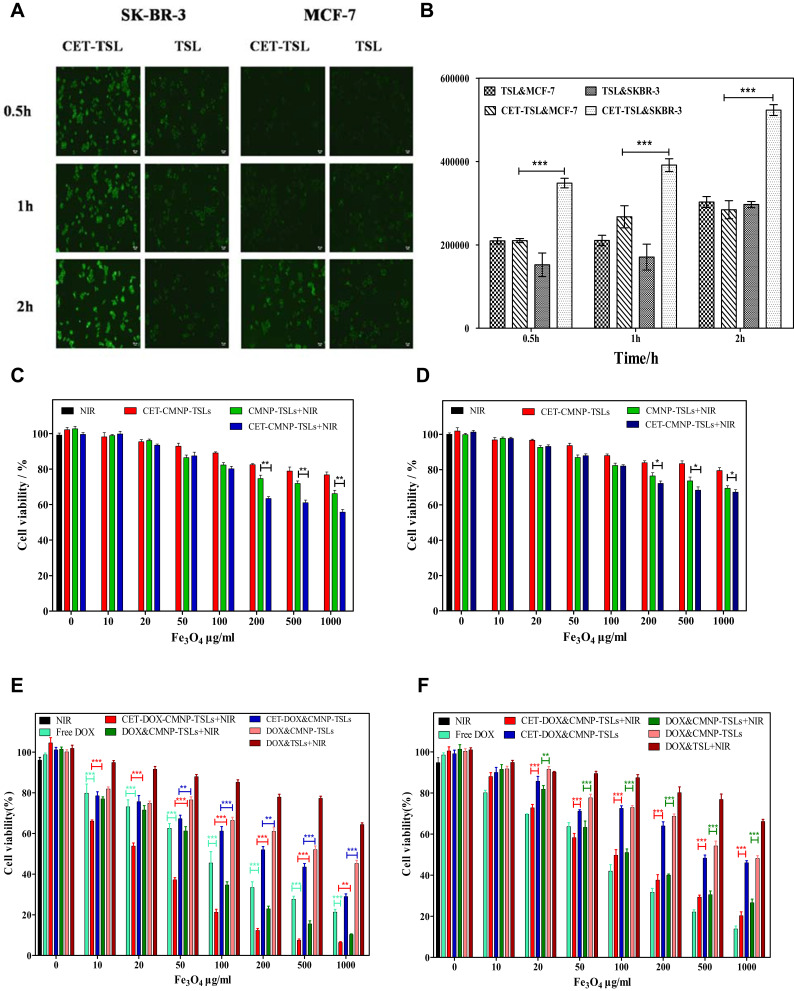
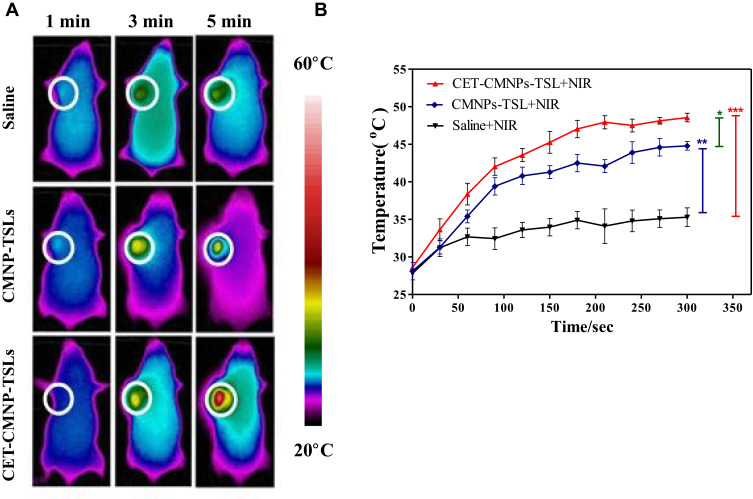
The resulting CET-DOX-CMNP-TSLs were stable with an average diameter of approximately 120 nm. First, the uptake of TSLs into breast cancer cells increased by the addition of the CET coating. Next, the viability of breast cancer cells treated with CET-CMNP-TSLs and CET-DOX-CMNP-TSLs was reduced by the addition of photo-thermal therapy using near-infrared (NIR) laser irradiation. What is more, the viability of breast cancer cells treated with CMNP-TSLs plus NIR was reduced by the addition of DOX to the CMNP-TSLs. Finally, photo-thermal therapy studies on tumor-bearing mice subjected to NIR laser irradiation showed that treatment with CMNP-TSLs or CET-CMNP-TSLs led to an increase in tumor surface temperature to 44.7°C and 48.7°C, respectively, compared with saline-treated mice body temperature ie, 35.2°C. Further, the hemolysis study shows that these nanocarriers are safe for systemic delivery.
Our studies revealed that a combined therapy of photo-thermal therapy and targeted chemotherapy in thermo-sensitive nano-carriers represents a promising therapeutic strategy against breast cancer.
癌症化疗的一个主要局限性是不能特异性地靶向肿瘤,可能导致全身细胞毒性等副作用。在这种情况下,我们生成了一种癌细胞靶向的纳米囊泡脂质体药物传递系统,该系统可以通过近红外激光激活,实现局部光热治疗和化疗药物的释放,从而达到联合治疗的效果。
为了利用氧化铁的磁性潜力,我们制备并表征了柠檬酸修饰的氧化铁磁性纳米粒子(CMNPs),并将其包封到热敏脂质体(TSLs)中。然后,将化疗药物阿霉素(DOX)加载到 CMNP-TSLs 中,并用针对表皮生长因子受体(EGFR)的抗体西妥昔单抗(CET)进行包被,以在体外和体内研究中靶向 EGFR 表达的乳腺癌细胞。
所得的 CET-DOX-CMNP-TSLs 粒径约为 120nm,且较为稳定。首先,加入 CET 涂层后,TSLs 被乳腺癌细胞摄取的量增加。其次,加入近红外(NIR)激光照射的光热治疗后,用 CET-CMNP-TSLs 和 CET-DOX-CMNP-TSLs 处理的乳腺癌细胞的活力降低。再者,在将 DOX 加入到 CMNP-TSLs 中后,用 CMNP-TSLs 处理的乳腺癌细胞的活力降低。最后,对接受 NIR 激光照射的荷瘤小鼠的光热治疗研究表明,与生理盐水处理的小鼠体温(即 35.2°C)相比,用 CMNP-TSLs 或 CET-CMNP-TSLs 处理后,肿瘤表面温度分别升高至 44.7°C 和 48.7°C。此外,溶血研究表明这些纳米载体可安全用于全身递送。
我们的研究表明,在热敏纳米载体中进行光热治疗和靶向化疗的联合治疗是一种有前途的治疗乳腺癌的策略。