
MASI:微生物群活性物质相互作用数据库。
MASI: microbiota-active substance interactions database.
机构信息
Department of Biological Medicines & Shanghai Engineering Research Center of Immunotherapeutics, Fudan University School of Pharmacy, Shanghai 201203, P. R. China.
The State Key Laboratory of Chemical Oncogenomics, Key Laboratory of Chemical Biology, Tsinghua University Shenzhen Graduate School, Shenzhen Technology and Engineering Laboratory for Personalized Cancer Diagnostics and Therapeutics, Shenzhen Kivita Innovative Drug Discovery Institute, Guangdong, P. R. China.
出版信息
Nucleic Acids Res. 2021 Jan 8;49(D1):D776-D782. doi: 10.1093/nar/gkaa924.
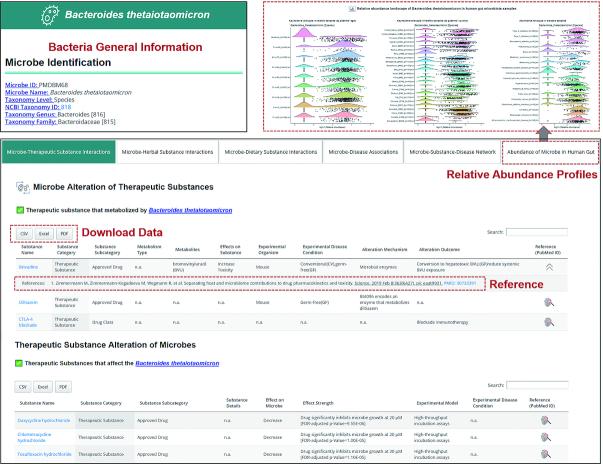
Xenobiotic and host active substances interact with gut microbiota to influence human health and therapeutics. Dietary, pharmaceutical, herbal and environmental substances are modified by microbiota with altered bioavailabilities, bioactivities and toxic effects. Xenobiotics also affect microbiota with health implications. Knowledge of these microbiota and active substance interactions is important for understanding microbiota-regulated functions and therapeutics. Established microbiota databases provide useful information about the microbiota-disease associations, diet and drug interventions, and microbiota modulation of drugs. However, there is insufficient information on the active substances modified by microbiota and the abundance of gut bacteria in humans. Only ∼7% drugs are covered by the established databases. To complement these databases, we developed MASI, Microbiota-Active Substance Interactions database, for providing the information about the microbiota alteration of various substances, substance alteration of microbiota, and the abundance of gut bacteria in humans. These include 1,051 pharmaceutical, 103 dietary, 119 herbal, 46 probiotic, 142 environmental substances interacting with 806 microbiota species linked to 56 diseases and 784 microbiota-disease associations. MASI covers 11 215 bacteria-pharmaceutical, 914 bacteria-herbal, 309 bacteria-dietary, 753 bacteria-environmental substance interactions and the abundance profiles of 259 bacteria species in 3465 patients and 5334 healthy individuals. MASI is freely accessible at http://www.aiddlab.com/MASI.
外源性物质和宿主活性物质与肠道微生物群相互作用,影响人类健康和治疗效果。饮食、药物、草药和环境物质被微生物群改变,从而改变了生物利用度、生物活性和毒性作用。外源性物质也会影响微生物群,从而对健康产生影响。了解这些微生物群和活性物质的相互作用对于理解微生物群调节的功能和治疗方法非常重要。现有的微生物组数据库提供了有关微生物组-疾病关联、饮食和药物干预以及药物对微生物组的调节的有用信息。然而,关于微生物群修饰的活性物质和人类肠道细菌的丰度的信息还不够充分。只有约 7%的药物被现有的数据库所涵盖。为了补充这些数据库,我们开发了 MASI(微生物群-活性物质相互作用数据库),用于提供关于各种物质的微生物群改变、微生物群改变物质以及人类肠道细菌丰度的信息。这些信息包括 1051 种药物、103 种饮食、119 种草药、46 种益生菌、142 种环境物质与 806 种与 56 种疾病和 784 种微生物群-疾病关联相关的微生物群物种相互作用。MASI 涵盖了 11215 种细菌-药物、914 种细菌-草药、309 种细菌-饮食、753 种细菌-环境物质相互作用,以及 259 种细菌在 3465 名患者和 5334 名健康个体中的丰度谱。MASI 可在 http://www.aiddlab.com/MASI 免费获取。


 Zotero 插件