Department of Chemistry, School of Sciences & Engineering, The American University in Cairo, AUC Avenue, P.O. Box 74, New Cairo 11835, Egypt.
School of Pharmacy, University of Hertfordshire-Egypt hosted by GAF, R5 New Garden City, New Administrative Capital AL109AB, Cairo 11835, Egypt.
Molecules. 2020 Oct 28;25(21):4981. doi: 10.3390/molecules25214981.
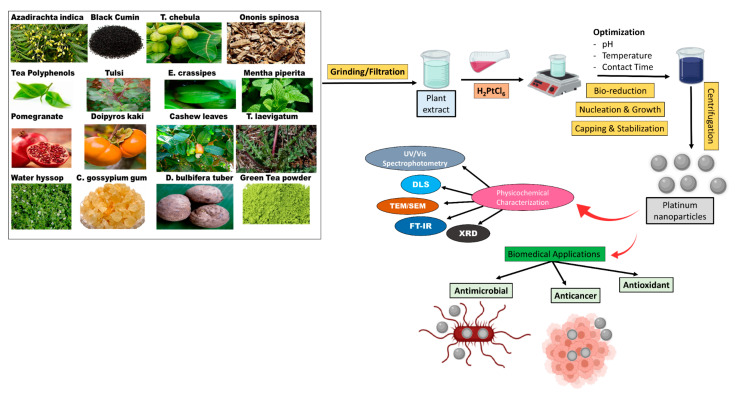
Platinum nanoparticles (PtNPs) have superior physicochemical properties and great potential in biomedical applications. Eco-friendly and economic approaches for the synthesis of PtNPs have been developed to overcome the shortcomings of the traditional physical and chemical methods. Various biogenic entities have been utilized in the green synthesis of PtNPs, including mainly plant extracts, algae, fungi bacteria, and their biomedical effects were assessed. Other biological derivatives have been used in the synthesis of PtNPs such as egg yolk, sheep milk, honey, and bovine serum albumin protein. The green approaches for the synthesis of PtNPs have reduced the reaction time, the energy required, and offered ambient conditions of fabrication. This review highlights the state-of-the-art methods used for green synthesis of PtNPs, synthesis parameters, and their reported biomedical applications.
铂纳米粒子(PtNPs)具有优越的物理化学性质,在生物医学应用中具有巨大的潜力。为了克服传统物理化学方法的缺点,已经开发出了环保和经济的合成 PtNPs 的方法。各种生物实体已被用于 PtNPs 的绿色合成,包括主要的植物提取物、藻类、真菌、细菌,并且已经评估了它们的生物医学效应。其他生物衍生剂已被用于合成 PtNPs,如蛋黄、绵羊奶、蜂蜜和牛血清白蛋白。PtNPs 的绿色合成方法减少了反应时间、所需的能量,并提供了温和的制造条件。本文综述了用于绿色合成 PtNPs 的最新方法、合成参数及其报道的生物医学应用。