Ivanov Julian, Polshakov Dmitrii, Kato-Weinstein Junko, Zhou Qiongqiong, Li Yingzhu, Granet Roger, Garner Linda, Deng Yi, Liu Cynthia, Albaiu Dana, Wilson Jeffrey, Aultman Christopher
CAS, A Division of the American Chemical Society, Columbus, Ohio 43210-3012, United States.
ACS Omega. 2020 Oct 14;5(42):27344-27358. doi: 10.1021/acsomega.0c03682. eCollection 2020 Oct 27.
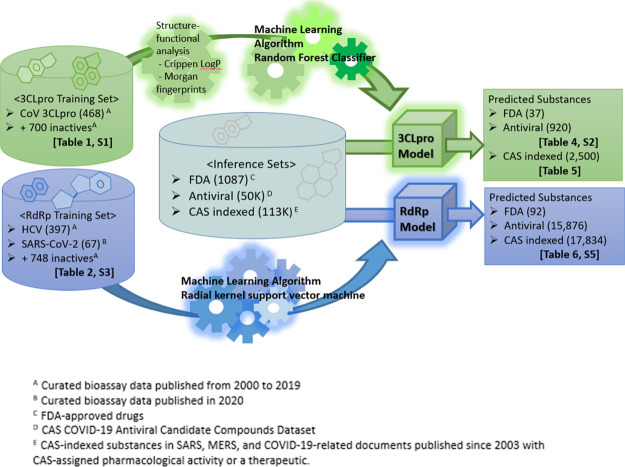
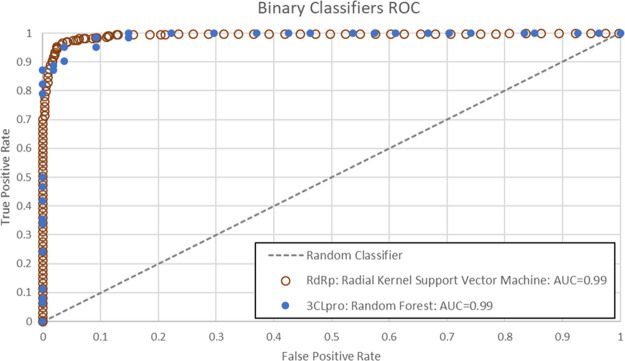
In response to the ongoing COVID-19 pandemic, there is a worldwide effort being made to identify potential anti-SARS-CoV-2 therapeutics. Here, we contribute to these efforts by building machine-learning predictive models to identify novel drug candidates for the viral targets 3 chymotrypsin-like protease (3CLpro) and RNA-dependent RNA polymerase (RdRp). Chemist-curated training sets of substances were assembled from CAS data collections and integrated with curated bioassay data. The best-performing classification models were applied to screen a set of FDA-approved drugs and CAS REGISTRY substances that are similar to, or associated with, antiviral agents. Numerous substances with potential activity against 3CLpro or RdRp were found, and some were validated by published bioassay studies and/or by their inclusion in upcoming or ongoing COVID-19 clinical trials. This study further supports that machine learning-based predictive models may be used to assist the drug discovery process for COVID-19 and other diseases.
为应对持续的新冠疫情,全球正在努力寻找潜在的抗SARS-CoV-2疗法。在此,我们通过构建机器学习预测模型来为病毒靶点3胰凝乳蛋白酶样蛋白酶(3CLpro)和RNA依赖性RNA聚合酶(RdRp)识别新型候选药物,为这些努力做出贡献。从化学文摘社(CAS)数据收集中整理出由化学家策划的物质训练集,并与策划的生物测定数据相结合。将表现最佳的分类模型应用于筛选一组与抗病毒药物相似或相关的FDA批准药物和CAS登记物质。发现了许多对3CLpro或RdRp具有潜在活性的物质,其中一些已通过已发表的生物测定研究和/或因其被纳入即将进行或正在进行的新冠临床试验而得到验证。这项研究进一步支持基于机器学习的预测模型可用于辅助新冠及其他疾病的药物发现过程。