Department of Radiology, The Affiliated Hospital of Qingdao University, No.59 Haier Road, Qingdao, 266000, China.
Department of Pediatric Surgery, Shandong University Qilu Hospital, Jinan, 250012, China.
BMC Cancer. 2020 Nov 9;20(1):1073. doi: 10.1186/s12885-020-07557-y.
The clinicopathological classification of breast cancer is proposed according to therapeutic purposes. It is simplified and can be conducted easily in clinical practice, and this subtyping undoubtedly contributes to the treatment selection of breast cancer. This study aims to investigate the feasibility of using a Fisher discriminant analysis model based on radiomic features of diffusion-weighted MRI for predicting the clinicopathological subtypes of breast cancer.
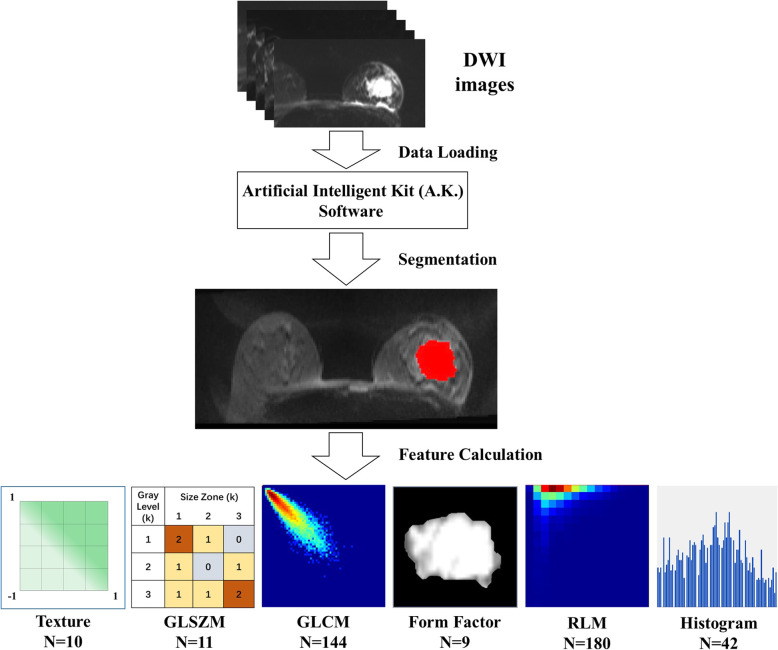
Patients who underwent breast magnetic resonance imaging were confirmed by retrieving data from our institutional picture archiving and communication system (PACS) between March 2013 and September 2017. Five clinicopathological subtypes were determined based on the status of ER, PR, HER2 and Ki-67 from the immunohistochemical test. The radiomic features of diffusion-weighted imaging were derived from the volume of interest (VOI) of each tumour. Fisher discriminant analysis was performed for clinicopathological subtyping by using a backward selection method. To evaluate the diagnostic performance of the radiomic features, ROC analyses were performed to differentiate between immunohistochemical biomarker-positive and -negative groups.
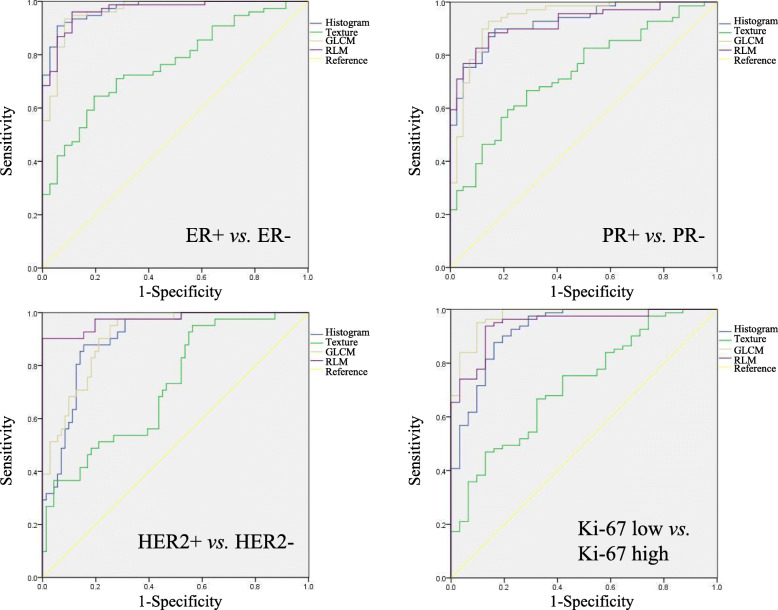
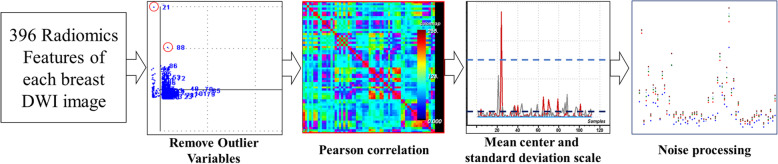
A total of 84 radiomic features of four statistical methods were included after preprocessing. The overall accuracy for predicting the clinicopathological subtypes was 96.4% by Fisher discriminant analysis, and the weighted accuracy was 96.6%. For predicting diverse clinicopathological subtypes, the prediction accuracies ranged from 92 to 100%. According to the cross-validation, the overall accuracy of the model was 82.1%, and the accuracies of the model for predicting the luminal A, luminal B, luminal B, HER2 positive and triple negative subtypes were 79, 77, 88, 92 and 73%, respectively. According to the ROC analysis, the radiomic features had excellent performance in differentiating between different statuses of ER, PR, HER2 and Ki-67.
The Fisher discriminant analysis model based on radiomic features of diffusion-weighted MRI is a reliable method for the prediction of clinicopathological breast cancer subtypes.
乳腺癌的临床病理分类是根据治疗目的提出的。它简化了临床实践中的操作,这种分型无疑有助于乳腺癌的治疗选择。本研究旨在探讨基于扩散加权 MRI 影像组学特征的 Fisher 判别分析模型预测乳腺癌临床病理亚型的可行性。
通过检索我院影像归档和通信系统(PACS)2013 年 3 月至 2017 年 9 月的数据,确定接受乳腺磁共振成像检查的患者。根据免疫组织化学检查中 ER、PR、HER2 和 Ki-67 的状态确定五种临床病理亚型。从每个肿瘤的感兴趣区域(VOI)中提取扩散加权成像的影像组学特征。采用后向选择法进行 Fisher 判别分析以进行临床病理分型。为了评估影像组学特征的诊断性能,通过 ROC 分析对免疫组化生物标志物阳性和阴性组进行了区分。
预处理后共纳入 84 个来自四种统计方法的影像组学特征。Fisher 判别分析预测临床病理亚型的总准确率为 96.4%,加权准确率为 96.6%。对于预测不同的临床病理亚型,预测准确率范围为 92%至 100%。根据交叉验证,该模型的总准确率为 82.1%,预测 luminal A、luminal B、luminal B、HER2 阳性和三阴性亚型的准确率分别为 79%、77%、88%、92%和 73%。根据 ROC 分析,影像组学特征在区分 ER、PR、HER2 和 Ki-67 的不同状态方面具有优异的性能。
基于扩散加权 MRI 影像组学特征的 Fisher 判别分析模型是预测乳腺癌临床病理亚型的可靠方法。