Department of Psychiatry, University of Oxford, Warneford Hospital, Oxford, OX3 7JX, UK.
Alzheimer Center Amsterdam, Amsterdam UMC, Amsterdam, Netherlands.
Alzheimers Res Ther. 2020 Nov 9;12(1):143. doi: 10.1186/s13195-020-00711-5.
The Amyloid/Tau/Neurodegeneration (ATN) framework has been proposed as a means of evidencing the biological state of Alzheimer's disease (AD). Predicting ATN status in pre-dementia individuals therefore provides an important opportunity for targeted recruitment into AD interventional studies. We investigated the extent to which ATN-defined biomarker status can be predicted by known AD risk factors as well as vascular-related composite risk scores.
One thousand ten cognitively healthy older adults were allocated to one of five ATN-defined biomarker categories. Multinomial logistic regression tested risk factors including age, sex, education, APOE4, family history of dementia, cognitive function, vascular risk indices (high systolic blood pressure, body mass index (BMI), high cholesterol, physical inactivity, ever smoked, blood pressure medication, diabetes, prior cardiovascular disease, atrial fibrillation and white matter lesion (WML) volume), and three vascular-related composite scores, to predict five ATN subgroups; ROC curve models estimated their added value in predicting pathology.
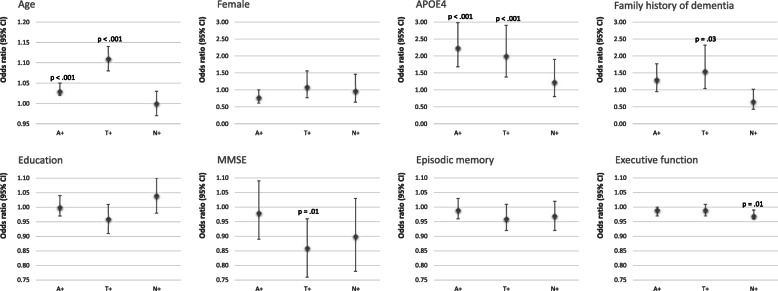
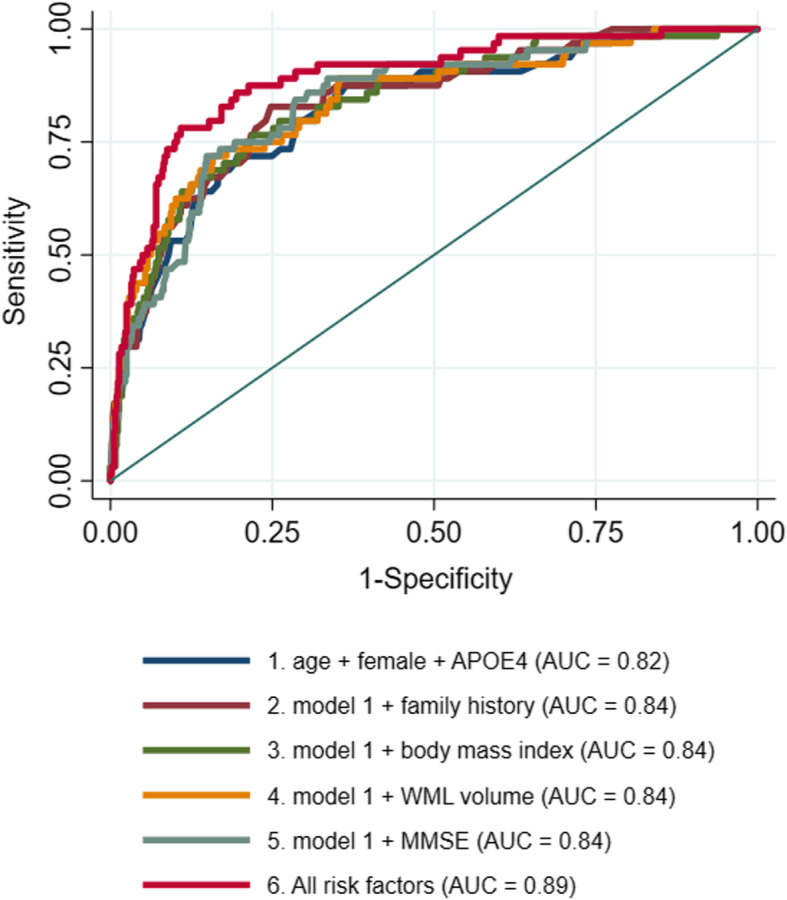
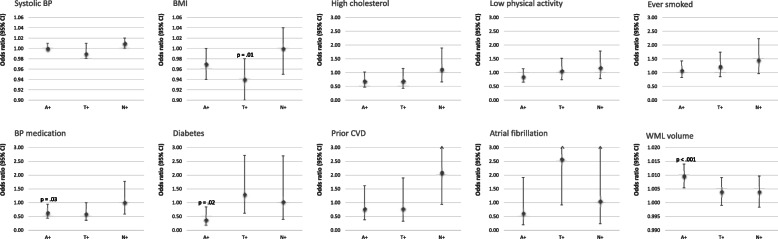
Age, APOE4, family history, BMI, MMSE and white matter lesions (WML) volume differed between ATN biomarker groups. Prediction of Alzheimer's disease pathology (versus normal AD biomarkers) improved by 7% after adding family history, BMI, MMSE and WML to a ROC curve that included age, sex and APOE4. Risk composite scores did not add value.
ATN-defined Alzheimer's disease biomarker status prediction among cognitively healthy individuals is possible through a combination of constitutional and cardiovascular risk factors but established dementia composite risk scores do not appear to add value in this context.
淀粉样蛋白/tau/神经退行性变(ATN)框架被提出作为一种证明阿尔茨海默病(AD)生物学状态的方法。因此,预测痴呆前期个体的 ATN 状态为 AD 干预研究提供了一个重要的靶向招募机会。我们研究了 ATN 定义的生物标志物状态在多大程度上可以通过已知的 AD 风险因素以及血管相关综合风险评分来预测。
1010 名认知健康的老年人被分配到 ATN 定义的五个生物标志物类别之一。多项逻辑回归检验了包括年龄、性别、教育程度、APOE4、痴呆家族史、认知功能、血管风险指数(高收缩压、体重指数(BMI)、高胆固醇、身体活动不足、吸烟史、血压药物、糖尿病、既往心血管疾病、心房颤动和白质病变(WML)体积)以及三个血管相关综合评分在内的风险因素,以预测五个 ATN 亚组;ROC 曲线模型估计了它们在预测病理方面的附加价值。
年龄、APOE4、家族史、BMI、MMSE 和 WML 体积在 ATN 生物标志物组之间存在差异。在包括年龄、性别和 APOE4 的 ROC 曲线中加入家族史、BMI、MMSE 和 WML 后,阿尔茨海默病病理(与正常 AD 生物标志物相比)的预测提高了 7%。风险综合评分没有增加价值。
通过结合体质和心血管风险因素,有可能预测认知健康个体的 ATN 定义的阿尔茨海默病生物标志物状态,但在这种情况下,已建立的痴呆综合风险评分似乎没有增加价值。