Fluicell AB, Flöjelbergsgatan 8C, 431 37, Mölndal, Sweden.
Cellectricon AB, Neongatan 4B, 431 53, Mölndal, Sweden.
Sci Rep. 2020 Nov 10;10(1):19529. doi: 10.1038/s41598-020-74191-w.
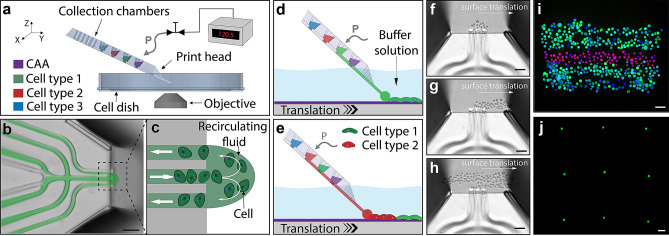
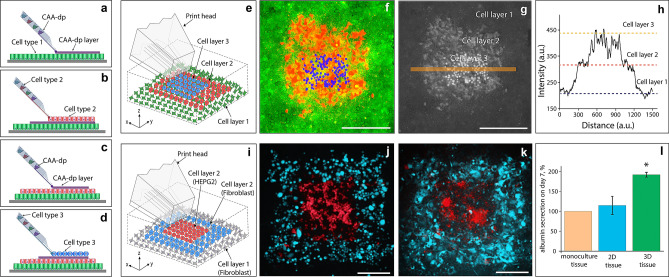
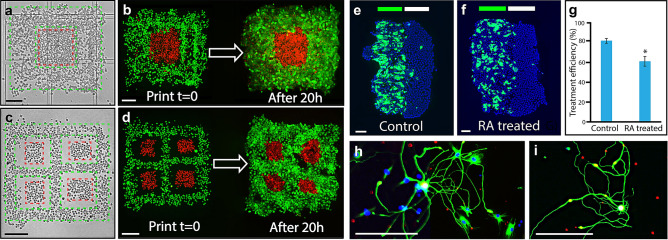
Significant strides have been made in the development of in vitro systems for disease modelling. However, the requirement of microenvironment control has placed limitations on the generation of relevant models. Herein, we present a biological tissue printing approach that employs open-volume microfluidics to position individual cells in complex 2D and 3D patterns, as well as in single cell arrays. The variety of bioprinted cell types employed, including skin epithelial (HaCaT), skin cancer (A431), liver cancer (Hep G2), and fibroblast (3T3-J2) cells, all of which exhibited excellent viability and survivability, allowing printed structures to rapidly develop into confluent tissues. To demonstrate a simple 2D oncology model, A431 and HaCaT cells were printed and grown into tissues. Furthermore, a basic skin model was established to probe drug response. 3D tissue formation was demonstrated by co-printing Hep G2 and 3T3-J2 cells onto an established fibroblast layer, the functionality of which was probed by measuring albumin production, and was found to be higher in comparison to both 2D and monoculture approaches. Bioprinting of primary cells was tested using acutely isolated primary rat dorsal root ganglia neurons, which survived and established processes. The presented technique offers a novel open-volume microfluidics approach to bioprint cells for the generation of biological tissues.
在疾病建模的体外系统开发方面已经取得了重大进展。然而,微环境控制的要求对相关模型的生成提出了限制。在此,我们提出了一种生物组织打印方法,该方法采用开体积微流控技术将单个细胞定位在复杂的 2D 和 3D 图案中,以及单细胞阵列中。所使用的各种生物打印细胞类型,包括皮肤上皮细胞(HaCaT)、皮肤癌细胞(A431)、肝癌细胞(Hep G2)和成纤维细胞(3T3-J2),所有这些细胞都表现出出色的活力和生存能力,使打印结构能够迅速发展为融合组织。为了展示一个简单的 2D 肿瘤模型,我们打印了 A431 和 HaCaT 细胞并使其生长为组织。此外,还建立了一个基本的皮肤模型来探测药物反应。通过将 Hep G2 和 3T3-J2 细胞共打印到已建立的成纤维细胞层上,实现了 3D 组织的形成,通过测量白蛋白的产生来探测其功能,发现与 2D 和单培养方法相比,其功能更高。使用急性分离的大鼠背根神经节神经元测试了原代细胞的生物打印,这些神经元存活并建立了过程。所提出的技术为生物打印细胞生成生物组织提供了一种新颖的开体积微流控方法。