Department of Chemistry, Purdue University, West Lafayette, IN, United States of America.
Institute for Drug Discovery, Purdue University, West Lafayette, IN, United States of America.
PLoS One. 2020 Nov 12;15(11):e0242372. doi: 10.1371/journal.pone.0242372. eCollection 2020.
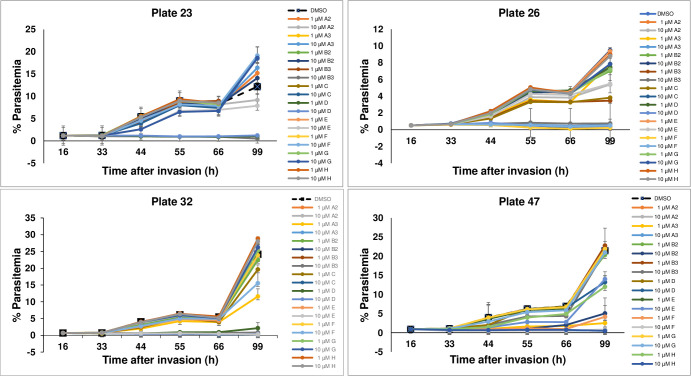
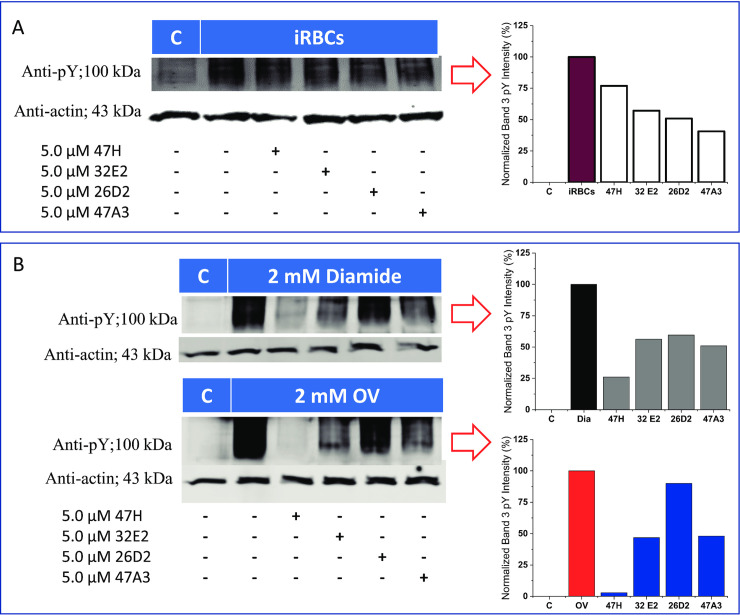
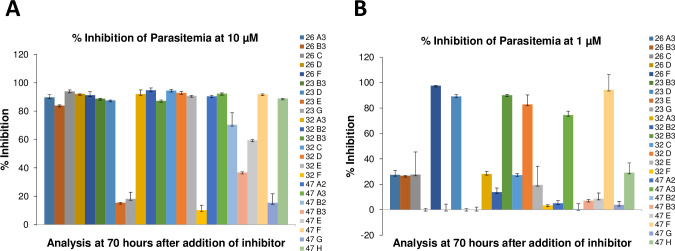
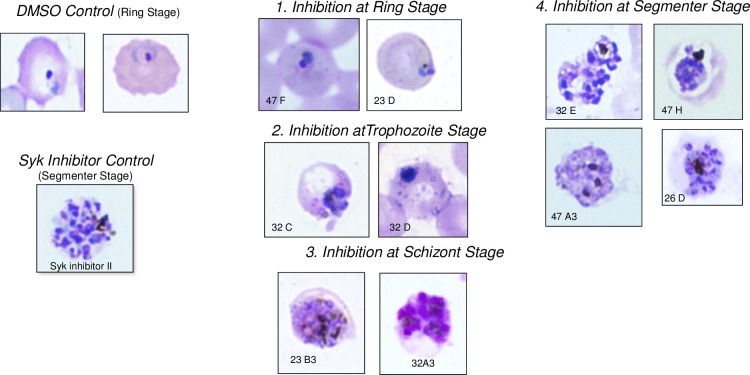
Although current malaria therapies inhibit pathways encoded in the parasite's genome, we have looked for anti-malaria drugs that can target an erythrocyte component because development of drug resistance might be suppressed if the parasite cannot mutate the drug's target. In search for such erythrocyte targets, we noted that human erythrocytes express tyrosine kinases, whereas the Plasmodium falciparum genome encodes no obvious tyrosine kinases. We therefore screened a library of tyrosine kinase inhibitors from Eli Lilly and Co. in a search for inhibitors with possible antimalarial activity. We report that although most tyrosine kinase inhibitors exerted no effect on parasite survival, a subset of tyrosine kinase inhibitors displayed potent anti-malarial activity. Moreover, all inhibitors found to block tyrosine phosphorylation of band 3 specifically suppressed P. falciparum survival at the parasite egress stage of its intra-erythrocyte life cycle. Conversely, tyrosine kinase inhibitors that failed to block band 3 tyrosine phosphorylation but still terminated the parasitemia were observed to halt parasite proliferation at other stages of the parasite's life cycle. Taken together these results suggest that certain erythrocyte tyrosine kinases may be important to P. falciparum maturation and that inhibitors that block these kinases may contribute to novel therapies for P. falciparum malaria.
虽然目前的疟疾疗法可以抑制寄生虫基因组编码的途径,但我们一直在寻找可以靶向红细胞成分的抗疟药物,因为如果寄生虫无法使药物的靶点发生突变,那么耐药性的发展可能会受到抑制。在寻找这种红细胞靶点时,我们注意到人类红细胞表达酪氨酸激酶,而疟原虫基因组没有明显的酪氨酸激酶编码。因此,我们在 Lilly 公司的酪氨酸激酶抑制剂文库中进行了筛选,寻找可能具有抗疟活性的抑制剂。我们报告说,尽管大多数酪氨酸激酶抑制剂对寄生虫的生存没有影响,但一组酪氨酸激酶抑制剂显示出很强的抗疟活性。此外,所有被发现可以阻断带 3 酪氨酸磷酸化的抑制剂都特异性地抑制疟原虫在其红细胞内生命周期的出芽阶段的生存。相反,虽然未能阻断带 3 酪氨酸磷酸化但仍能终止疟原虫血症的酪氨酸激酶抑制剂被观察到在寄生虫生命周期的其他阶段阻止寄生虫增殖。综上所述,这些结果表明,某些红细胞酪氨酸激酶可能对疟原虫的成熟很重要,而阻断这些激酶的抑制剂可能有助于开发治疗疟疾的新疗法。