AMOLF Institute, Amsterdam, Netherlands.
Departments of Molecular, Cellular and Developmental Biology and Physics, Yale University, New Haven, CT, USA.
Sci Adv. 2020 Nov 13;6(46). doi: 10.1126/sciadv.abc1087. Print 2020 Nov.
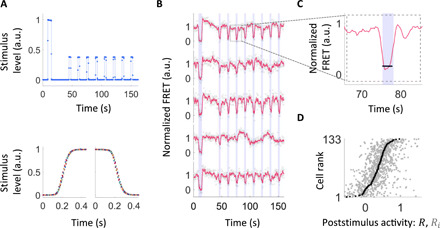
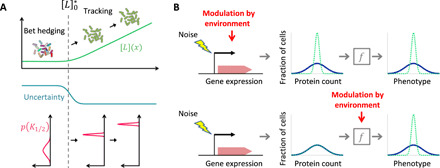
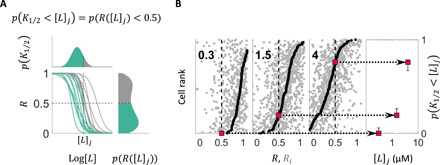
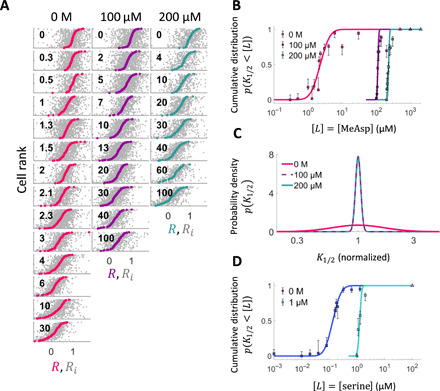
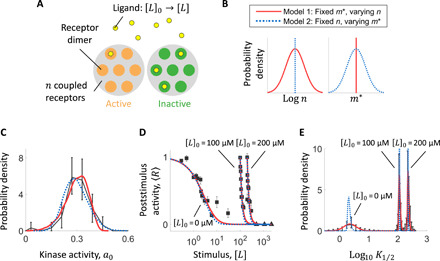
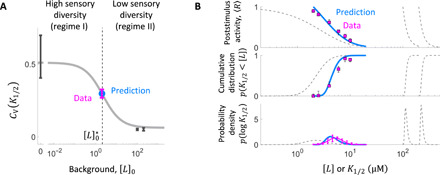
In the face of uncertainty, cell populations tend to diversify to enhance survival and growth. Previous studies established that cells can optimize such bet hedging upon environmental change by modulating gene expression to adapt both the average and diversity of phenotypes. Here, we demonstrate that cells can tune phenotypic diversity also using posttranslational modifications. In the chemotaxis network of , we find, for both major chemoreceptors Tar and Tsr, that cell-to-cell variation in response sensitivity is dynamically modulated depending on the presence or absence of their cognate chemoeffector ligands in the environment. Combining experiments with mathematical modeling, we show that this diversity tuning requires only the environment-dependent covalent modification of chemoreceptors and a standing cell-to-cell variation in their allosteric coupling. Thus, when environmental cues are unavailable, phenotypic diversity enhances the population's readiness for many signals. However, once a signal is perceived, the population focuses on tracking that signal.
面对不确定性,细胞群体往往会多样化以增强生存和生长。先前的研究已经证实,细胞可以通过调节基因表达来适应环境变化,从而优化这种风险对冲,以适应表型的平均值和多样性。在这里,我们证明细胞也可以使用翻译后修饰来调节表型多样性。在的趋化作用网络中,我们发现,对于主要的趋化受体 Tar 和 Tsr,它们对响应灵敏度的细胞间变异性是根据环境中是否存在其同源化学感受器配体而动态调节的。通过实验和数学建模相结合,我们表明这种多样性调节只需要趋化受体的环境依赖性共价修饰,以及它们变构偶联的细胞间固有变异性。因此,当环境线索不可用时,表型多样性会增强群体对多种信号的准备程度。但是,一旦感知到信号,群体就会专注于跟踪该信号。