Lefebvre Gregory, Shevlyakova Maya, Charpagne Aline, Marquis Julien, Vogel Mandy, Kirsten Toralf, Kiess Wieland, Austin Sean, Sprenger Norbert, Binia Aristea
Société des Produits Nestlé SA-Nestlé Research, Ecole Polytechnique Fédéral de Lausanne Innovation Park, Lausanne, Switzerland.
Société des Produits Nestlé SA-Nestlé Research, Lausanne, Switzerland.
Front Nutr. 2020 Oct 29;7:574459. doi: 10.3389/fnut.2020.574459. eCollection 2020.
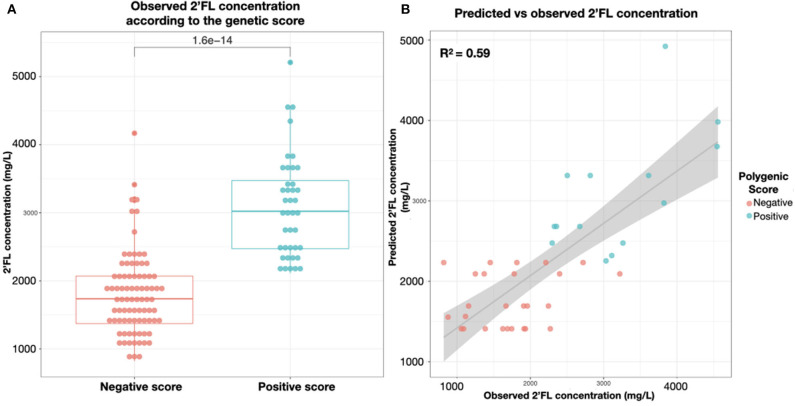
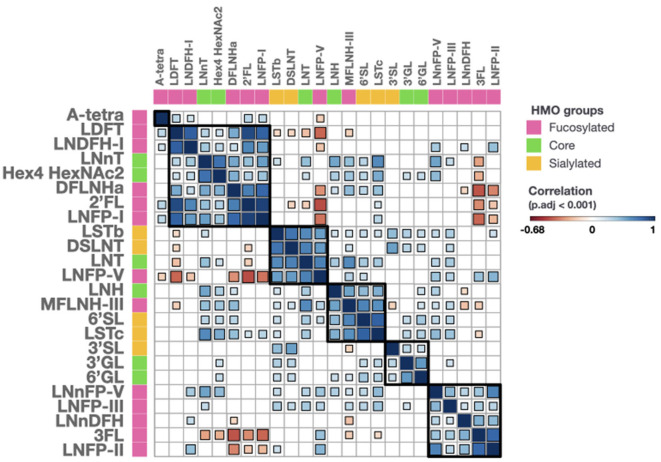
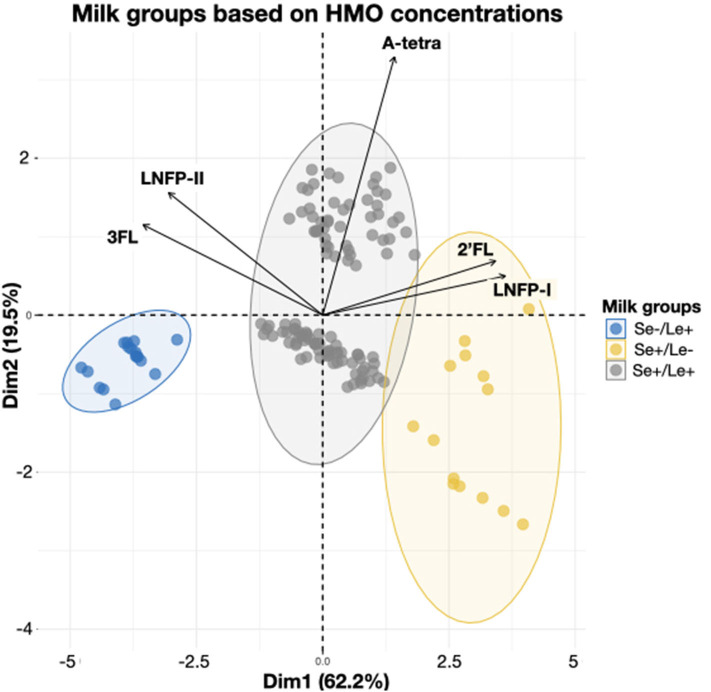
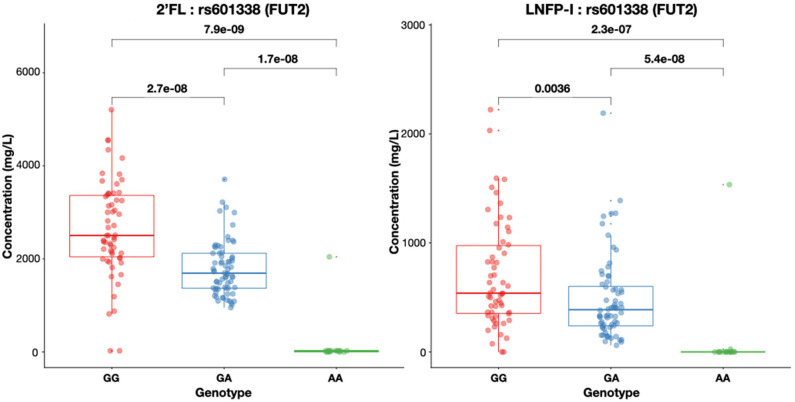
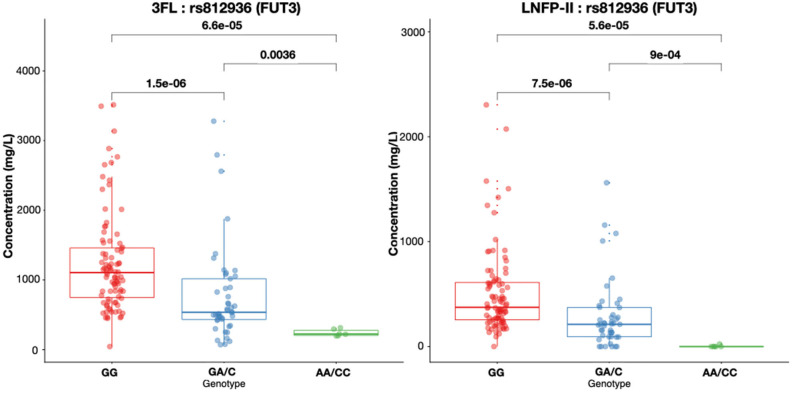
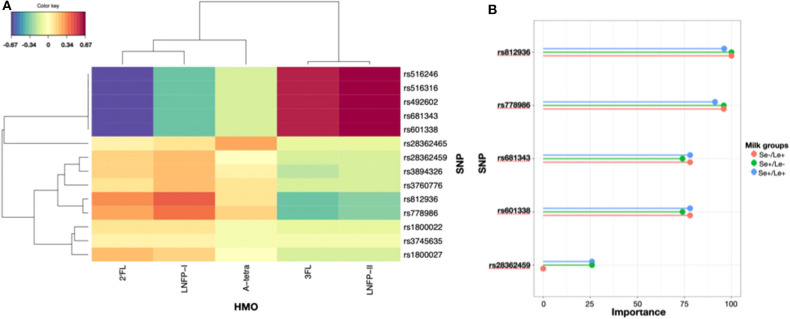
Human milk oligosaccharides (HMOs) vary among mothers and genetic factors contribute to this variability. We assessed changes in HMO concentrations during the first year of lactation and the relationship with Secretor group and Lewis group defining genetic polymorphisms. Milk samples were collected from lactating mothers participating in the LIFE Child cohort in Leipzig, Germany. The concentrations of 24 HMOs in milk samples collected at 3 months ( = 156), 6 months ( = 122), and 12 months ( = 28) were measured using liquid chromatography. Concentrations of HMOs were compared at all time-points and were tested for their associations with and genetic variations by sPLS regression. SNP rs601338 was found to predominantly define the Secretor status Se-: 11.8% and it was highly correlated with 2'-fucosyllactose (2'FL, < 0.001) and lacto-N-fucosylpentaose-I (LNFP-I, < 0.001). SNPs rs28362459 and rs812936 were found to define Lewis status (Le-: 5.9%) and correlated with lacto-N-fucosylpentaose-II (LNFP-II, < 0.001). A polygenic score predicted the abundance of 2'FL levels within Secretors' milk (adj. = 0.58, < 0.001). Mean concentrations of most of the individual HMOs, as well as the sums of the measured HMOs, the fucosylated HMOs, and the neutral HMOs were lower at 6 and 12 months compared to 3 months ( < 0.001). Secretor and Lewis status defined by specific and SNPs are confirmed to be good proxies for specific individual HMOs and milk group variabilities. The polygenic score developed here is an opportunity for clinicians to predict 2'FL levels in milk of future mothers. These results show opportunities to strengthen our understanding of factors controlling FUT2 and FUT3 functionality, the temporal changes and variability of HMO composition during lactation and eventually their significance for infant development.
人乳寡糖(HMOs)在不同母亲之间存在差异,遗传因素导致了这种变异性。我们评估了哺乳期第一年HMO浓度的变化以及与定义遗传多态性的分泌型组和Lewis组的关系。从参与德国莱比锡LIFE儿童队列研究的哺乳期母亲中收集乳汁样本。使用液相色谱法测量在3个月(n = 156)、6个月(n = 122)和12个月(n = 28)时收集的乳汁样本中24种HMO的浓度。在所有时间点比较HMO的浓度,并通过稀疏偏最小二乘回归测试它们与Se和Le基因变异的关联。发现单核苷酸多态性(SNP)rs601338主要决定分泌型状态Se - :11.8%,并且它与2'-岩藻糖基乳糖(2'FL,P < 0.001)和乳糖-N-岩藻糖基五糖-I(LNFP-I,P < 0.001)高度相关。发现SNP rs28362459和rs812936决定Lewis状态(Le - :5.9%),并与乳糖-N-岩藻糖基五糖-II(LNFP-II,P < 0.001)相关。一个多基因评分预测了分泌型母亲乳汁中2'FL水平的丰度(调整后R² = 0.58,P < 0.001)。与3个月相比,大多数个体HMO的平均浓度以及所测HMO、岩藻糖基化HMO和中性HMO的总和在6个月和12个月时较低(P < 0.001)。由特定Se和Le SNPs定义的分泌型和Lewis状态被证实是特定个体HMO和乳汁组变异性的良好代表。这里开发的多基因评分使临床医生有机会预测未来母亲乳汁中的2'FL水平。这些结果显示了加强我们对控制FUT2和FUT3功能的因素、哺乳期HMO组成的时间变化和变异性以及最终它们对婴儿发育的意义的理解的机会。