Department of Liver Surgery, Center of Liver Transplantation, West China Hospital, Sichuan University, 37 Guo Xue Road, Chengdu, 610041, Sichuan Province, China.
Department of Hepatobiliary Surgery, the Second Affiliated Hospital of Army Medical University, No. 183 Xinqiao High Street, Shapingba District, Chongqing, 400037, China.
Cancer Imaging. 2020 Nov 16;20(1):82. doi: 10.1186/s40644-020-00360-9.
Hepatocellular carcinoma (HCC) is associated with a dismal prognosis, and prediction of the prognosis of HCC can assist in therapeutic decision-makings. An increasing number of studies have shown that the texture parameters of images can reflect the heterogeneity of tumors, and may have the potential to predict the prognosis of patients with HCC after surgical resection. The aim of this study was to investigate the prognostic value of computed tomography (CT) texture parameters in patients with HCC after hepatectomy and to develop a radiomics nomogram by combining clinicopathological factors and the radiomics signature.
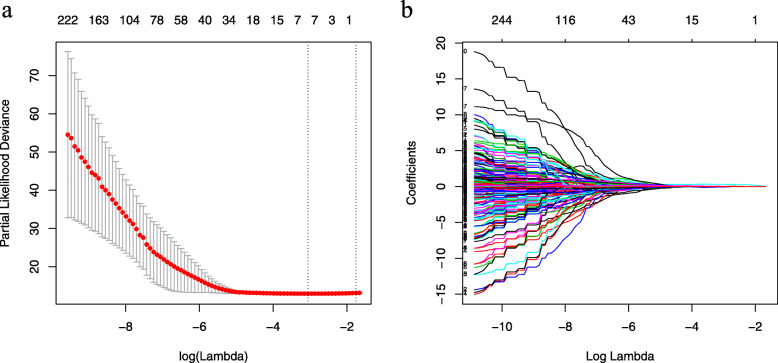
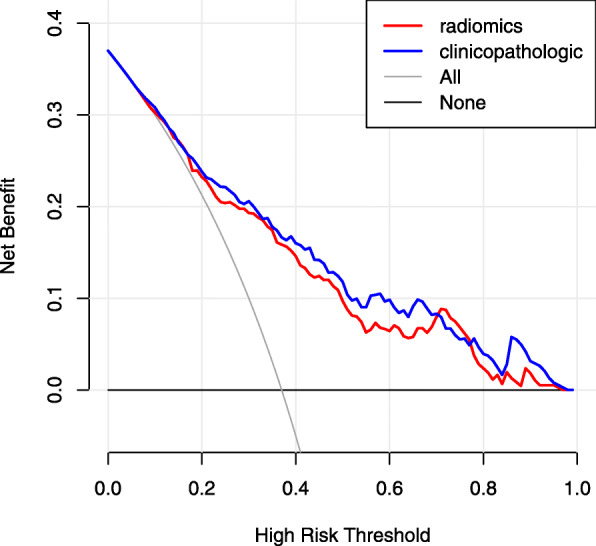
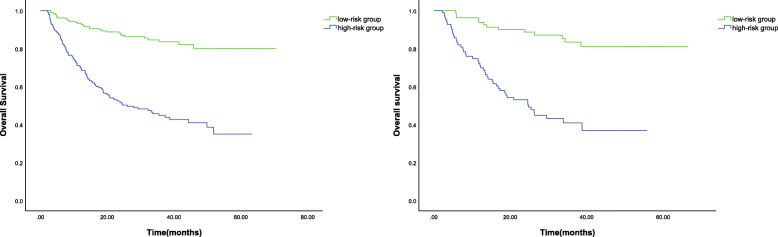
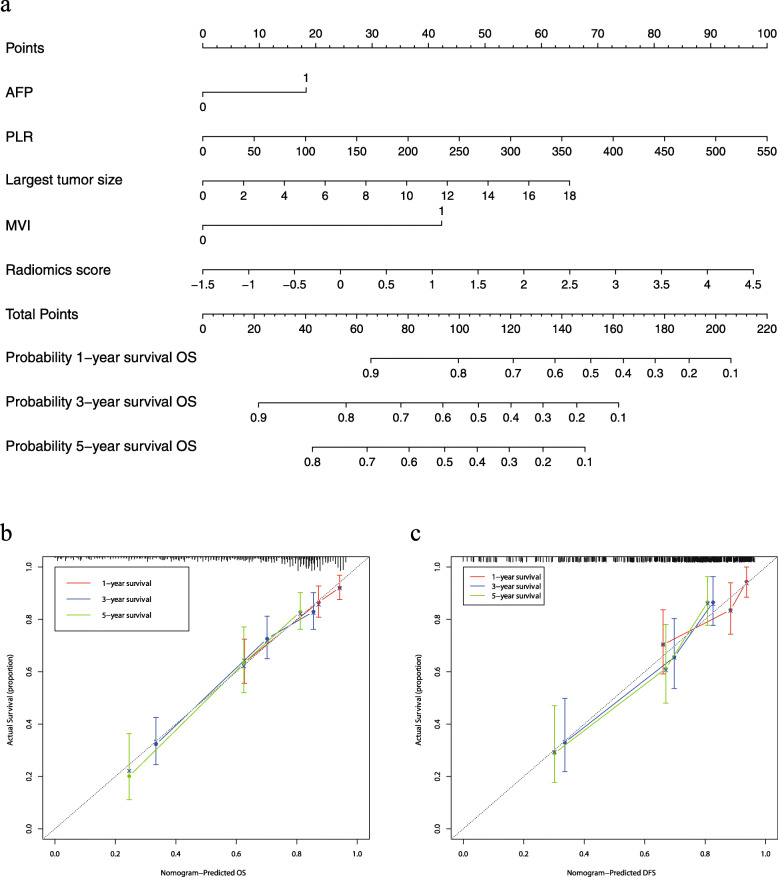
In all, 544 eligible patients were enrolled in this retrospective study and were randomly divided into the training cohort (n = 381) and the validation cohort (n = 163). The tumor regions of interest (ROIs) were delineated, and the corresponding texture parameters were extracted. The texture parameters were selected by using the least absolute shrinkage and selection operator (LASSO) Cox model in the training cohort, and a radiomics signature was established. Then, the radiomics signature was further validated as an independent risk factor for overall survival (OS). The radiomics nomogram was established based on the Cox regression model. The concordance index (C-index), calibration plot and decision curve analysis (DCA) were used to evaluate the performance of the radiomics nomogram.
The radiomics signature was formulated based on 7 OS-related texture parameters, which were selected in the training cohort. In addition, the radiomics nomogram was developed based on the following five variables: α-fetoprotein (AFP), platelet-to-lymphocyte ratio (PLR), largest tumor size, microvascular invasion (MVI) and radiomics score (Rad-score). The nomogram displayed good accuracy in predicting OS (C-index = 0.747) in the training cohort and was confirmed in the validation cohort (C-index = 0.777). The calibration plots also showed excellent agreement between the actual and predicted survival probabilities. The DCA indicated that the radiomics nomogram showed better clinical utility than the clinicopathologic nomogram.
The radiomics signature is a potential prognostic biomarker of HCC after hepatectomy. The radiomics nomogram that integrated the radiomics signature can provide a more accurate estimation of OS than the clinicopathologic nomogram for HCC patients after hepatectomy.
肝细胞癌(HCC)预后较差,预测 HCC 的预后有助于治疗决策。越来越多的研究表明,图像的纹理参数可以反映肿瘤的异质性,并且可能有潜力预测 HCC 患者手术后的预后。本研究旨在探讨 CT 纹理参数对 HCC 患者肝切除术后预后的预测价值,并结合临床病理因素和放射组学特征建立放射组学列线图。
本回顾性研究共纳入 544 例符合条件的患者,随机分为训练队列(n=381)和验证队列(n=163)。勾画肿瘤感兴趣区(ROI),提取相应的纹理参数。在训练队列中,使用最小绝对值收缩和选择算子(LASSO)Cox 模型选择纹理参数,并建立放射组学特征。然后,进一步验证放射组学特征是否为总生存期(OS)的独立危险因素。基于 Cox 回归模型建立放射组学列线图。采用一致性指数(C-index)、校准图和决策曲线分析(DCA)评估放射组学列线图的性能。
基于 7 个与 OS 相关的纹理参数,构建了放射组学特征,该特征在训练队列中进行了验证。此外,基于以下 5 个变量:甲胎蛋白(AFP)、血小板与淋巴细胞比值(PLR)、最大肿瘤直径、微血管侵犯(MVI)和放射组学评分(Rad-score)建立了放射组学列线图。该列线图在训练队列中预测 OS 的准确性较高(C-index=0.747),并在验证队列中得到验证(C-index=0.777)。校准图也显示了实际和预测生存率之间的良好一致性。DCA 表明,放射组学列线图比临床病理列线图具有更好的临床实用性。
放射组学特征是 HCC 患者肝切除术后潜在的预后生物标志物。放射组学列线图结合放射组学特征,可以为 HCC 患者肝切除术后提供比临床病理列线图更准确的 OS 估计。