Department of Liver Surgery and Transplantation, Liver Cancer Institute, Zhongshan Hospital and Key Laboratory of Carcinogenesis and Cancer Invasion, Fudan University, 180 Fenglin Road, Shanghai, 200032, China.
Department of Hematology, Shanghai Jiao Tong University School of Medicine Affiliated Tongren Hospital, Shanghai, China.
BMC Cancer. 2018 Nov 21;18(1):1148. doi: 10.1186/s12885-018-5024-z.
Radiomics is an emerging field in oncological research. In this study, we aimed at developing a radiomics score (rad-score) to estimate postoperative recurrence and survival in patients with solitary hepatocellular carcinoma (HCC).
A total of 319 solitary HCC patients (training cohort: n = 212; validation cohort: n = 107) were enrolled. Radiomics features were extracted from the artery phase of preoperatively acquired computed tomography (CT) in all patients. A rad-score was generated by using the least absolute shrinkage and selection operator (lasso) logistic model. Kaplan-Meier and Cox's hazard regression analyses were used to evaluate the prognostic significance of the rad-score. Final nomograms predicting recurrence and survival of solitary HCC patients were established based on the rad-score and clinicopathological factors. C-index and calibration statistics were used to assess the performance of nomograms.
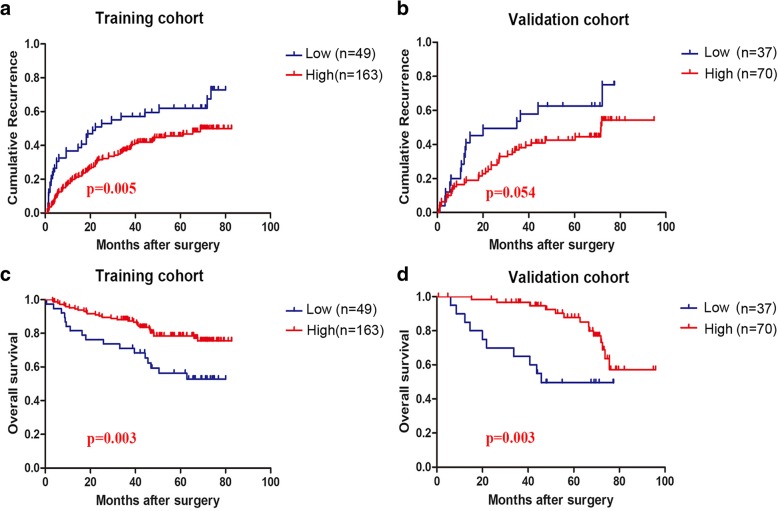
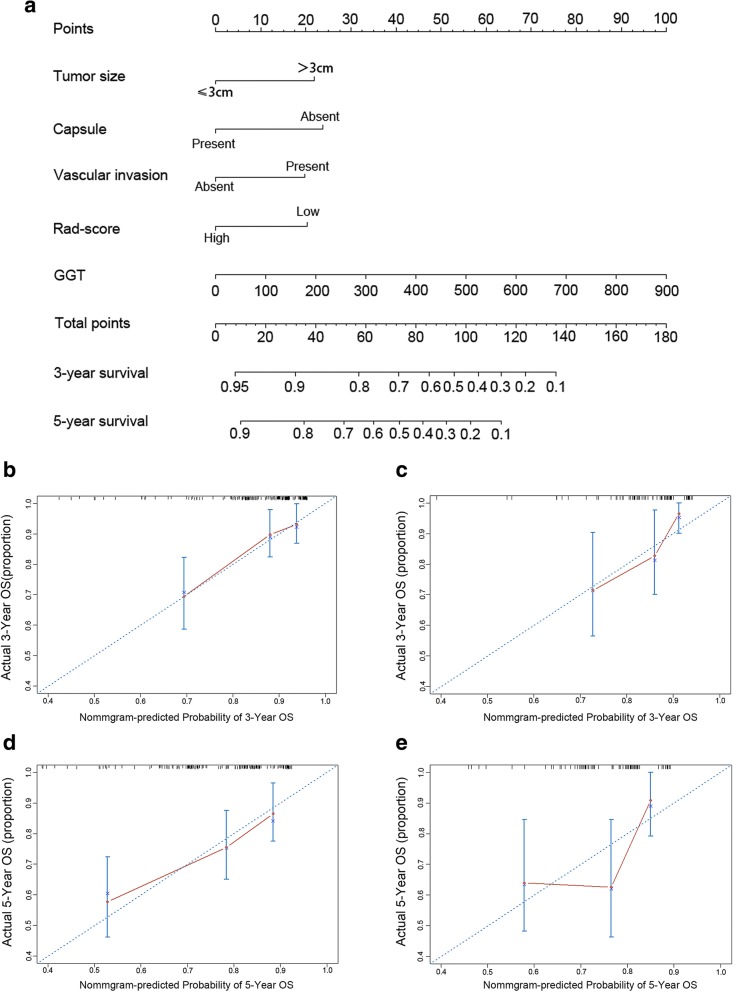
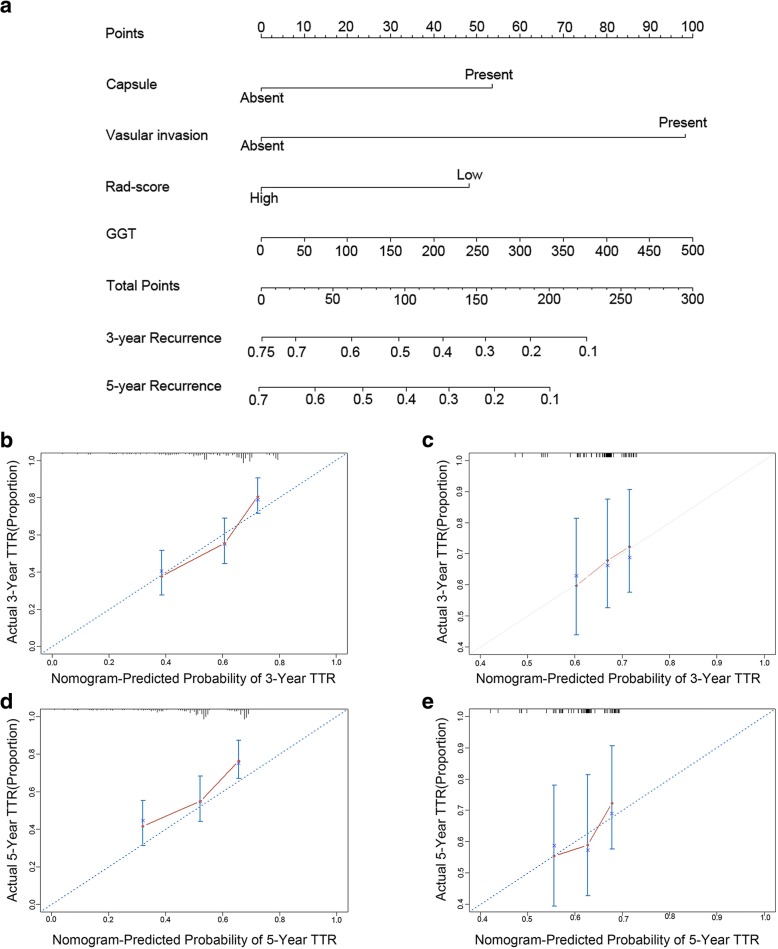
Six potential radiomics features were selected out of 110 texture features to formulate the rad-score. Low rad-score positively correlated with aggressive tumor phenotypes, like larger tumor size and vascular invasion. Meanwhile, low rad-score was significantly associated with increased recurrence and reduced survival. In addition, multivariate analysis identified the rad-score as an independent prognostic factor (recurrence: Hazard ratio (HR): 2.472, 95% confident interval (CI): 1.339-4.564, p = 0.004;survival: HR: 1.558, 95%CI: 1.022-2.375, p = 0.039). Notably, the nomogram integrating rad-score had a better prognostic performance as compared with traditional staging systems. These results were further confirmed in the validation cohort.
The preoperative CT image based rad-score was an independent prognostic factor for the postoperative outcome of solitary HCC patients. This score may be complementary to the current staging system and help to stratify individualized treatments for solitary HCC patients.
放射组学是肿瘤学研究中的一个新兴领域。在这项研究中,我们旨在开发一种放射组学评分(rad-score),以估计单发肝细胞癌(HCC)患者的术后复发和生存情况。
共纳入 319 例单发 HCC 患者(训练队列:n=212;验证队列:n=107)。所有患者均在术前获取的 CT 动脉期采集放射组学特征。使用最小绝对值收缩和选择算子(lasso)逻辑模型生成 rad-score。Kaplan-Meier 和 Cox 风险回归分析用于评估 rad-score 的预后意义。最终基于 rad-score 和临床病理因素建立了预测单发 HCC 患者复发和生存的列线图。C 指数和校准统计用于评估列线图的性能。
从 110 个纹理特征中选择出 6 个潜在的放射组学特征来制定 rad-score。低 rad-score 与侵袭性肿瘤表型呈正相关,如肿瘤较大和血管侵犯。同时,低 rad-score 与复发增加和生存时间缩短显著相关。此外,多变量分析确定 rad-score 为独立的预后因素(复发:风险比(HR):2.472,95%置信区间(CI):1.339-4.564,p=0.004;生存:HR:1.558,95%CI:1.022-2.375,p=0.039)。值得注意的是,整合 rad-score 的列线图具有比传统分期系统更好的预后性能。这些结果在验证队列中得到进一步证实。
基于术前 CT 图像的 rad-score 是单发 HCC 患者术后结局的独立预后因素。该评分可能对当前的分期系统具有补充作用,并有助于为单发 HCC 患者分层个体化治疗。