Department of Psychology, University of Waterloo, 200 University Ave. W., Waterloo, ON N2L 3G1, Canada.
Division of Tobacco Control Policy Research, National Cancer Center Japan, 5-1-1 Tsukiji, Chuo-ku, Tokyo 104-0045, Japan.
Int J Environ Res Public Health. 2020 Nov 13;17(22):8418. doi: 10.3390/ijerph17228418.
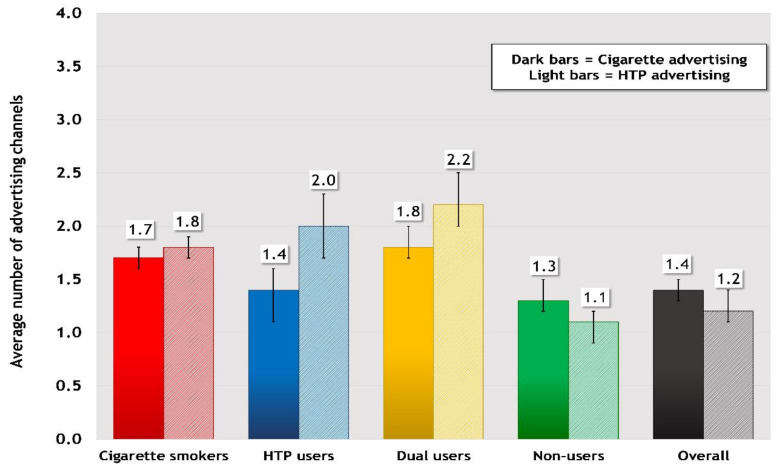
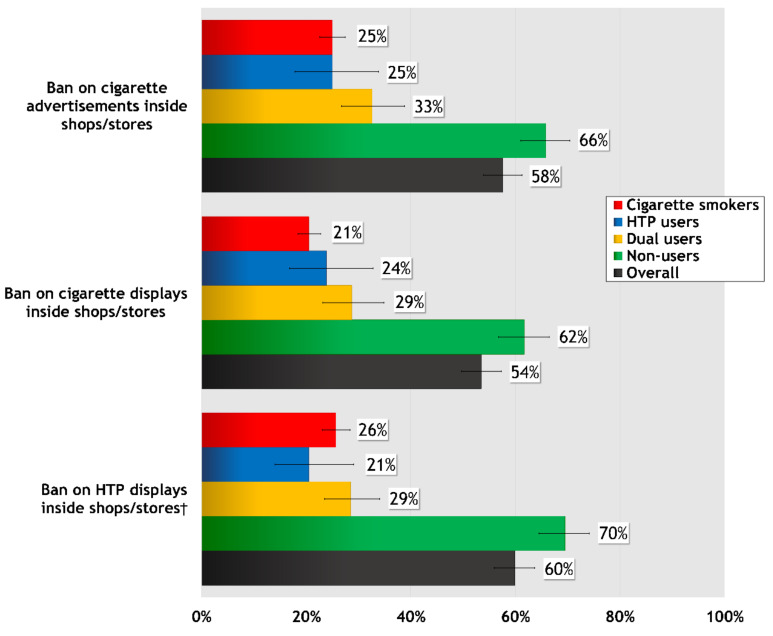
Japan is one of the world's largest cigarette markets and the top heated tobacco product (HTP) market. No forms of tobacco advertising, promotion, and sponsorship (TAPS) are banned under national law, although the industry has some voluntary TAPS restrictions. This study examines Japanese tobacco users' self-reported exposure to cigarette and HTP marketing through eight channels, as well as their support for TAPS bans. Data are from the 2018 ITC Japan Survey, a cohort survey of adult exclusive cigarette smokers ( = 3288), exclusive HTP users ( = 164), HTP-cigarette dual users ( = 549), and non-users ( = 614). Measures of overall average exposure to the eight channels of cigarette and HTP advertising were constructed to examine differences in exposure across user groups and products. Dual users reported the highest exposure to cigarette and HTP advertising. Tobacco users (those who used cigarettes, HTPs, or both) reported higher average exposure to HTP compared to cigarette advertising, however non-users reported higher average exposure to cigarette compared to HTP advertising. Retail stores where tobacco or HTPs are sold were the most prevalent channel for HTP and cigarette advertising, reported by 30-43% of non-users to 66-71% of dual users. Non-users reported similar exposure to cigarette advertising via television and newspapers/magazines as cigarette smokers and dual users; however, advertising via websites/social media was lower among non-users and HTP users than among cigarette smokers and dual users ( < 0.05). Most respondents supported a ban on cigarette (54%) and HTP (60%) product displays in stores, and cigarette advertising in stores (58%).
日本是世界上最大的香烟市场之一,也是顶级加热烟草产品(HTP)市场。尽管该行业有一些自愿的 TAPS 限制,但国家法律并未禁止任何形式的烟草广告、促销和赞助(TAPS)。本研究通过八种渠道调查了日本烟草使用者对香烟和 HTP 营销的自我报告暴露情况,以及他们对 TAPS 禁令的支持情况。数据来自 2018 年 ITC 日本调查,这是一项针对成年纯香烟吸烟者(=3288)、纯 HTP 用户(=164)、HTP-香烟双重使用者(=549)和非使用者(=614)的队列调查。构建了衡量对八种渠道的香烟和 HTP 广告的总体平均暴露量的指标,以检验不同使用者群体和产品之间的暴露差异。双重使用者报告的对香烟和 HTP 广告的暴露最高。与 HTP 广告相比,烟草使用者(使用香烟、HTP 或两者的人)报告的 HTP 平均暴露更高,然而,非使用者报告的对香烟的平均暴露高于 HTP 广告。销售烟草或 HTP 的零售店是 HTP 和香烟广告最常见的渠道,非使用者报告的比例为 30-43%,双重使用者报告的比例为 66-71%。非使用者报告的通过电视和报纸/杂志接触香烟广告的情况与香烟吸烟者和双重使用者相似;然而,与香烟吸烟者和双重使用者相比,非使用者和 HTP 用户通过网站/社交媒体接触广告的比例较低(<0.05)。大多数受访者支持在商店中禁止展示香烟(54%)和 HTP(60%)产品,以及在商店中进行香烟广告(58%)。