Department of Psychology, University of Waterloo, Waterloo, ON N2L 3G1, Canada.
Ontario Institute for Cancer Research, Toronto, ON M5G 0A3, Canada.
Int J Environ Res Public Health. 2020 Apr 1;17(7):2394. doi: 10.3390/ijerph17072394.
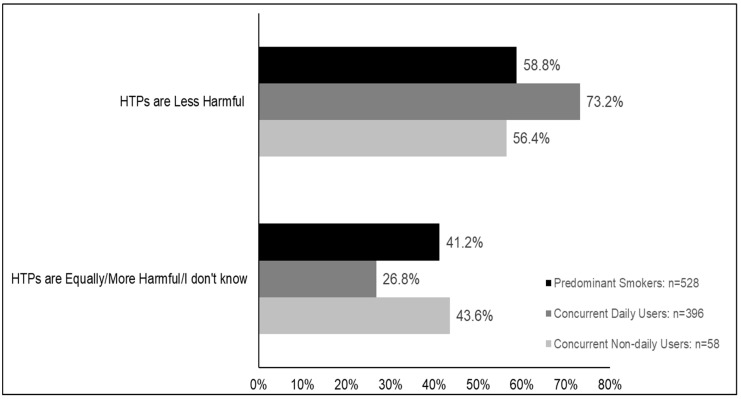
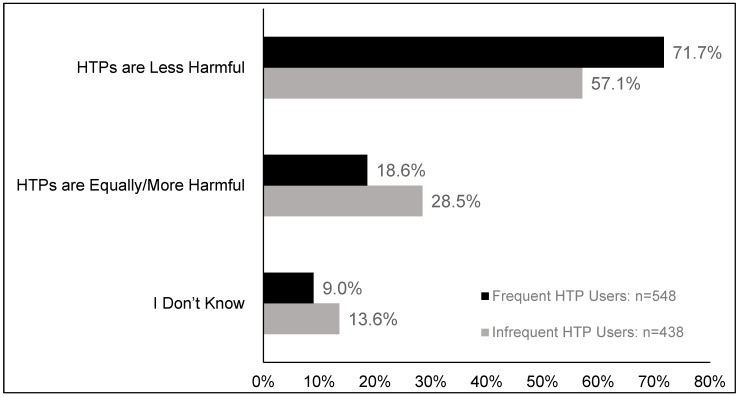
In Japan, the tobacco industry promotes heated tobacco products (HTPs) as a reduced-risk tobacco product. This study examines: (1) smokers' harm perceptions of HTPs relative to combustible cigarettes; (2) differences in relative harm perceptions between exclusive smokers and smokers who use HTPs (concurrent users) and between concurrent users based on frequency of product use; and (3) if smokers who were exposed to HTP advertising hold beliefs that are consistent with marketing messages of lower harmfulness. This cross-sectional study included 2614 adult exclusive cigarette smokers and 986 concurrent users who reported their perceptions of harmfulness of HTPs compared to cigarettes, as well as their exposure to HTP advertising in the last six months. Among all smokers, 47.5% perceive that HTPs are less harmful than cigarettes, 24.6% perceive HTPs to be equally as harmful, 1.8% perceive HTPs as more harmful, and 26.1% did not know. Concurrent users are more likely than exclusive smokers to believe that HTPs are less harmful (62.1% versus 43.8%, < 0.0001) and less likely to report that they did not know (14.3% versus 29.4%, < 0.0001). Frequent HTP users are more likely than infrequent users to believe that HTPs are less harmful (71.7% versus 57.1%, ≤ 0.001). Believing that HTPs are less harmful than cigarettes was associated with noticing HTP advertising on TV ( = 0.0005), in newspapers/magazines ( = 0.0001), on posters/billboards ( < 0.0001), in stores where tobacco ( < 0.0001) or where HTPs ( < 0.0001) are sold, on social media ( < 0.0001), or in bars/pubs ( = 0.04). HTP users were significantly more likely than non-HTP users to believe that HTPs are less harmful than cigarettes, with this belief being more prominent among frequent users. Smokers who have been exposed to HTP advertising were more likely to perceive HTPs as less harmful than cigarettes.
在日本,烟草业将加热烟草产品(HTP)宣传为低风险烟草产品。本研究旨在探讨:(1)吸烟者对 HTP 相对于可燃香烟的危害感知;(2)仅吸烟与同时使用 HTP 的吸烟者(同时使用者)之间以及基于产品使用频率的同时使用者之间的相对危害感知差异;(3)如果吸烟者接触到 HTP 广告,他们是否持有与低危害性营销信息一致的信念。这项横断面研究包括 2614 名成年香烟独吸者和 986 名同时使用者,他们报告了对 HTP 相对于香烟的危害性的感知,以及在过去六个月中接触 HTP 广告的情况。在所有吸烟者中,47.5%的人认为 HTP 比香烟危害性小,24.6%的人认为 HTP 与香烟危害性相同,1.8%的人认为 HTP 危害性更大,26.1%的人不知道。与仅吸烟的吸烟者相比,同时使用者更有可能认为 HTP 危害性较小(62.1%比 43.8%,<0.0001),而不太可能表示不知道(14.3%比 29.4%,<0.0001)。频繁使用 HTP 的人比不频繁使用者更有可能认为 HTP 危害性较小(71.7%比 57.1%,≤0.001)。认为 HTP 比香烟危害性小与注意到 HTP 在电视上(=0.0005)、报纸/杂志上(=0.0001)、海报/广告牌上(<0.0001)、销售烟草的商店(<0.0001)、销售 HTP 的商店(<0.0001)、社交媒体上(<0.0001)或酒吧/酒馆(=0.04)上的 HTP 广告有关。与非 HTP 用户相比,HTP 用户更有可能认为 HTP 比香烟危害性小,而这种信念在频繁使用者中更为明显。接触过 HTP 广告的吸烟者更有可能认为 HTP 比香烟危害性小。