Linköping Univ., Sweden.
Perimed AB, Sweden.
J Biomed Opt. 2020 Nov;25(11). doi: 10.1117/1.JBO.25.11.112905.
Diffuse reflectance spectroscopy (DRS) is frequently used to assess oxygen saturation and hemoglobin concentration in living tissue. Methods solving the inverse problem may include time-consuming nonlinear optimization or artificial neural networks (ANN) determining the absorption coefficient one wavelength at a time.
To present an ANN-based method that directly outputs the oxygen saturation and the hemoglobin concentration using the shape of the measured spectra as input.
A probe-based DRS setup with dual source-detector separations in the visible wavelength range was used. ANNs were trained on spectra generated from a three-layer tissue model with oxygen saturation and hemoglobin concentration as target.
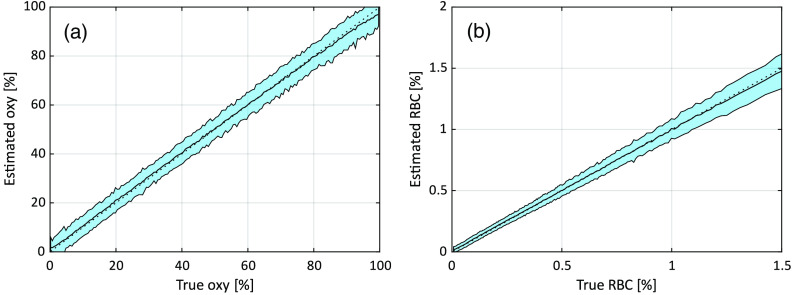
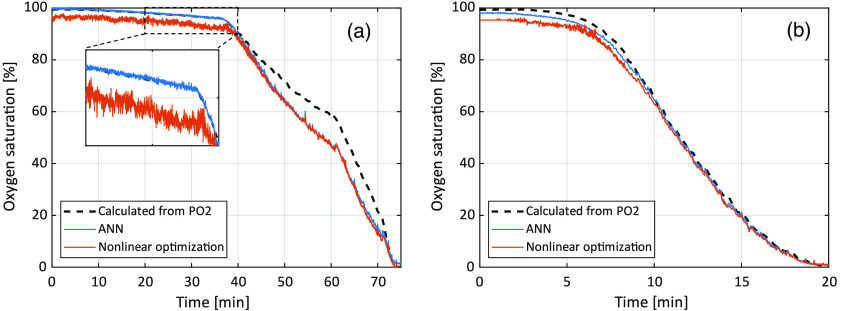
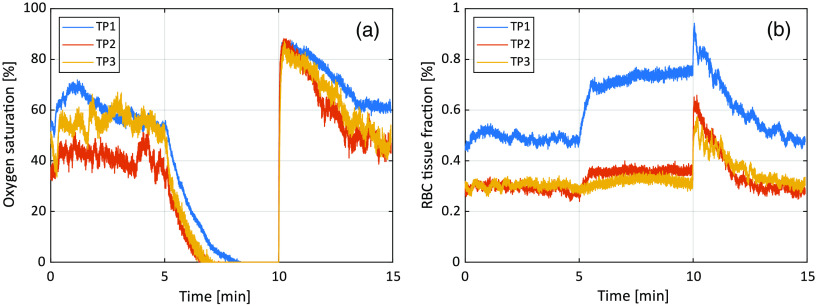
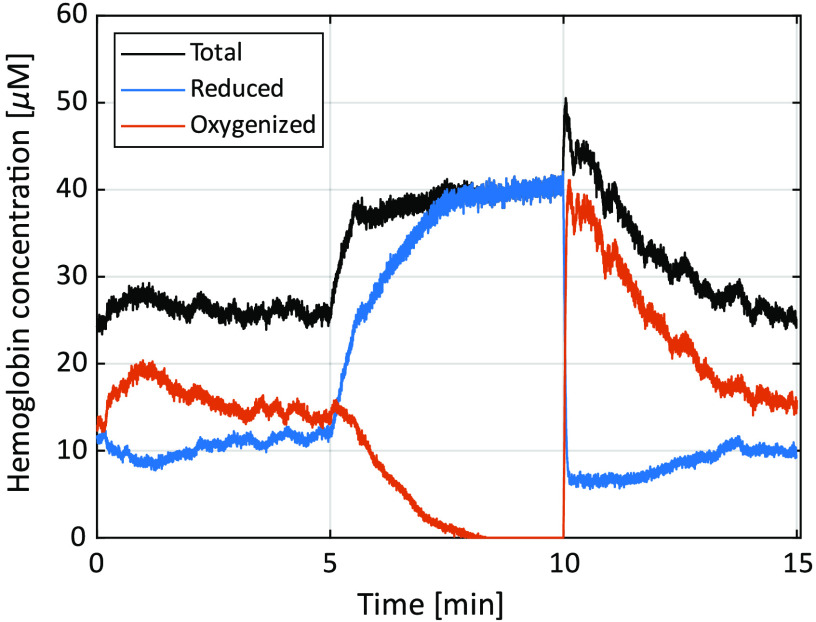
Modeled evaluation data with realistic measurement noise showed an absolute root-mean-square (RMS) deviation of 5.1% units for oxygen saturation estimation. The relative RMS deviation for hemoglobin concentration was 13%. This accuracy is at least twice as good as our previous nonlinear optimization method. On blood-intralipid phantoms, the RMS deviation from the oxygen saturation derived from partial oxygen pressure measurements was 5.3% and 1.6% in two separate measurement series. Results during brachial occlusion showed expected patterns.
The presented method, directly assessing oxygen saturation and hemoglobin concentration, is fast, accurate, and robust to noise.
漫反射光谱(DRS)常用于评估活体组织中的氧饱和度和血红蛋白浓度。解决反问题的方法可能包括耗时的非线性优化或人工神经网络(ANN),一次确定一个波长的吸收系数。
提出一种基于 ANN 的方法,直接将测量光谱的形状作为输入,输出氧饱和度和血红蛋白浓度。
使用可见波长范围内具有双源-探测器分离的探头式 DRS 装置。ANN 基于具有氧饱和度和血红蛋白浓度作为目标的三层组织模型生成的光谱进行训练。
具有实际测量噪声的模型评估数据显示,氧饱和度估计的绝对均方根(RMS)偏差为 5.1%。血红蛋白浓度的相对 RMS 偏差为 13%。该准确性至少是我们之前的非线性优化方法的两倍。在血液-脂肪乳剂体模上,从部分氧压力测量得出的氧饱和度的 RMS 偏差在两个单独的测量系列中分别为 5.3%和 1.6%。肱动脉闭塞期间的结果显示出预期的模式。
所提出的方法直接评估氧饱和度和血红蛋白浓度,快速、准确且对噪声具有鲁棒性。