Laiton-Donato Katherine, Villabona-Arenas Christian Julián, Usme-Ciro José A, Franco-Muñoz Carlos, Álvarez-Díaz Diego A, Villabona-Arenas Liz Stephany, Echeverría-Londoño Susy, Cucunubá Zulma M, Franco-Sierra Nicolás D, Flórez Astrid C, Ferro Carolina, Ajami Nadim J, Walteros Diana Marcela, Prieto Franklin, Durán Carlos Andrés, Ospina-Martínez Martha Lucia, Mercado-Reyes Marcela
Emerg Infect Dis. 2020 Dec;26(12):2854-2862. doi: 10.3201/eid2612.202969.
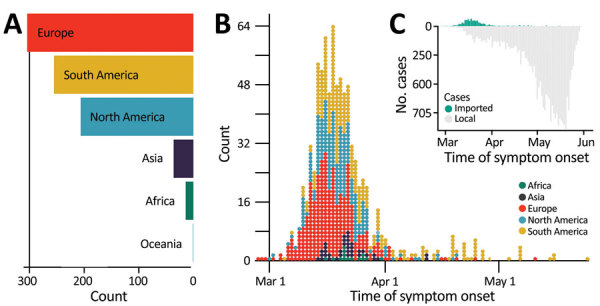
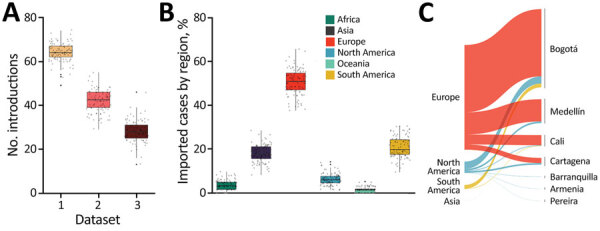
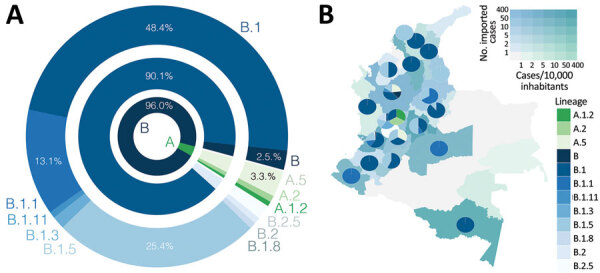
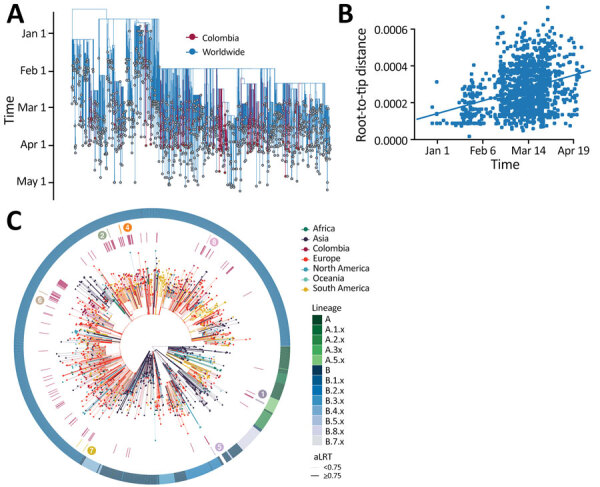
Coronavirus disease (COVID-19) in Colombia was first diagnosed in a traveler arriving from Italy on February 26, 2020. However, limited data are available on the origins and number of introductions of COVID-19 into the country. We sequenced the causative agent of COVID-19, severe acute respiratory syndrome coronavirus 2 (SARS-CoV-2), from 43 clinical samples we collected, along with another 79 genome sequences available from Colombia. We investigated the emergence and importation routes for SARS-CoV-2 into Colombia by using epidemiologic, historical air travel, and phylogenetic observations. Our study provides evidence of multiple introductions, mostly from Europe, and documents >12 lineages. Phylogenetic findings validate the lineage diversity, support multiple importation events, and demonstrate the evolutionary relationship of epidemiologically linked transmission chains. Our results reconstruct the early evolutionary history of SARS-CoV-2 in Colombia and highlight the advantages of genome sequencing to complement COVID-19 outbreak investigations.
2020年2月26日,哥伦比亚首次在一名从意大利抵达的旅行者身上诊断出冠状病毒病(COVID-19)。然而,关于COVID-19传入该国的源头和次数的可用数据有限。我们对从我们收集的43份临床样本中提取的COVID-19病原体——严重急性呼吸综合征冠状病毒2(SARS-CoV-2)进行了测序,同时还有另外79个可从哥伦比亚获取的基因组序列。我们通过流行病学、历史航空旅行和系统发育观察,研究了SARS-CoV-2传入哥伦比亚的情况及输入途径。我们的研究提供了多次传入的证据,多数来自欧洲,并记录了超过12个谱系。系统发育研究结果验证了谱系多样性,支持多次输入事件,并展示了流行病学相关传播链的进化关系。我们的结果重建了SARS-CoV-2在哥伦比亚的早期进化史,并突出了基因组测序在补充COVID-19疫情调查方面的优势。