Buchinger Wilhelmi Clinic Überlingen Germany.
Charité-Universitätsmedizin Berlincorporate member of Freie Universität BerlinHumboldt-Universität zu Berlin, and Berlin Institute of Health Berlin Germany.
J Am Heart Assoc. 2020 Dec;9(23):e018649. doi: 10.1161/JAHA.120.018649. Epub 2020 Nov 23.
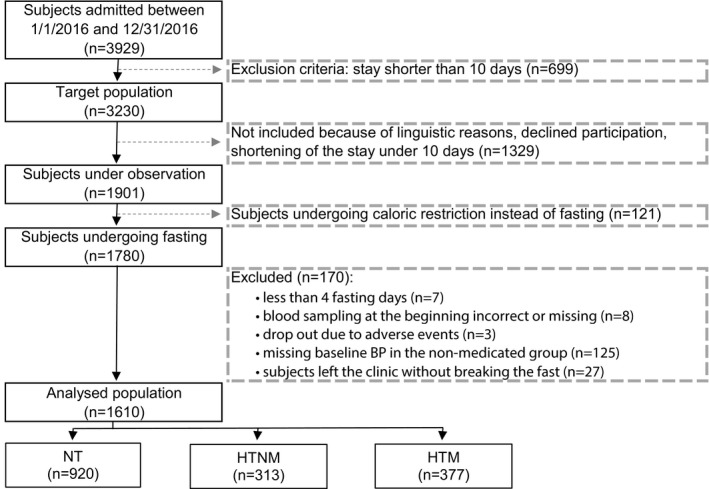
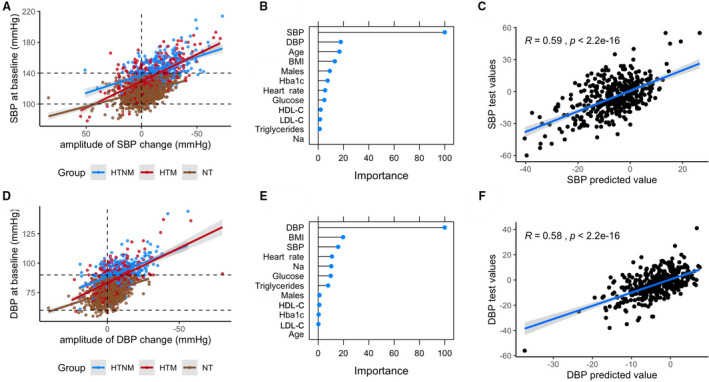
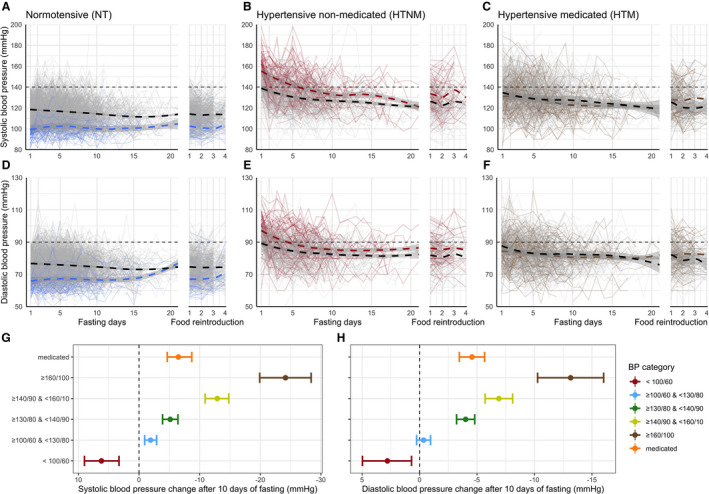
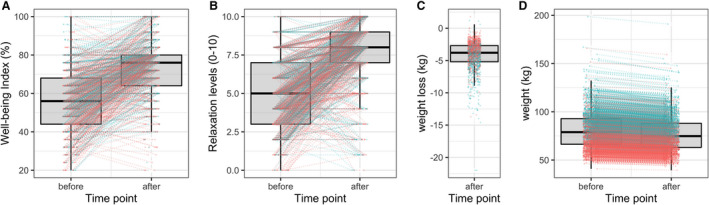
Background We investigated daily blood pressure (BP) changes during fasting periods ranging from 4 to 41 (10.0±3.8) days in a cohort of 1610 subjects, including 920 normotensive, 313 hypertensive nonmedicated, and 377 hypertensive medicated individuals. Methods and Results Subjects underwent a multidisciplinary fasting program with a daily intake of ≈250 kcal. Weight and stress scores decreased during fasting, and the well-being index increased, documenting a good tolerability. BP mean values decreased from 126.2±18.6/81.4±11.0 to 119.7±15.9/77.6±9.8 mm Hg (mean change, -6.5/3.8 mm Hg). BP changes were larger for hypertensive nonmedicated subjects (>140/90 mm Hg) and reduced by 16.7/8.8 mm Hg. This reduction reached 24.7/13.1 mm Hg for hypertensive nonmedicated subjects (n=76) with the highest BP (>160/100 mm Hg). In the normotensive group, BP decreased moderately by 3.0/1.9 mm Hg. Interestingly, we documented an increase of 6.3/2.2 mm Hg in a subgroup of 69 female subjects with BP <100/60 mm Hg. In the hypertensive medicated group, although BP decreased from 134.6/86.0 to 127.3/81.3 mm Hg, medication was stopped in 23.6% of the subjects, whereas dosage was reduced in 43.5% and remained unchanged in 19.4%. The decrease in BP was larger in subjects fasting longer. Baseline metabolic parameters, such as body mass index and glucose levels, as well as age, can be used to predict the amplitude of the BP decrease during fasting with a machine learning model. Conclusions Long-term fasting tends to decrease BP in subjects with elevated BP values. This effect persisted during the 4 days of stepwise food reintroduction, even when subjects stopped their antihypertensive medication. Registration URL: https://www.drks.de/drks_web/; Unique identifier: DRKS00010111.
背景 在一项包括 1610 名受试者的队列研究中,我们调查了禁食期从 4 天到 41 天(10.0±3.8)期间的日常血压(BP)变化,其中包括 920 名血压正常者、313 名未服用降压药的高血压者和 377 名服用降压药的高血压者。
方法和结果 受试者接受了一项多学科禁食计划,每天摄入约 250 卡路里。禁食期间体重和应激评分下降,健康指数增加,证明耐受性良好。BP 平均值从 126.2±18.6/81.4±11.0 降至 119.7±15.9/77.6±9.8mmHg(平均变化,-6.5/3.8mmHg)。未服用降压药的高血压者(>140/90mmHg)的 BP 变化更大,降低了 16.7/8.8mmHg。未服用降压药的高血压者(n=76)中血压最高(>160/100mmHg)者的这种降低达到 24.7/13.1mmHg。在血压正常组,BP 适度下降 3.0/1.9mmHg。有趣的是,我们在一组 69 名血压<100/60mmHg 的女性亚组中记录到 6.3/2.2mmHg 的增加。在服用降压药的高血压组中,尽管 BP 从 134.6/86.0 降至 127.3/81.3mmHg,但有 23.6%的受试者停止服用药物,43.5%的受试者减少剂量,19.4%的受试者剂量保持不变。禁食时间较长的受试者 BP 下降幅度更大。基于机器学习模型,基线代谢参数(如体重指数和血糖水平)和年龄可以预测禁食期间 BP 下降的幅度。
结论 长期禁食往往会降低血压升高者的血压。这种效应在逐步重新引入食物的 4 天内持续存在,即使受试者停止服用降压药物。