Mengu Deniz, Luo Yi, Rivenson Yair, Ozcan Aydogan
Electrical and Computer Engineering Department, Bioengineering Department, University of California, Los Angeles, CA 90095 USA, and also with the California NanoSystems Institute, University of California, Los Angeles, CA 90095 USA.
IEEE J Sel Top Quantum Electron. 2020 Jan-Feb;26(1). doi: 10.1109/JSTQE.2019.2921376. Epub 2019 Jun 6.
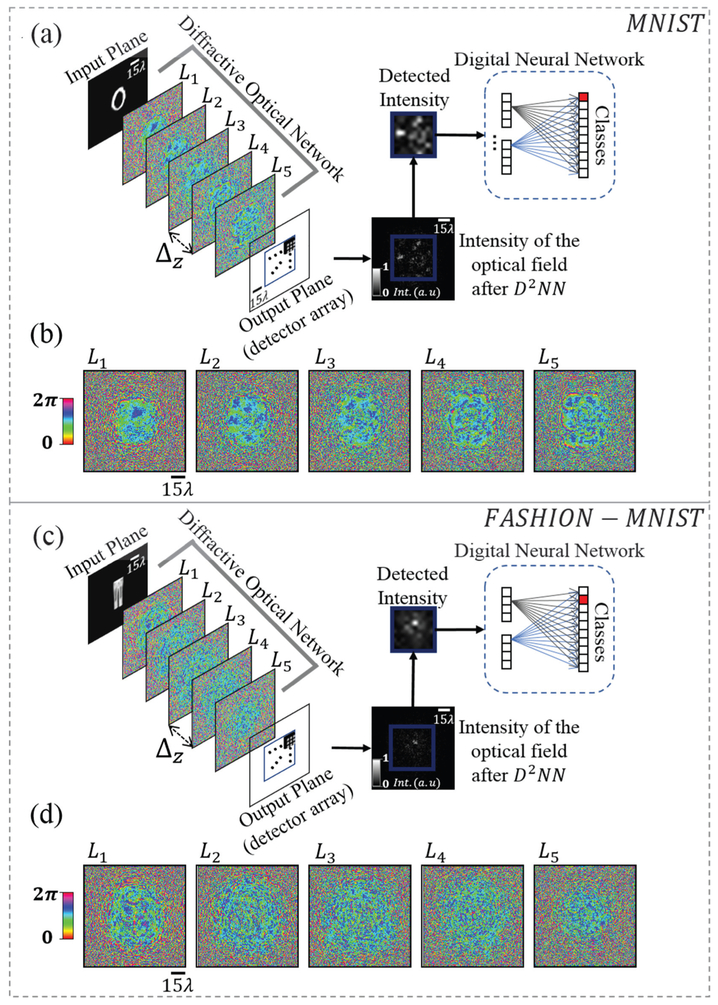
Optical machine learning offers advantages in terms of power efficiency, scalability and computation speed. Recently, an optical machine learning method based on Diffractive Deep Neural Networks (DNNs) has been introduced to execute a function as the input light diffracts through passive layers, designed by deep learning using a computer. Here we introduce improvements to DNNs by changing the training loss function and reducing the impact of vanishing gradients in the error back-propagation step. Using five phase-only diffractive layers, we numerically achieved a classification accuracy of 97.18% and 89.13% for optical recognition of handwritten digits and fashion products, respectively; using both phase and amplitude modulation (complex-valued) at each layer, our inference performance improved to 97.81% and 89.32%, respectively. Furthermore, we report the integration of DNNs with electronic neural networks to create hybrid-classifiers that significantly reduce the number of input pixels into an electronic network using an ultra-compact front-end DNN with a layer-to-layer distance of a few wavelengths, also reducing the complexity of the successive electronic network. Using a 5-layer phase-only DNN jointly-optimized with a single fully-connected electronic layer, we achieved a classification accuracy of 98.71% and 90.04% for the recognition of handwritten digits and fashion products, respectively. Moreover, the input to the electronic network was compressed by >7.8 times down to 10×10 pixels. Beyond creating low-power and high-frame rate machine learning platforms, DNN-based hybrid neural networks will find applications in smart optical imager and sensor design.
光学机器学习在功率效率、可扩展性和计算速度方面具有优势。最近,一种基于衍射深度神经网络(DNN)的光学机器学习方法被引入,用于执行一种功能,即输入光通过由计算机深度学习设计的无源层时发生衍射。在这里,我们通过改变训练损失函数并减少误差反向传播步骤中梯度消失的影响来改进DNN。使用仅五个相位的衍射层,我们在数值上分别实现了对手写数字和时尚产品进行光学识别的分类准确率为97.18%和89.13%;在每层同时使用相位和幅度调制(复值)时,我们的推理性能分别提高到了97.81%和89.32%。此外,我们报告了将DNN与电子神经网络集成以创建混合分类器,该分类器使用层间距离为几个波长的超紧凑前端DNN显著减少输入到电子网络中的像素数量,同时也降低了后续电子网络的复杂性。使用与单个全连接电子层联合优化的5层仅相位DNN,我们对手写数字和时尚产品的识别分别实现了98.71%和90.04%的分类准确率。此外,输入到电子网络的数据被压缩了7.8倍以上,降至10×10像素。除了创建低功耗和高帧率的机器学习平台外,基于DNN的混合神经网络还将在智能光学成像器和传感器设计中找到应用。